Complete Guide: 401(k) Growth Calculator & Retirement Planning
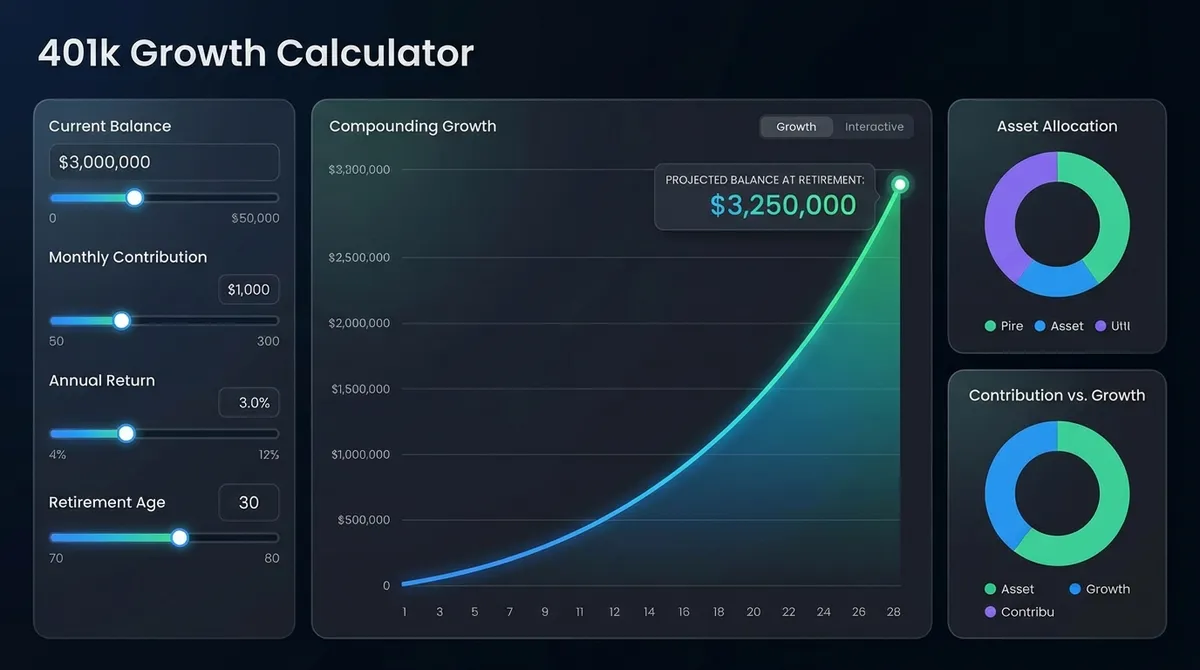
Understanding how your 401(k) will grow over time is one of the most critical aspects of retirement planning. With contribution limits rising to $23,500 for 2025 ($31,000 if you're 50 or older), maximizing your 401(k) growth potential has never been more important.
Our 401(k) Growth Calculator helps you project your retirement savings based on your current age, salary, contribution rate, employer match, and expected investment returns. Unlike basic calculators, ours includes advanced features like employer matching limits, annual salary increases, and investment fees to give you a realistic picture of your financial future.
Why 401(k) Growth Matters for Your Retirement
Your 401(k) is likely to be your largest retirement asset. According to recent data, the average 401(k) balance for workers in their 60s with 20+ years of tenure exceeds $250,000. However, balances vary dramatically based on contribution rates, employer matching, investment choices, and how early you start saving.
The power of compound interest means that starting early—even with smaller contributions—often beats starting later with larger contributions. For example, a 25-year-old contributing $5,000 annually with a 7% return will have approximately $1.2 million at age 65. A 35-year-old contributing the same amount would have only about $567,000 at retirement.
How 401(k) Growth Works: The Three Pillars
1. Your Contributions (Employee Deferrals)
Your contributions form the foundation of your 401(k) growth. In 2025, you can contribute up to $23,500 of your pre-tax salary. If you're 50 or older, you can add an extra $7,500 in catch-up contributions, bringing your total to $31,000. Workers aged 60-63 can contribute even more—up to $34,750—thanks to new SECURE 2.0 Act provisions.
Many financial advisors recommend contributing at least 10-15% of your salary to your 401(k), including employer match. Our calculator lets you adjust your contribution percentage to see how even small increases can dramatically impact your final balance.
2. Employer Matching Contributions
Free money—that's what employer matching contributions represent. The most common match is 50% of your contributions up to 6% of your salary. Some generous employers match 100% up to 3-4% of salary, while others use tiered matching structures.
Our calculator accounts for employer match limits and vesting schedules (though immediate vesting is assumed for projection purposes). Always contribute enough to get the full employer match—it's an instant 50-100% return on your money that you can't get anywhere else.
3. Investment Growth and Compound Returns
This is where the magic happens. Your contributions and employer matches are invested in mutual funds, target-date funds, or other investment options. Over time, these investments generate returns that are reinvested, creating exponential growth.
Historically, a diversified portfolio of 60% stocks and 40% bonds has returned approximately 7-8% annually after inflation. Our calculator uses a default 7% return rate, but you can adjust this based on your risk tolerance and investment strategy. Remember, higher returns typically come with higher risk and volatility.
Understanding Your 401(k) Growth Results
Final Balance at Retirement
This is your projected 401(k) balance when you reach retirement age. It's the sum of your contributions, employer matches, and investment growth over your working years. For a 30-year-old earning $75,000 and contributing 6% with a 3% employer match, this could easily exceed $1.5 million by age 67.
Total Contributions vs. Investment Growth
Our calculator breaks down how much you contributed versus how much your investments earned. In most cases, investment growth accounts for 60-70% of your final balance if you start early. This demonstrates why time in the market is more important than timing the market.
For example, if you contribute $300,000 over 35 years, your investment growth might add another $700,000+, giving you a $1 million+ balance. The longer your time horizon, the more powerful compound interest becomes.
Estimated Monthly Income in Retirement
Based on the 4% withdrawal rule—a widely accepted guideline for sustainable retirement spending—this shows how much monthly income your 401(k) could generate. A $1 million 401(k) balance would provide approximately $3,333 per month in retirement income.
The 4% rule assumes you withdraw 4% of your balance in the first year of retirement, then adjust for inflation annually. This strategy historically provides a 90%+ probability that your money will last 30 years.
401(k) Growth Formula: The Math Behind Your Projections
Annual 401(k) Growth Formula:
Ending Balance = (Beginning Balance × (1 + Annual Return - Fees)) + Employee Contributions + Employer Match
Our calculator applies this formula annually, adjusting your salary for raises and recalculating contributions based on your new salary each year. This creates a realistic projection that accounts for salary growth over your career.
The formula accounts for:
- Beginning Balance: Your 401(k) balance at the start of each year
- Investment Growth: Returns based on your expected annual return rate minus fees
- Employee Contributions: Your salary percentage contribution for that year
- Employer Match: Company contributions based on matching rules
- Salary Increases: Annual raises that increase contribution amounts
Key Factors That Impact Your 401(k) Growth
1. Contribution Rate
Increasing your contribution by just 1% can add hundreds of thousands to your final balance. A 30-year-old earning $75,000 who increases contributions from 6% to 7% will have approximately $200,000 more at retirement, assuming a 7% annual return.
2. Employer Match
Not maximizing your employer match is like leaving free money on the table. If your employer matches 50% up to 6% of salary and you earn $75,000, that's $2,250 in free money annually. Over 35 years with 7% returns, that match alone grows to over $330,000.
3. Investment Returns
A 1% difference in annual returns dramatically impacts your final balance. Over 35 years, a 7% return versus an 8% return on $10,000 annual contributions creates a $400,000+ difference. However, higher returns require accepting more risk and volatility.
4. Time Horizon
Starting at age 25 versus 35 can double your final balance, even with identical contributions. The power of compound interest rewards early starters disproportionately. A 25-year-old contributing $5,000 annually has the potential to accumulate $1.2 million by retirement, while a 35-year-old contributing the same amount would have only about $567,000.
5. Investment Fees
A 1% fee doesn't sound like much, but over 35 years, it can cost you 20-25% of your potential balance. Our calculator includes a fee input so you can see how expense ratios impact your long-term growth. Choosing low-cost index funds can save you hundreds of thousands in fees over your career.
6. Salary Growth
Annual raises increase your contribution amounts in dollar terms, even if you maintain the same percentage. A 3% annual raise means your contributions grow exponentially, accelerating your account growth in the later years of your career.
Common 401(k) Growth Mistakes to Avoid
Mistake #1: Not Contributing Enough to Get Full Employer Match
This is the most expensive mistake you can make. If your employer matches 50% up to 6% of salary and you earn $75,000, you're leaving $2,250 of free money on the table annually. Over 35 years, that costs you over $330,000 in lost retirement savings.
Mistake #2: Cashing Out When Changing Jobs
Cashing out your 401(k) before age 59½ triggers income taxes plus a 10% early withdrawal penalty. More importantly, you lose decades of compound growth. A $50,000 balance at age 30 could grow to over $500,000 by retirement. Cash it out and you get maybe $35,000 after taxes and penalties.
Mistake #3: Being Too Conservative When Young
Young workers often choose stable value funds or money market options because they're afraid of losing money. But being too conservative can cost you millions. A 25-year-old invested 100% in stocks versus 100% in bonds could see a $1 million+ difference at retirement due to the power of compound growth.
Mistake #4: Ignoring Fees
That actively managed fund with a 1.5% expense ratio might sound impressive, but it could cost you $300,000+ more than a low-cost index fund with a 0.05% expense ratio over your career. Always check expense ratios and choose low-cost index funds when available.
Mistake #5: Not Increasing Contributions After Raises
When you get a 3% raise, increase your 401(k) contribution by 1-2%. You still get a take-home pay increase, but your retirement savings accelerate dramatically. This "pay yourself first" strategy is how many people become 401(k) millionaires.
401(k) Growth Strategies for Different Life Stages
In Your 20s: Start Early, Be Aggressive
Contribute at least enough to get the full employer match, ideally 10-15% of salary. Invest 80-100% in stocks for maximum growth potential. Even $100 per month starting at age 22 can grow to over $350,000 by retirement. Time is your greatest asset—use it.
In Your 30s: Increase Contributions, Stay Aggressive
As your salary grows, increase your contribution percentage. Aim for 15% total (including employer match). If you get a 3% raise, increase your 401(k) contribution by 1-2%. Stay 70-90% invested in stocks. Your 30s are often your highest-growth years for both career and investments.
In Your 40s: Maximize Contributions, Moderate Risk
This is typically your peak earning decade. Max out your 401(k) contributions if possible ($23,500 in 2025). Consider a 60-80% stock allocation. Review and rebalance annually. Your 40s are critical for catching up if you started late.
In Your 50s: Catch-Up Contributions, Preserve Capital
Take advantage of catch-up contributions ($7,500 extra in 2025). Workers aged 60-63 can contribute even more ($11,250 extra). Shift to 50-70% stocks as you approach retirement. Consider working with a financial advisor to create a withdrawal strategy.
In Your 60s: Plan Withdrawals, Manage Risk
Plan your withdrawal strategy using the 4% rule as a starting point. Consider a 40-60% stock allocation. Delay Social Security if possible to maximize benefits. Create a tax-efficient withdrawal strategy that minimizes taxes in retirement.
Advanced 401(k) Growth Optimization Techniques
Front-Loading Contributions
If you can afford it, max out your 401(k) early in the year. This gives your money more time to grow in the market. However, be careful not to lose employer matching contributions, which are often calculated per pay period.
Roth 401(k) vs Traditional 401(k)
Many employers now offer Roth 401(k) options. With a Roth, you contribute after-tax dollars but withdrawals in retirement are tax-free. This can be powerful if you expect to be in a higher tax bracket in retirement. Consider splitting contributions between traditional and Roth for tax diversification.
Mega Backdoor Roth
If your plan allows after-tax contributions beyond the $23,500 limit, you may be able to contribute up to $70,000 total (including employer match) and convert to Roth. This is an advanced strategy for high earners who want tax-free retirement income.
Automatic Escalation
Many plans offer automatic escalation, which increases your contribution by 1% annually. This painless strategy can help you reach 15% contributions over time without feeling the impact on your take-home pay.
Important Limitations & Considerations
Our Calculator Assumes:
- Consistent annual returns (actual returns will vary significantly year-to-year)
- Immediate vesting of employer contributions (your plan may have a vesting schedule)
- Continuous employment without interruptions
- No loans or early withdrawals from your 401(k)
- Current tax laws and contribution limits remain unchanged
- Annual salary increases are steady and predictable
Real-world results will vary based on market performance, job changes, life events, and changes to tax laws. Our calculator provides estimates based on the information you provide and should be used as a planning tool, not a guarantee of future results.
Consult with a qualified financial advisor for personalized retirement planning advice, especially as you approach retirement age. They can help you create a comprehensive plan that includes Social Security optimization, tax strategies, and withdrawal planning.
Key Takeaways
Your 401(k) growth potential is determined by four key factors: how much you contribute, your employer match, your investment returns, and most importantly, time. By starting early, contributing consistently, maximizing employer matching, and keeping fees low, you can build substantial retirement wealth.
Next Steps:
- Use our 401(k) Growth Calculator above to project your retirement savings
- Increase your contribution rate to at least get the full employer match
- Review your investment options and choose low-cost index funds when available
- Set up automatic escalation to increase contributions by 1% annually
- Revisit your projection annually and adjust as needed
Remember: The best time to start maximizing your 401(k) growth was 20 years ago. The second best time is today. Every dollar you contribute now has the potential to grow 5-10x by retirement through the power of compound interest and consistent investing.