Auto Loan Refinancing: The 2025 Guide
Maximize your savings with improved credit, lower rates, and smarter loan terms.
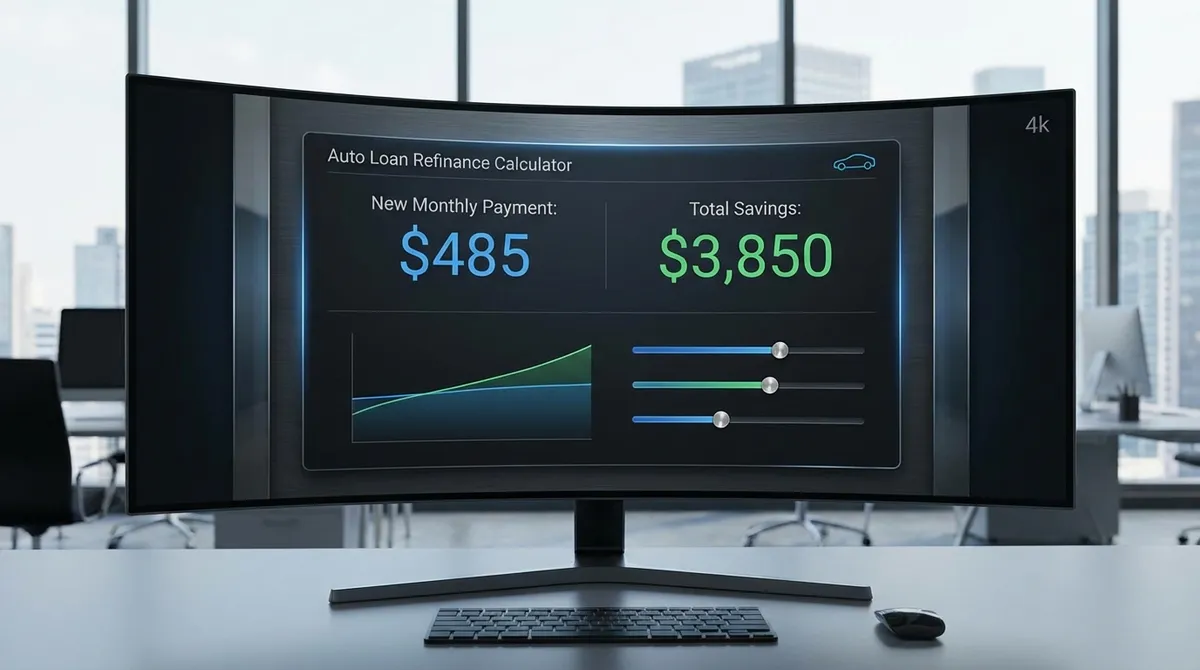
2025 Market Snapshot
- Average Savings: Borrowers who refinance in 2025 with an improved credit score are saving an average of $110/month or $1,800+ in total interest.
- Rate Environment: While new car rates remain high (~7-9%), refinance rates for Prime borrowers have stabilized around 6.5% - 7.5%.
- LTV Limits: Lenders are tightening standards. You likely need a Loan-to-Value (LTV) ratio below 125% to qualify without a down payment.
How Auto Refinancing Actually Works
Refinancing is simply replacing your current auto loan with a new one from a different lender. This new lender pays off your old balance entirely, and you start making payments to them instead—ideally with much better terms.
The Rate Reduction Strategy
The most common reason to refinance. If your credit score has improved since you bought the car (or if rates have dropped), you could slash your APR from 12% to 7%. On a $25,000 loan, that’s thousands in savings. Compare options with our personal loan calculator.
The Cash Flow Strategy
Need lower monthly bills? You can extend your loan term. For example, turning remaining 36 months into a new 60-month term. Warning: This lowers payments but increases total interest paid. See the impact with our loan payoff tool.
The "Sweet Spot": When to Refinance
Perfect Timing Indicators
- •Your Credit Score Rose 50+ Points: Moving from "Fair" (620) to "Good" (670+) can drop your rate by 3-5%. Check your potential with our credit score calculator.
- •Dealer Markup: If you financed at the dealership, you likely paid a markup (often 1-2%). Direct lenders cut this out.
- •Income Improved: A lower Debt-to-Income (DTI) ratio makes you more attractive to premium lenders. Calculate yours with our DTI calculator.
Stop Signs (Wait Awhile)
- •Upside Down / Underwater: You owe more than the car is worth. Lenders rarely refinance over 125% LTV.
- •Old Vehicle: Cars older than 10 years or with 100k+ miles are difficult to refinance at good rates.
- •Prepayment Penalties: Check your current contract. If paying off early costs $500, it kills your savings.
Real World Scenarios: Does it Pay Off?
Scenario A: The Credit Improver
Mike bought a truck 2 years ago with a 600 credit score. He's since improved to 720.
Scenario B: The Cash Flow Fix
Sarah needs to lower her $550/mo payment to afford daycare.
Estimated Refinance Rates by Credit Score (Q4 2025)
| Credit Tier | Score Range | Est. APR | Monthly Cost* |
|---|---|---|---|
| Super Prime | 781 - 850 | 5.99% - 6.75% | $290 |
| Prime | 661 - 780 | 6.99% - 8.25% | $299 |
| Non-Prime | 601 - 660 | 9.50% - 11.99% | $320 |
| Subprime | 501 - 600 | 14.00% - 18.00% | $365 |
The "Gotchas" of Refinancing
Refinancing fees can silently eat up your savings. Always calculate your "Break-Even Point" (Total Fees ÷ Monthly Savings) before signing.
Pro Tactics to Maximize Savings
Shop 3 Sources in 14 Days
Apply with a Credit Union, an Online Lender, and a Bank. All inquiries within 14-45 days count as a single "hard pull" on your credit report.
Avoid "Gap Insurance" Rip-offs
Lenders will try to sell you Gap Insurance for $500+. You can often get the same coverage from your auto insurer for $20-40/year.
The "Principal" Pay Down
If your LTV is too high (over 125%), make a lump sum payment of $500-$1,000 to bring the balance down before applying.
Step-by-Step Guide to the Refinancing Process
Refinancing isn't just about clicking a button. To ensure you get the best deal without damaging your credit, follow this precise workflow used by financial professionals.
1. Audit Your Current Loan
Before applying, you need your "Payoff Amount" (not just the balance on your dashboard). Call your current lender and ask for a "10-day payoff quote." This includes daily interest accrual. Also, confirm there are no prepayment penalties.
2. Gather Your Documents
Lenders need proof you can repay. Have these fees ready:
- Proof of Income: Recent pay stubs or W-2s. Self-employed? Two years of tax returns.
- Proof of Residence: Utility bill or lease agreement.
- Vehicle Information: VIN, mileage, and proof of insurance.
- Driver’s License: A valid government ID.
3. Application Strategy
Apply to 3-4 lenders within a 14-day window. FICO scoring models treat multiple auto loan inquiries in a short period as a single "hard pull," minimizing the impact on your score.
Refinance Calculator Terminology
Amortization
The schedule of your payments over time. At the start of a loan, most of your payment goes to interest. At the end, most goes to principal. Refinancing "resets" this clock. Visualize this with our amortization schedule calculator.
Variable APR
An interest rate that can change with the Federal Reserve's benchmark rate. Avoid these for auto loans; stick to Fixed APR.
Lien Holder
The bank or legal entity that owns your car title until the loan is paid off. Refinancing changes who the lien holder is.
Closing Costs
Fees charged to process the new loan. Unlike mortgages, auto refinance closing costs should be minimal ($15-$50).
Negative Equity
When you owe more on the car than it is worth (also called being "underwater"). This makes refinancing difficult without a cash payment.
Debt-to-Income (DTI)
The percentage of your monthly gross income that goes to paying debts. Lenders want to see this under 36% (including the new car payment).
Understanding the Credit Score Impact
Many borrowers fear refinancing will tank their credit. The reality is more nuanced. Here is the exact breakdown of how it affects your score:
The Hard Inquiry
When you apply, lenders check your credit. This small dip is temporary and usually recovers within 3-6 months.
Account Age Reduction
Closing your old loan reduces the "average age" of your accounts. If your old loan was your oldest account, the drop might be more noticeable.
Long-Term Payment History
By securing a lower monthly payment, you decrease your Debt-to-Income (DTI) ratio and lower the risk of missed payments. Consistent on-time payments on the new loan are the strongest factor in building long-term credit health.
Frequently Asked Questions About Auto Refinancing
Can I refinance with bad credit?
Yes, but proceed with caution. "Bad credit" refinance loans often come with predatory rates (15-20%+). If your score is below 600, you might only qualify if you have a co-signer with strong credit. Otherwise, it is often better to focus on rebuilding your credit for 6-12 months before applying. Read more at CFPB's auto loan guide.
Can I refinance a lease?
Technically, this is called a "lease buyout." You are taking out a loan to purchase the car from the leasing company. This is a great move if the "residual value" (the buy-price set at lease signing) is significantly lower than the current market value of the car.
Is there a limit on how many times I can refinance?
No legal limit exists, but practical limits do. Each refinance costs money (title fees) and involves a hard credit pull. Lenders may also deny you if the loan balance is too small (under $5,000) or if the car is too old. Refinancing more than once every 12-18 months rarely makes mathematical sense.
What documents do I need to refinance?
Speed up the process by having these ready: Driver's license, proof of insurance, pay stubs (last 30 days), strict proof of residence (utility bill), top sheet of your current loan statement (showing account number and payoff address), and your vehicle registration.
How soon can I refinance after buying my car?
You must wait until the title work from your original purchase is complete, which typically takes 60-90 days. Some lenders require 6 months of payment history. However, if you were placed in a high-rate loan by a dealership, looking for a refinance option as soon as your title clears is a smart financial move.