What Is Burn Rate and Why It Matters in 2025?
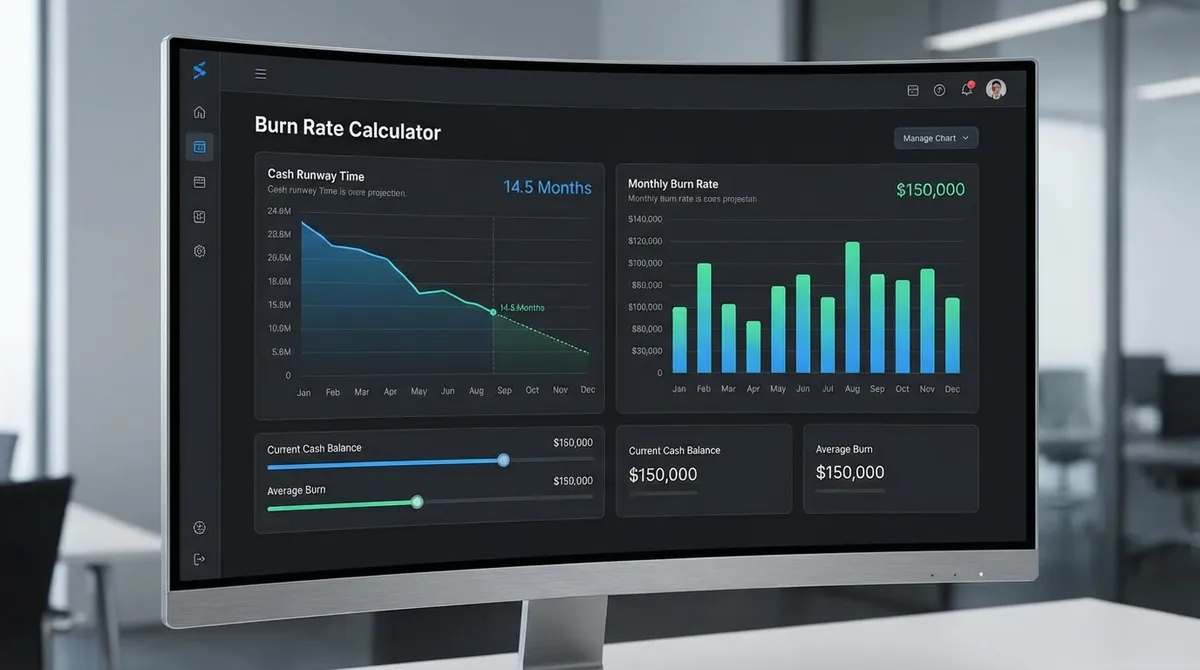
Burn rate measures how quickly your startup consumes cash reserves before achieving positive cash flow or profitability. In 2025's evolving economic landscape—with interest rates stabilizing and investors prioritizing efficiency over growth-at-all-costs—your burn rate tells a story about capital discipline, strategic planning, and financial maturity.
For early-stage founders, burn rate answers critical questions: How long can we operate before needing another round? Are we spending efficiently? Can we weather a fundraising delay or market downturn? For investors, it's a key due diligence metric that influences valuation, investment size, and confidence in your management team.
Key Statistic: In 2025, 29% of startups fail due to running out of cash, making burn rate arguably the most important financial metric between fundraising rounds. Recent data shows that investors now scrutinize burn rate efficiency as closely as revenue growth.
Gross vs. Net Burn Rate: The Critical Distinction
Many founders focus exclusively on gross burn—the total monthly expenses—but smart operators obsess over net burn, which accounts for revenue. Consider this: Two companies each spend $200,000 monthly. Company A generates $150,000 in revenue (net burn: $50K), while Company B generates zero revenue (net burn: $200K). Despite identical gross burn, Company A has 4x the cash runway.
In 2025, investors reward this efficiency. The "burn multiple" metric—calculated as Net Burn ÷ Net New ARR—has become a key evaluation criteria. A burn multiple below 1.0x at Series A suggests efficient growth, while above 2.0x raises red flags about capital efficiency.
Gross Burn Rate
Gross Burn = Total Monthly Operating ExpensesTotal cash outflow including salaries, rent, marketing, software, and all operating costs. Doesn't factor in revenue.
Net Burn Rate
Net Burn = Gross Burn - Monthly RevenueActual monthly cash loss after accounting for revenue. Determines your cash runway and financial health.
2025 Burn Rate Benchmarks by Funding Stage
Understanding where you stand relative to peers helps contextualize your burn rate. Based on 2025 market data from Carta and Graphite Financial:
Pre-Seed Startups
$25,000-$50,000/month gross burn
2-3 founders, minimal staff, focusing on product-market fit. Runway target: 12-18 months.
Seed Stage
$100,000-$200,000/month gross burn
Team of 5-15 employees, initial go-to-market. Runway target: 18 months minimum.
Series A
$400,000-$800,000/month gross burn
Team of 20-50, scaling sales and marketing. Net burn $200K-$500K/month. Runway: 18-24 months.
Series B+
$800,000-$2M+/month gross burn
Path to profitability within 24-36 months. Runway target: 24+ months.
Calculating Your Cash Runway: The Foundation of Survival
Cash runway is the most practical application of burn rate: how many months can you operate before hitting zero? The formula is simple:
Cash Runway = Current Cash Balance ÷ Net Burn RateHowever, the strategic application is nuanced. In 2025's fundraising environment—which remains selective despite stabilizing interest rates—founders should target 18-24 months of runway. This accounts for longer fundraising cycles (often 6+ months from first meeting to close) and provides buffer for market volatility.
Cash Runway Thresholds
What Burn Multiple Tells Investors About Your Efficiency
Popularized by David Sacks, burn multiple measures how efficiently you convert capital into recurring revenue:
Burn Multiple = Net Burn ÷ Net New ARRBelow 1.0x: Best-in-class efficiency (enterprise SaaS)
1.0x-1.5x: Good efficiency, investor-friendly
1.5x-2.0x: Acceptable for high-growth startups
Above 2.0x: Concerning—may indicate poor unit economics
Reducing Burn Rate Without Sacrificing Growth
The most successful 2025 startups optimize burn while maintaining growth velocity. Here's how:
1. Rethink Your Cost Structure
Separate fixed costs (salaries, rent) from variable costs (marketing, contractors). When runway shrinks, cut variable costs first—they're easier to scale back without layoffs.
2. Implement Variable Compensation
Shift sales teams to higher commission structures. This reduces base salary (fixed cost) while aligning compensation with revenue generation.
3. Optimize Cloud & Software Spend
Audit your AWS, GCP, or Azure usage. Companies often overspend by 30-40% on idle resources. Use tools like CloudHealth or optimize instance sizing.
4. Extend Payment Terms Strategically
Negotiate 60-90 day payment terms with vendors while collecting revenue upfront. This improves working capital and reduces net burn.
When to Worry About Your Burn Rate
Not all high burn rates are bad—but unsustainable patterns are. Watch for these warning signs:
Runway Below 12 Months
This is your fundraising window. Below 12 months creates urgency and weakens negotiating position.
Burn Multiple Above 2.0x
Spending $2 to generate $1 of new ARR suggests flawed unit economics or inefficient GTM.
Flat or Declining Revenue with Rising Burn
The worst scenario—costs increasing while revenue stagnates.
No Path to Profitability Within 24-36 Months
In 2025, investors expect a credible plan to profitability, not just growth.
5 Common Burn Rate Mistakes to Avoid
Even experienced founders can mismanage burn rate. Here are the most frequent pitfalls we see in 2025:
- Confusing Cash with Revenue: Booking revenue isn't the same as collecting cash. If you have 60-day payment terms, your cash burn might be higher than your P&L suggests. Always manage burn based on cash in the bank.
- Hiring Ahead of Revenue: Adding headcount in anticipation of sales that haven't closed is the fastest way to shorten your runway. Hire when it hurts, not when you hope.
- Ignoring "Hidden" Costs: Payroll taxes, benefits, software seats, and travel often add 20-30% to base salaries. Failing to model these fully leads to surprising cash crunches.
- Assuming Linear Growth: Burn rate models often assume revenue will grow linearly while costs stay flat. In reality, costs often step-function up (new office, new management layer) while revenue growth can be lumpy.
- Waiting Too Long to Cut: When runway dips below 9 months, you must act. Founders often wait for "one more big deal" to save them. The earlier you cut burn, the less drastic the cuts need to be.
How Burn Rate Impacts Your Valuation
Your burn rate directly influences your pre-money valuation. Investors use burn rate as a proxy for risk. A high burn rate increases the "desperation factor"—investors know you *need* money, giving them leverage to negotiate a lower valuation.
Conversely, a low burn rate gives you "walk-away power." If you have 24 months of runway, you can walk away from a bad term sheet. This leverage often translates to a 15-20% premium in valuation.
Furthermore, valuation multiples (e.g., 10x ARR) are adjusted for efficiency. A company growing 100% YoY with a 3.0x burn multiple might get a 6x revenue multiple, while a peer growing 80% with a 0.8x burn multiple might trade at 12x revenue.
The Burn Rate Story for Investors
When presenting to investors, frame your burn rate as a strategic tool, not just a cost center:
"Our current net burn of $75K/month gives us 18 months of runway. We're investing aggressively in product development (40% of burn) to achieve 15% monthly revenue growth. This positions us to reach $2M ARR and breakeven within 14 months, at which point we'll have 12 months of runway remaining. Our burn multiple of 1.2x demonstrates efficient capital deployment."
Key Takeaways for 2025
Burn rate management in 2025 is about balance. Investors want growth, but they want efficient, sustainable growth. Target 18-24 months of runway, keep burn multiple under 1.5x, and have a credible path to profitability. Use our calculator monthly to track your metrics, and remember: the best burn rate is the one that positions you for the next milestone without risking survival.
As you scale, your burn rate will increase—that's normal. The key is ensuring each dollar burned generates more than a dollar in enterprise value. That's the difference between a startup that burns bright and one that burns out.
About the Author
Jurica Šinko is a Finance Expert and Founder of EFinanceCalculator. With over 15 years of experience in startup finance and venture capital analysis, jurica-sinko has helped 200+ startups optimize their burn rates and successfully raise over $500M in funding. His expertise in financial modeling and cash runway management makes him a trusted advisor for founders navigating the 2025 funding landscape.