Complete Guide: Cash on Cash Return
What Is Cash on Cash Return?
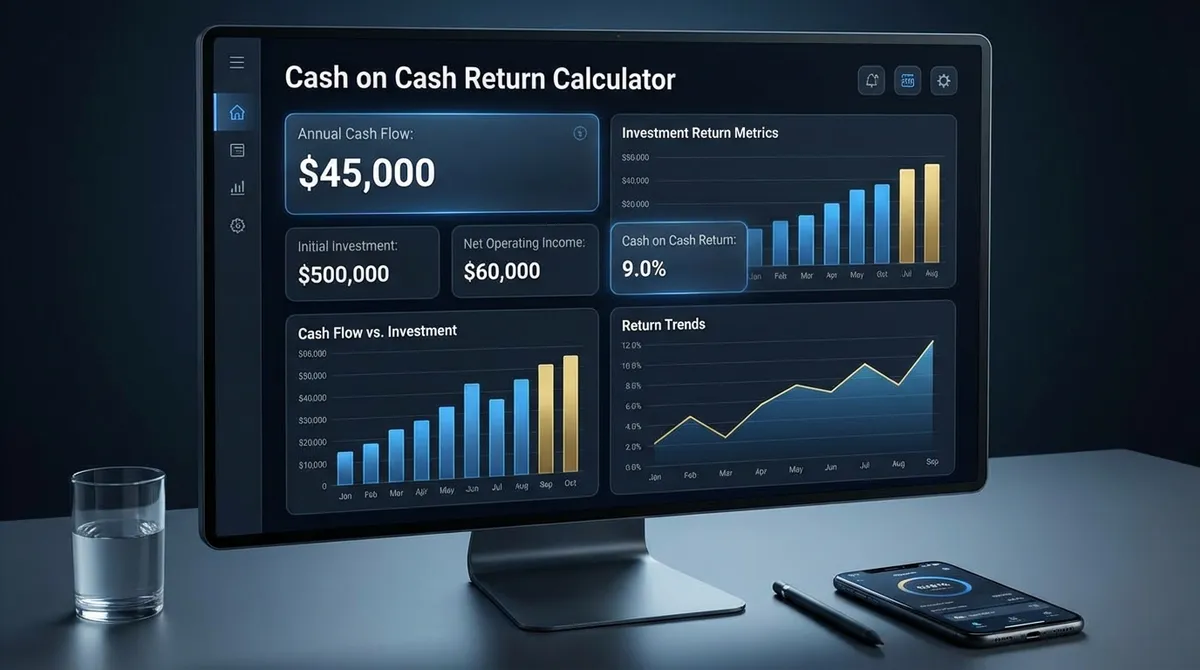
Cash on Cash Return (CoC) is the most important metric for real estate investors who use leverage (mortgages). It measures the annual cash income earned on the property compared to the actual cash you invested. Learn more at Investopedia.
Unlike Cap Rate, which calculates return on the total property value (as if you paid all cash), Cash on Cash Return tells you exactly how hard your specific dollar is working. It answers the question: "If I put $50,000 into this deal, what percentage of that will I get back in cash flow this year?"
The Formula:
Cash on Cash Return = (Annual Pre-Tax Cash Flow / Total Cash Invested) × 100%
Breaking Down the Formula
To get an accurate number, you need to calculate two variables precisely:
1. Annual Cash Flow
This is your "take-home" profit considering NOI after ALL expenses.
- Gross Rent
- (-) Vacancy & Management
- (-) Maintenance & Repairs
- (-) Taxes & Insurance
- (-) Mortgage Payments (P&I)
2. Total Cash Invested
Every dollar that left your bank account to acquire the deal.
- Down Payment
- Closing Costs
- Rehab/Renovation Costs
- Inspection & Appraisal Fees
Real World Example: The $300k Duplex
Let's say you find a duplex for $300,000. You put 20% down ($60,000) and pay $5,000 in closing costs. Current interest rates are at 7%.
| Item | Monthly | Annual |
|---|---|---|
| Gross Rent | +$3,000 | +$36,000 |
| Operating Exp (35%) | -$1,050 | -$12,600 |
| Mortgage (P&I) | -$1,600 | -$19,200 |
| Net Cash Flow | +$350 | +$4,200 |
Calculation:
Total Cash Invested = $60,000 (Down) + $5,000 (Closing) = $65,000
CoC Return = ($4,200 / $65,000) × 100 = 6.46%
What Is a "Good" Cash on Cash Return in 2025?
With interest rates hovering around 6-7%, finding double-digit returns has become harder. Here are the benchmarks most investors use today:
- 4-7%Acceptable: Typical for turnkey properties in appreciation markets (like Austin or Denver). You accept lower cash flow for higher potential appreciation.
- 8-12%Great (Target): The "sweet spot" for most rental investors. This covers your debt comfortably and provides solid income. Often found in Midwest or Southern markets.
- 15%+Home Run: Rare in major cities. Usually found in off-market deals, BRRRR projects, or Short Term Rentals (Airbnb) due to higher risk/effort.
3 Mistakes That Kill Your Returns
1. Underestimating Maintenance
New investors often budget 0% for repairs. Always allocate 5-10% of rent for maintenance and another 5-10% for CapEx (roof, HVAC replacements).
2. Ignoring Vacancy
Properties don't stay rented 365 days a year. A 5% vacancy rate assumption (roughly 18 days/year) is standard safety practice.
3. Forgetting Closing Costs
Closing costs can add 2-5% to your acquisition price. Forgetting this increases your cash denominator and inflates your perceived return.
5 Proven Ways to Boost Your Cash on Cash Return
If your calculation shows a lackluster 3% return, don't walk away yet. You might be able to engineer a better deal using our rental property analysis.
1. The "Value-Add" Play
Find a property with below-market rents. If you can raise rents by $200/month with minor cosmetic updates (paint/flooring), you add $2,400 to your Annual Cash Flow without significantly increasing your Total Cash Invested. This purely profit-focused move spikes your CoC return immediately.
2. Reduce Operating Expenses
Are you paying for water/sewer? Install sub-meters and bill it back to tenants. Are taxes high? Appeal the assessment. Every $100 saved in expenses is $100 added to your bottom line.
3. Lower Your Interest Rate (Refinance)
Debt service is usually the biggest expense. If rates drop (as expected post-2024), refinancing from 7% to 5.5% can save hundreds per month, directly increasing your Net Cash Flow and thus your CoC return.
4. Lower Your Down Payment
Mathematically, lowering the "Denominator" (Total Cash Invested) skyrockets your return—but it increases risk. Using an FHA loan (3.5% down) instead of a conventional loan (20% down) requires less cash, meaning even a small monthly profit yields a massive percentage return.
5. Interest-Only Financing
Some investors use interest-only loans for the first 5-10 years. By not paying principal, your monthly payment is lower, and your cash flow is higher. This boosts your CoC return significantly in the short term, though you don't build equity through paydown.
The Magic of Leverage: A Comparative Analysis
Why do real estate investors love debt? Because "Positive Leverage" can turn a boring 6% return into a 12% return. Here is the math behind usage of other people's money (OPM).
| Scenario | Purchase Price | Down Payment | Loan Amount | Net Cash Flow | CoC Return |
|---|---|---|---|---|---|
| All Cash | $100,000 | $100,000 | $0 | $7,000 | 7.0% |
| 20% Down (5% Rate) | $100,000 | $20,000 | $80,000 | $3,000 | 15.0% |
| 20% Down (8% Rate) | $100,000 | $20,000 | $80,000 | $600 | 3.0% |
*Note: In the 5% rate scenario, your return on actual cash invested more than doubles. This is why investors chase "Cash Flow" properties when rates are low. However, note how quickly the return collapses when rates rise to 8%.
Comparison: CoC vs. ROI vs. IRR
Real estate has an "alphabet soup" of metrics. Here is when to use which.
| Metric | What It Measures | Includes Appreciation? | Best Used For |
|---|---|---|---|
| Cash on Cash (CoC) | Annual cash income vs. cash invested. | NO | Day-to-day liquidity; "Will this pay the bills?" |
| Return on Investment (ROI) | Total profit (cashflow + equity) vs. cash invested. | YES | Checking total wealth growth annually. |
| Internal Rate of Return (IRR) | Total return over time, accounting for time value of money. | YES | Long-term hold analysis (5+ years); comparing to stocks (IRR). |
| Cap Rate | Property yield without debt. | NO | Comparing property quality/price, ignoring financing. |
Frequently Asked Questions
How is Cash on Cash different from ROI?
ROI (Return on Investment) typically includes all financial benefits: cash flow, principal paydown (appreciation), and tax benefits. Cash on Cash Return looks strictly at the actual cash hitting your bank account relative to what you put in. It's a cleaner measure of liquidity.
Does CoC include tax benefits?
Generally, no. This calculator provides the pre-tax Cash on Cash return. While depreciation can shelter some income, tax situations vary wildly per investor, so standard analysis sticks to pre-tax numbers. However, effective (after-tax) CoC is often higher because real estate income is taxed more favorably than W-2 income.
Is a higher CoC always better?
Not always. A property in a dangerous neighborhood might offer a 20% CoC return because the price is low, but the risk of unpaid rent or eviction is high. Properties in "A-Class" neighborhoods often have lower CoC (4-5%) but higher safety and appreciation potential. It's a balance of Risk vs. Return.
How can I increase my Cash on Cash Return?
You can boost CoC by: 1) Increasing rents (forcing appreciation), 2) Lowering operating expenses (self-managing), 3) Negotiating a lower purchase price, or 4) Refinancing to a lower interest rate to reduce debt service. The "Value-Add" strategy (forcing appreciation) is the most powerful method.
Why is my Cash on Cash return infinite?
This happens in a "BRRRR" (Buy, Rehab, Rent, Refinance, Repeat) strategy when you refinance and pull all your original capital out of the deal. If your Total Cash Invested is $0 (or less), but you still have positive cash flow, your return is mathematically infinite. This is the holy grail of real estate investing.
What is the "Rule of 72" in real estate?
The Rule of 72 is a mental math shortcut to estimate how long it takes to double your money. Divide 72 by your annual rate of return. If you have a 12% Cash on Cash return, it will take roughly 6 years (72 ÷ 12) to double your initial investment from cash flow alone, ignoring appreciation.