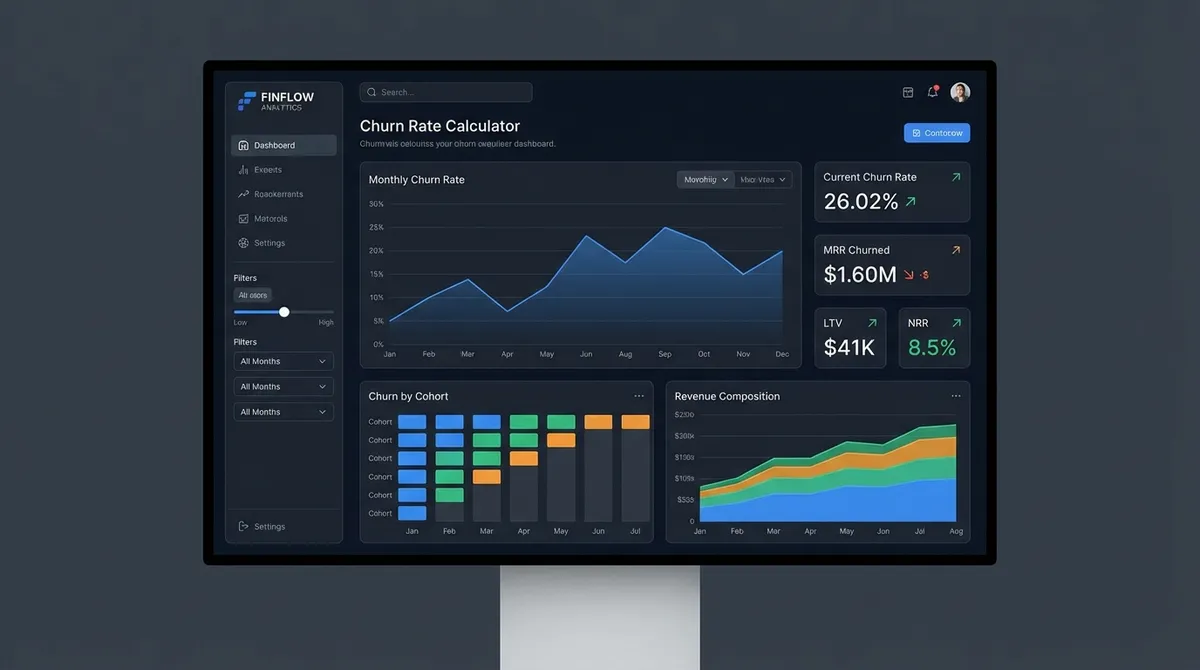
Churn Rate Guide 2025: Formulas, Benchmarks, and Reduction Strategies
What is Churn Rate?
Churn rate (or attrition rate) is the percentage of customers who stop doing business with an entity during a given period. It is the inverse of retention rate. While it is most commonly associated with subscription businesses (SaaS, streaming services, gyms), it applies to any business with repeat customers.
Logo Churn
The percentage of customer accounts lost. This metric tells you how many people are leaving, regardless of how much they pay.
Revenue Churn
The percentage of monthly recurring revenue (MRR) lost. This is often more critical for B2B SaaS, as losing one enterprise client hurts more than losing ten small ones.
2025 Churn Rate Benchmarks by Industry
"Good" churn is relative. A B2C streaming service will naturally have higher churn than an enterprise B2B platform with annual contracts. Here are the median monthly churn rates observed in early 2025, according to ProfitWell:
| Industry / Model | Good Monthly Churn | Average Monthly Churn | Danger Zone |
|---|---|---|---|
| SaaS (Enterprise B2B) | < 0.5% | 0.5% – 1.0% | > 2.0% |
| SaaS (SMB B2B) | < 2.5% | 3.0% – 5.0% | > 7.0% |
| B2C Subscription (Media/Box) | < 5.0% | 6.0% – 8.0% | > 10.0% |
| Mobile Apps (Freemium) | < 10% | 15% – 20% | > 25% |
Strategies to Reduce Churn
Up to 40% of churn is due to failed payments (expired cards, fraud flags). Implement automated dunning emails and card updaters.
Most churn happens in the first 90 days. Ensure customers reach their "Aha!" moment within the first session. This boosts LTV (Lifetime Value).
Annual plans typically have 50-70% lower churn than monthly plans because the purchase decision is made only once a year.
The Math Behind the Calculator
Period Churn Rate:
Churn = Lost Customers / Starting Customers
Monthly Churn (from Quarterly/Annual):
Monthly = 1 - (1 - PeriodChurn)^(1/Months)
We use geometric compounding, not simple division, to account for the fact that customers leaving in month 1 are not there to leave in month 2.
Annualized Churn:
Annualized = 1 - (1 - MonthlyChurn)^12
Why Annualized Churn Looks Scary
A "small" monthly churn of 5% results in an annualized churn of 46%. This means you lose nearly half your customer base every year. This visualizes why small improvements in monthly retention compound into massive gains over time.
Cohort Analysis: The Secret to Understanding Churn
Looking at a single aggregate churn number often hides the truth. Startups often have high churn because they acquire many "bad fit" customers who leave quickly. Mature companies might have lower churn because their base is older and more loyal.
Cohort Analysis solves this by tracking groups of customers based on when they signed up. For example, tracking the "January 2025 Cohort" separately from the "February 2025 Cohort" might reveal that your new onboarding flow is actually worsening retention, even if your overall churn rate looks stable due to a large existing base.
Net Negative Churn: The Holy Grail of SaaS
Most companies fight to get churn to zero. The best companies get it to negative.
Net Negative Churn happens when the expansion revenue from your existing customers (through upsells, cross-sells, or seat expansion) exceeds the revenue lost from customers who cancel.
Example Calculation
- Starting MRR: $100,000
- Lost MRR (Cancellations): -$5,000 (5% churn)
- Expand MRR (Upsells): +$7,000 (Existing customers buying more) - see Revenue Growth
- Net MRR Change: +$2,000 - see Profit Margin
Result: Even with cancellations, the business grew by 2% without adding a single new customer!
Churn Formulas for Different Business Models
While the standard formula is Churn = Lost / Start, different models need nuance:
- B2C Subscription (Netflix, Spotify): Focus on Voluntary vs. Involuntary churn. Involuntary churn (failed payments) can account for 20-40% of losses in B2C.
- Enterprise B2B (Salesforce, SAP): Focus on Revenue Churn over Logo Churn. Losing a $100/mo customer is noise; losing a $100k/yr contract is a signal.
- E-Commerce (Non-Subscription): Use "Repeat Purchase Rate" instead of churn. If a customer doesn't buy again in 90 days, are they "churned"? Defining the window is key.
Case Studies: Success Stories in Churn Reduction
Understanding the theory is great, but let's look at how giants solved this problem.
Adobe's Transition to Creative Cloud
The Problem: Adobe used to sell boxed software (CS6) for $700+. Once a user bought it, they wouldn't upgrade for 3-4 years. This wasn't "churn" in the subscription sense, but it was a revenue retention problem.
The Solution: Breaking the $700 cost into a $50/month subscription lowered the barrier to entry. But to keep people paying, Adobe had to shift from "shipping once" to "shipping continuously." By adding cloud storage, Typekit (fonts), and regular feature updates, they made the service indispensable. Their net retention is now comfortably over 100%.
Slack's Value Metric
The Insight: Slack realized that churn wasn't about price; it was about usage. A team paying for Slack but not using it would eventually cancel.
The Solution: Slack introduced a "Fair Billing Policy." If a user on a paid plan goes inactive, Slack automatically gives you credit back for that user. This counter-intuitive move built massive trust. Instead of feeling ripped off by paying for inactive seats (a huge cause of churn), admins felt Slack was on their side.
Churn vs. Retention: The Mirror Metric
It is mathematically true that Churn Rate + Retention Rate = 100%. However, the psychological focus is different.
- Focusing on Churn: This is a defensive mindset. "How do we stop people from leaving?" It leads to strategies like win-back emails, exit surveys, and discount offers.
- Focusing on Retention: This is an offensive mindset. "How do we make people stay?" It leads to strategies like better onboarding, customer success managers, and community building.
"The best defense against churn isn't a lock-in contract; it's a product so good that leaving feels like a downgrade."
The Hidden Cost of Churn: CAC Payback Period
Churn is deadly because it extends your CAC Payback Period. If it costs you $500 to acquire a customer (CAC) and they pay you $50/month (ARPU), it takes 10 months just to break even.
Scenario A: 10% Monthly Churn
Average Lifetime: 10 months
Result: You barely make your money back. Profit is $0.
Scenario B: 2% Monthly Churn
Average Lifetime: 50 months
Result: You make 5x your acqusition cost in profit. Check ROI.
Advanced Tactics: The Psychology of Retention
Reducing churn isn't just about fixing bugs; it's about engineering habit. Leading SaaS companies use behavioral triggers to race users to their "Champagne Moment"—the specific action that correlates with long-term retention (e.g., Slack's "2,000 messages sent").
The "Pause" Strategy
Don't make it impossible to cancel, but make it thoughtful. Offering a "pause subscription" option often saves 15-20% of would-be churners who just need a temporary break but intend to return.
Automated Deflection
If a user selects "Too Expensive" as their cancellation reason, automatically display a discount offer or a downgrade path to a cheaper tier. This saves the account without human intervention.
Frequently Asked Questions
What is a good churn rate for a SaaS startup?
For SMB SaaS, 3-5% monthly is acceptable starting out. For Enterprise SaaS, you want to be under 1%. The lower your price point, the higher the natural churn will be.
How do I calculate churn if I have no cancellations?
Your churn rate is 0%. Enjoy it while it lasts! However, double check that you aren't counting "dormant" users (who stopped using the product but haven't cancelled) as active.
Is negative churn actually possible?
Yes! If your expansion revenue (upsells to existing clients) exceeds your lost revenue (cancellations), your net churn is negative. This is the engine of hyper-growth companies like Slack and Snowflake.
Should I track daily churn?
No. Daily volatility is too high to be a useful signal. Stick to Monthly (MoM) and Annual (YoY) tracking to spot genuine trends and avoid overreacting to noise. Consistent tracking is the key to long-term growth.