Understanding Your Closing Costs in 2025
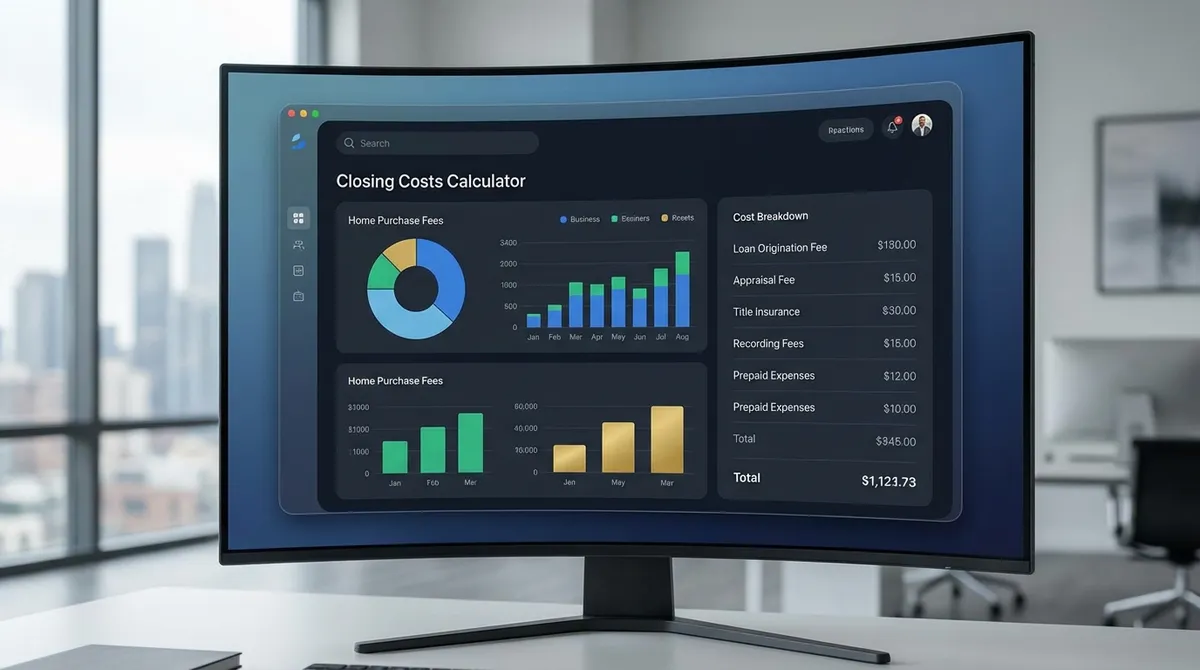
Closing costs are the collection of fees, taxes, and advance payments required to finalize a mortgage. For most homebuyers, these range from 2% to 6% of the loan amount. On a $400,000 home, that means bringing an extra $8,000 to $24,000 to the closing table on top of your down payment.
Understanding these costs is crucial because unlike your down payment, which builds equity, closing costs are largely sunk costs. Our calculator helps you itemize these fees to avoid "sticker shock" days before your signing date. Being prepared allows you to negotiate better terms and ensure you have enough liquidity to close the deal without stress.
What Exactly Is Included?
Closing costs break down into three main categories. Understanding each bucket helps you identify where you can shop around and save.
1. Lender Fees (Origination Charges)
These are fees charged directly by your bank or lender for processing your loan. They are often the most negotiable part of your closing costs.
- Origination Fee: Usually 0.5% to 1% of the loan amount. It covers the lender's administrative costs.
- Underwriting Fee: The cost for the lender's team to verify your finances and approve the loan.
- Discount Points: Optional upfront fees paid to lower your interest rate permanently. One point equals 1% of the loan amount. Use our discount points calculator to decide.
- Application Fee: A non-refundable fee to process your initial request.
2. Third-Party Services
Services required to validate the property and legally transfer ownership. You can often shop around for some of these services, like title insurance.
- Appraisal ($500-$800): An independent assessment of the home's fair market value. Lenders require this to ensure they aren't lending more than the home is worth.
- Title Search & Insurance: Checks for liens or claims on the property. "Lender's Policy" is mandatory; "Owner's Policy" is optional but highly recommended to protect your equity.
- Credit Report Fee: The cost to pull your credit scores from the three bureaus.
- Flood Certification: Determines if the property is in a flood zone requiring special insurance. Common with FHA loans.
3. Prepaids & Government Fees
These aren't technical "fees" but advance payments required to set up your escrow account and satisfy local laws.
- Property Taxes: Lenders typically require 3-6 months of taxes paid upfront into an escrow account.
- Homeowners Insurance: You usually must pay the first full year's premium at closing.
- Per Diem Interest: Interest on your loan from the closing date to the end of the month. Closing later in the month reduces this cost.
- Recording Fees: Paid to the county to officially record the deed and mortgage.
- Transfer Taxes: A tax charged by the city, county, or state on the transfer of property title.
Buyer vs. Seller: Who Pays What?
While everything is negotiable, local customs usually dictate who pays for specific items.
Buyer Typically Pays:
- Loan origination and lender fees
- Appraisal and inspection fees
- Title insurance (Lender's policy)
- Prepaid taxes and insurance (Escrow setup)
- Recording fees for the mortgage
Seller Typically Pays:
- Real estate agent commissions (often 5-6% total)
- Title insurance (Owner's policy) - depends on state
- Property taxes prorated up to the closing date
- Transfer taxes (often split or paid by seller)
- Recording fees for the deed
Strategy: "Cash to Close" vs. "Closing Costs"
Many first-time buyers confuse these terms. Closing Costs are the fees (~2-6%). Cash to Close is the total check you write, which includes your Down Payment + Closing Costs + Prepaids - Credits. Check your full schedule with the amortization calculator.
Pro Tip: If you're short on cash, ask your lender for a "no closing cost" loan. They will raise your interest rate slightly (e.g., from 6.5% to 6.75%) and give you a Lender Credit to cover the fees. This reduces your upfront cash requirement but increases your monthly payment.
Real World Example: The $400,000 Purchase
Let's assume you obtain a $320,000 loan (20% down on $400k). Here is a realistic breakdown of where your money goes:
| Item | Estimated Cost | Who Gets Paid? |
|---|---|---|
| Origination Fee (1%) | $3,200 | Lender |
| Appraisal | $600 | Appraiser |
| Title Services & Insurance | $1,800 | Title Company |
| Recording Fees | $250 | County/State |
| Prepaid Property Taxes | $1,200 | Escrow Account |
| Prepaid Insurance | $1,000 | Insurance Co/Escrow |
| TOTAL Estimate | $8,050 | ~2.5% of Loan |
How to Reduce Your Closing Costs
You can't eliminate taxes or government fees, but you can lower other expenses:
- Shop for Title Insurance: In many states, you can choose your own title company. Quotes can vary by hundreds of dollars.
- Negotiate Lender Fees: Ask banks to waive the Application Fee or reduce the Origination Fee to win your business.
- Ask for Seller Concessions: In a buyer's market, ask the seller to pay a portion of your closing costs (e.g., $5,000) as part of the purchase offer.
- Close at the End of the Month: This reduces the per-diem interest you must prepay.
Deep Dive: Negotiating Your Closing Costs
Many first-time buyers think the Loan Estimate is set in stone. It's not. Here is a script for negotiating with your lender:
"I have a competitive offer from another lender with lower origination fees. Can you waive the application fee and lower the origination charge to match them? If you can, I’m ready to lock the rate today."
Section A (Origination Charges) is the only section the lender completely controls. They can zero this out if they want your business badly enough.Section C (Services You Can Shop For) lists title and survey companies. You are free to call 3-4 local title agencies and find a cheaper rate.
Common Traps to Avoid
Ignoring "Cash to Close"
Don't just look at the monthly payment. Ensure you have liquid assets for the full Cash to Close, or the deal will fall through.
Paying for Points Unnecessarily
Buying down your rate costs thousands upfront. Calculate your "break-even point" (cost of points ÷ monthly savings). If you move in 5 years, it might not be worth it.
The Final Walkthrough Checklist
Before you sign the papers, run through this quick checklist to ensure your closing costs are accurate:
- ✓Compare Page 2, Section A of your CD to your original Loan Estimate. They should match exactly.
- ✓Verify your spelling of name and address. A typo here can delay recording for weeks.
- ✓Check the "Cash to Close" amount. Is it a cashier's check or wire transfer? Personal checks are rarely accepted.
- ✓Ask for "re-issue rates" on title insurance if the seller owned the home for less than 10 years.
The Closing Disclosure (CD) Explained
Three days before you sign, you will receive a 5-page document called the Closing Disclosure. This is the final receipt. You must compare it line-by-line with your original Loan Estimate.
| Section | What It Means | Can It Change? |
|---|---|---|
| Page 2, Section A | Lender Fees | NO increase allowed |
| Page 2, Section B | Appraisal/Credit Report | NO increase allowed |
| Page 2, Section C | Title Services (if you picked provider) | Can increase by 10% max |
| Page 2, Section F | Prepaids (Taxes/Insurance) | Unlimited (depends on 3rd parties) |
Frequently Asked Questions (FAQ)
Can I roll closing costs into the loan?
Generally, no for purchase loans (unless you accept a higher rate for a lender credit). However, for refinance loans, you can almost always roll closing costs into the new loan balance.
Are closing costs tax deductible?
Most closing costs are not deductible. However, Discount Points and prepaid Property Taxes may be deductible if you itemize your deductions. Always consult a tax professional.
Why did my closing costs change?
The initial "Loan Estimate" is just an estimate. The final "Closing Disclosure" (CD) you receive 3 days before closing has the exact numbers. Lenders are legally restricted from increasing certain fees (like their own origination fees) without a valid reason, known as a "change of circumstance."
What is the "Good Faith Estimate"?
This is an outdated term. Since 2015, it has been replaced by the Loan Estimate (LE), which is a standardized form designed to make it easier to compare offers from different lenders. Learn more at the CFPB website.