Complete Guide to Commercial Mortgages (2025)
Securing a commercial mortgage is fundamentally different from getting a home loan. Whether you are acquiring an office building, a retail strip center, or a multifamily complex, lenders evaluate the property's income potential just as much as—if not more than—your personal creditworthiness.
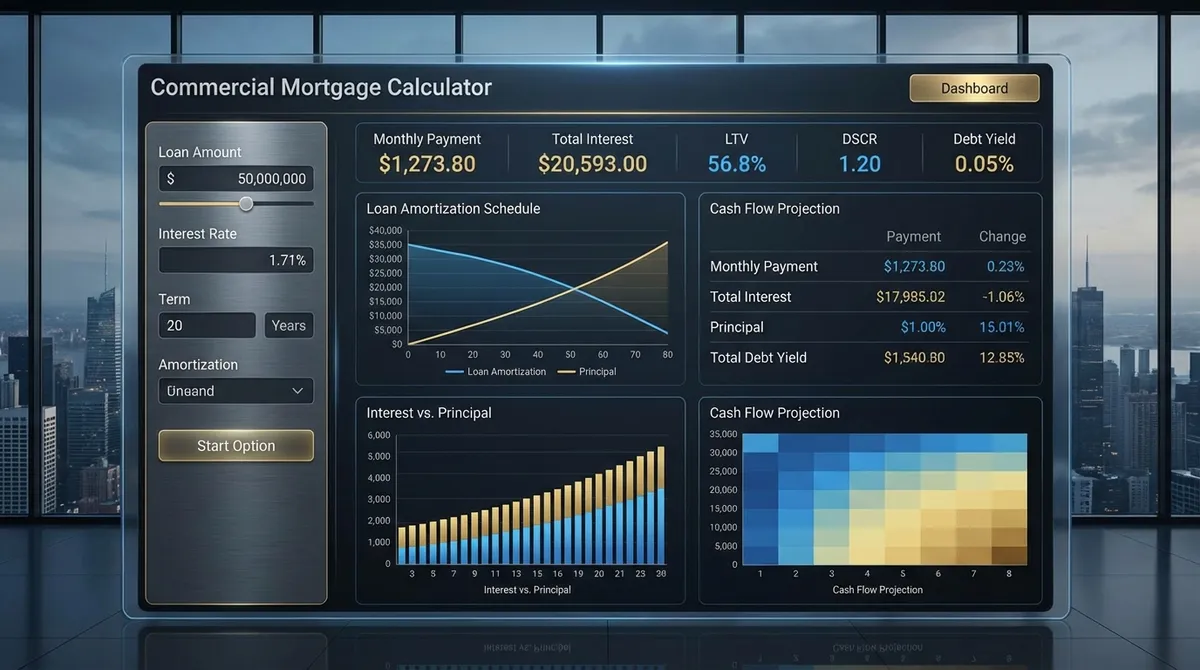
This Commercial Mortgage Calculator is designed to help investors and business owners estimate monthly payments and determine maximum loan proceeds based on the two critical metrics lenders use: Debt Service Coverage Ratio (DSCR) and Loan-to-Value (LTV).
How Commercial Mortgages Work
Unlike residential loans, which are often 30-year fixed-rate mortgages, commercial loans typically have shorter terms (e.g., 5, 7, or 10 years) but are amortized over a longer period (e.g., 20 or 25 years). This structure results in a lower monthly payment but requires a "balloon payment" of the remaining balance when the term ends. See how amortization works with our amortization calculator.
The Golden Rule of Commercial Lending
Lenders will always lend the lesser of two amounts: the amount supported by the property's cash flow (DSCR) or the amount supported by the property's collateral value (LTV).
Deep Dive: Understanding DSCR
The Debt Service Coverage Ratio (DSCR) is the primary safety metric for banks. It answers the question: "Can this property pay for itself?" (See also: Cash Flow Calculator)
The Formula
DSCR = Net Operating Income (NOI) ÷ Annual Debt Service
NOI is Gross Income minus Operating Expenses (Taxes, Insurance, Maintenance, Utilities, Management). It does not include mortgage payments or depreciation.
What The Numbers Mean
- 1.00x: Break-even. Income exactly matches debt.
- 1.25x: Standard Minimum. The property generates $1.25 for every $1.00 of debt.
- 1.40x+: High Safety. Often qualifies for lower interest rates.
Pro Tip: Lenders often "stress test" your NOI. They might assume a 5-10% vacancy rate and a 4-5% management fee, even if you are fully occupied and self-managing. Always build these buffers into your calculator inputs to be conservative.
Commercial Loan Types Matrix
Not all money costs the same. Choosing the right loan program can save you thousands in interest or provide higher leverage.
| Loan Type | Best For | Typical LTV | Pros/Cons |
|---|---|---|---|
| Conventional Bank | Stabilized Properties | 65% - 75% | Low rates, but personal recourse required. |
| SBA 504 | Owner-Occupied | Up to 90% | High leverage, fixed rate (25yr), but high fees. Learn more at Commercial Real Estate Loan. |
| CMBS (Conduit) | Large Assets ($2M+) | 70% - 75% | Non-recourse (safe), but strict prepayment penalties. |
| Bridge Loan | Fix & Flip / Value-Add | 75% - 80% LTC | Fast funding, but high rates (8-12%+) and short term. |
The "Balloon Payment" Risk
Most commercial loans calculate payments based on a 25-year schedule but become due in 5 or 10 years. This remaining balance is the balloon payment.
Risk Alert: Refinancing risk is real. If property values drop or interest rates spike when your balloon payment is due (Maturity Date), you might not be able to get a new loan large enough to pay off the old one. This is how many investors lose properties during recessions.
Prepayment Penalties Explained
Unlike residential mortgages, you often cannot just pay off a commercial loan early without a fee. Lenders expect a guaranteed yield.
- Step-Down (Fixed): A simple percentage fee that decreases over time (e.g., 5% in Yr 1, 4% in Yr 2, etc.). Common in bank loans.
- Yield Maintenance: You must pay the lender the difference between your interest rate and the current market rate for the remaining term. Can be massive if rates fall.
- Defeasance: Common in CMBS. You must substitute the collateral with US Treasuries. Extremely complex and expensive to execute.
Calculating Maximum Loan Proceeds (Step-by-Step)
Our calculator finds your maximum loan size by running two parallel tests:
The DSCR Test
We divide your Net Operating Income (NOI) by the minimum required DSCR (e.g., 1.25). This gives the maximum allowable annual payment. Using the interest rate and amortization, we convert this payment into a loan amount.
The LTV Test
We simply multiply your Property Value by the maximum LTV percentage (e.g., 75%).
The lower of these two numbers is your "Final Maximum Loan." This ensures the loan checks both boxes: sufficient cash flow coverage and sufficient equity cushion.
Example Scenario: Buying "Main Street Office"
Imagine you want to buy a small office building for $2,000,000. The property generates $160,000 in Net Operating Income (NOI). The bank offers a 7.0% interest rate with a 25-year amortization and requires a 1.25x DSCR and max 75% LTV. You can model this with the Rental Property Calculator.
- LTV Limit: $2,000,000 × 75% = $1,500,000
- DSCR Limit: $160,000 / 1.25 = $128,000 (Max Annual Debt Service)
- Loan Supported by DSCR: A $128,000 annual payment at 7.0% confirms a loan of roughly $1,510,000.
In this case, the LTV limit ($1.5M) is the bottleneck. Even though the cash flow supports $1.51M, the bank won't exceed 75% of value. You would need a $500,000 down payment.
Commercial Loan Documentation Checklist
Unlike a residential mortgage where a couple of paystubs suffice, commercial underwriting is exhaustive. To speed up your closing, have these documents ready before you apply:
Property Documents
- Rent Roll: Current list of tenants, lease terms, and rents.
- T-12 P&L: Profit & Loss statement for the trailing 12 months.
- Lease Agreements: Copies of all executed leases.
- Site Plan & Survey: Existing property maps.
- Capital Improvements List: Proof of recent renovations.
Sponsor (Borrower) Documents
- Personal Financial Statement (PFS): Assets vs. Liabilities. Calculate yours with the Net Worth Calculator.
- Tax Returns: Last 3 years (Personal & Business entities).
- Resume/Bio: Proof of real estate experience.
- Liquidity Proof: Bank statements showing down payment funds.
- SREO Schedule: Schedule of Real Estate Owned (other properties).
Essential Glossary of Commercial Terms
Commercial real estate has its own language. Mastering these terms will help you negotiate better with lenders.
Amortization vs. Term
The Term is how long the loan lasts before you must pay it off (e.g., 10 years). The Amortization is the schedule used to calculate payments (e.g., 25 years). A longer amortization lowers your monthly payment.
Cap Rate (Capitalization Rate)
The rate of return on a real estate investment property based on the income that the property is expected to generate. Formula: NOI / Purchase Price. A higher Cap Rate implies higher risk or higher return.
Estoppel Certificate
A document signed by a tenant verifying their lease terms, rent amount, and that the landlord is not in default. Lenders require these before closing to ensure the rent roll is accurate.
Non-Recourse Loan
A loan secured by the property, not the borrower's personal assets. If you default, the lender can take the building but cannot sue you personally (unless you committed fraud—see "Bad Boy Carve-outs").
Vacancy Rate
The percentage of all available units in a rental property that are vacant or unoccupied at a particular time. Lenders will often use a "market vacancy" rate (e.g., 5%) even if your building is 100% full to be conservative.
Frequently Asked Questions
Common questions investors ask about commercial financing.
Can I use projected rental income?
Typically, no. Lenders use the "trailing 12 months" (T-12) of actual collected income. Pro-forma or projected income is usually only accepted for bridge loans or construction loans, not permanent financing.
What are "Bad Boy Carve-outs"?
Even in "non-recourse" loans, there are exceptions. If you commit fraud, misappropriate funds, or file bankruptcy, the loan becomes "full recourse," meaning the lender can come after your personal assets.
How long does it take to close?
Commercial loans are slow. Expect 45-90 days for a conventional or SBA loan due to third-party reports (Appraisal, Phase 1 Environmental, Property Condition Report).