What Is Compound Interest and Why It Matters in 2025?
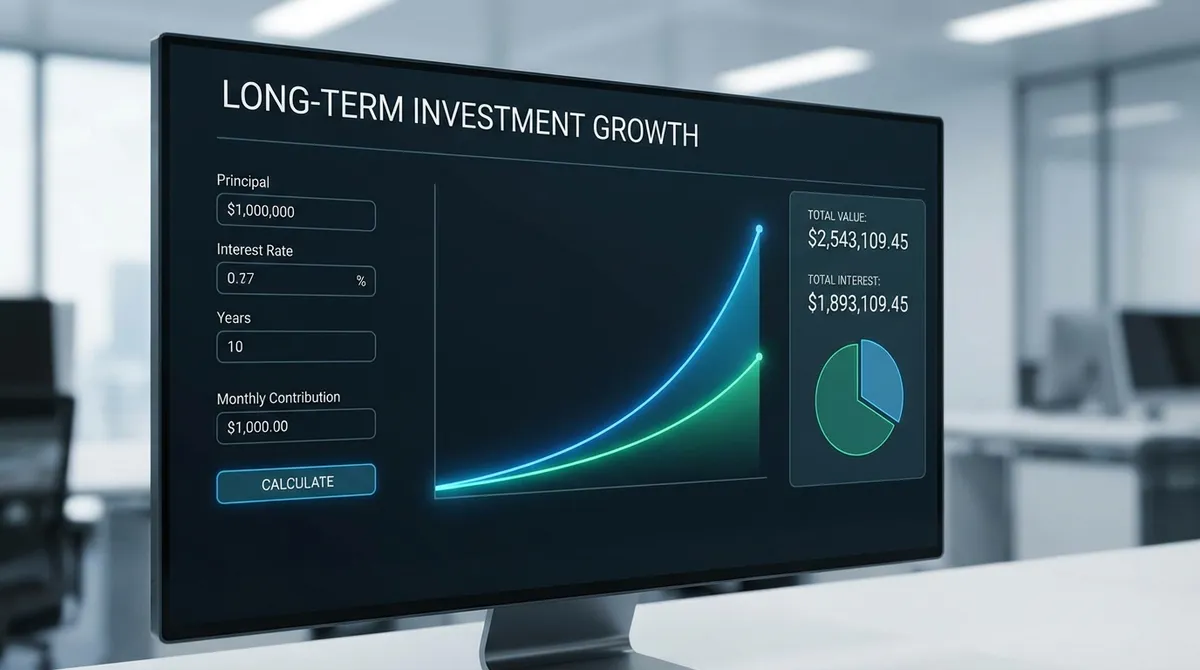
Compound interest is the financial phenomenon where your money earns interest not just on the initial principal, but also on all the interest that has accumulated over time. Unlike simple interest that only calculates returns on your original investment, compound interest creates a snowball effect where your earnings generate their own earnings, leading to exponential growth that accelerates dramatically over long periods.
In 2025, with high-yield savings accounts offering APYs up to 5.25% and the S&P 500's historical average return of 10%, understanding compound interest isn't just financial literacy—it's your most powerful wealth-building tool. Whether you're saving for retirement, building an emergency fund, or investing for financial independence, compound interest is the engine that transforms modest, consistent contributions into life-changing wealth. Learn more at Investor.gov.
Key Statistic: A $10,000 investment at 7% annual return grows to $76,123 in 30 years through compound interest—more than 7x your initial investment, even without additional contributions. With monthly contributions of $500, that same investment balloons to $820,483, demonstrating the explosive power of combining compound interest with consistent saving habits.
How Compound Interest Calculations Work: The Math Behind the Magic
The compound interest formula might look intimidating, but it's actually straightforward once you understand each component. The formula A = P(1 + r/n)^(nt) contains five variables that determine your investment's future value:
- •A (Future Value): The total amount you'll have after the investment period, including principal and all accumulated interest.
- •P (Principal): Your initial investment amount—the starting capital that begins earning interest.
- •r (Annual Interest Rate): The annual rate of return expressed as a decimal (7% = 0.07). This is where realistic expectations matter—use historical averages, not optimistic projections.
- •n (Compounding Frequency): How many times interest is compounded per year. Higher frequency = more growth: daily (365), monthly (12), quarterly (4), or annually (1).
- •t (Time in Years): The length of your investment horizon. This is the most powerful variable—time is compound interest's best friend.
The real power comes from the exponent (nt)—this creates exponential growth where your money accelerates over time. In the first year, you earn interest on your principal. In year two, you earn interest on your principal plus year one's interest. By year 30, you're earning interest on 29 years of accumulated interest, creating a snowball effect that becomes unstoppable.
Real-World Example: Sarah's 30-Year Journey to Millionaire Status
Meet Sarah, a 25-year-old software engineer who understands that time is her greatest asset. She starts with a $15,000 initial investment (her signing bonus) and commits to contributing $600 monthly to her investment account. She chooses a diversified portfolio of index funds averaging 8% annual returns, compounded monthly.
• Initial Investment: $15,000
• Monthly Contribution: $600
• Annual Return: 8%
• Time Horizon: 30 years
• Compounding: Monthly
• Total Contributions: $231,000
• Interest Earned: $1,089,247
• Final Balance: $1,320,247
• Return Multiple: 5.7x contributions
• Millionaire status: Achieved at age 53
The remarkable aspect isn't just the $1.3 million final balance—it's how the growth accelerates. In the first 10 years, Sarah's account grows to $135,000 (mostly from her contributions). In the next 10 years, it reaches $485,000 as compound interest kicks into gear. In the final decade, her account explodes to $1.32 million, with the last 5 years alone generating more growth than the entire first 20 years combined. This demonstrates why starting early matters more than investing large amounts later.
💡 Expert Tips from Jurica Šinko to Maximize Compound Interest
1. Start Today, Not Tomorrow: Every day you delay costs you exponentially more than you think. A 25-year-old investing $300/month reaches $1 million by age 60. Wait until 35, and you must invest $775/month for the same result—2.5x more! The cost of procrastination isn't linear; it's exponential.
2. Automate Your Contributions: Set up automatic transfers from your checking account to your investment account on payday. This "pay yourself first" strategy removes willpower from the equation. According to Vanguard, automated investors have 2.3x higher balances than manual investors after 10 years, simply because they don't skip months.
3. Choose Daily Compounding When Possible: While the difference between daily and monthly compounding seems small (0.02% annually on a $10,000 investment), over 30 years this adds up to nearly $2,000 in extra earnings. Always opt for accounts that compound daily—most high-yield savings accounts and money market funds do this automatically.
4. Never Interrupt Compounding: The biggest wealth destroyer is withdrawing your earnings. A $50,000 investment at 8% grows to $543,000 in 30 years. But if you withdraw the $4,000 annual interest each year, you'll have only $170,000—69% less! Let your earnings generate more earnings by reinvesting dividends and interest.
5. Increase Contributions Annually: Boost your monthly contribution by just 3% each year (a $15 increase on a $500 monthly contribution). This small adjustment leverages both compound interest and compound contributions. Over 30 years, this strategy adds $287,000 to your final balance compared to static contributions—a 22% improvement with minimal lifestyle impact.
⚠️ Common Mistakes That Destroy Compound Interest Wealth
Mistake 1: Waiting for the "Perfect" Time to Invest
Market timing is a loser's game. Investors who try to time the market underperform consistent investors by 3.5% annually, according to Dalbar's QAIB study. The perfect time to start was yesterday; the second-best time is today. Dollar-cost averaging through regular monthly contributions eliminates timing risk.
Mistake 2: Choosing Low-Interest Savings Accounts
Keeping money in a traditional savings account earning 0.01% APY is financial suicide by inflation. On $10,000, you earn $1 per year—while inflation erodes $350 of purchasing power (check our Inflation Calculator). You're guaranteed to lose money. High-yield savings accounts (4.5-5.25% APY) and index funds (7-10% returns) are essential for compound interest to work.
Mistake 3: Withdrawing Interest Instead of Reinvesting
This kills the compounding engine. A $100,000 investment at 8% generates $8,000 in year one. If you spend that $8,000 instead of reinvesting, you lose $160,000 in potential growth over 20 years. Treat investment accounts as sacred—never withdraw earnings until retirement.
Mistake 4: Ignoring Fees and Expense Ratios
A 1% fee doesn't sound bad, but over 30 years it reduces your final balance by 28%! On a $500,000 portfolio, that's $140,000 lost to fees. Choose low-cost index funds with expense ratios under 0.10% and avoid actively managed funds with high fees that compound against you.
Mistake 5: Underestimating the Power of Time
Most investors focus on finding the "hot" stock instead of maximizing time in the market. A 25-year-old investing $200/month at 8% reaches $622,000 by age 60. A 40-year-old must invest $1,100/month to reach the same amount—that's 5.5x more! Time is more valuable than investment selection.