Understanding Your Credit Card APR in 2025
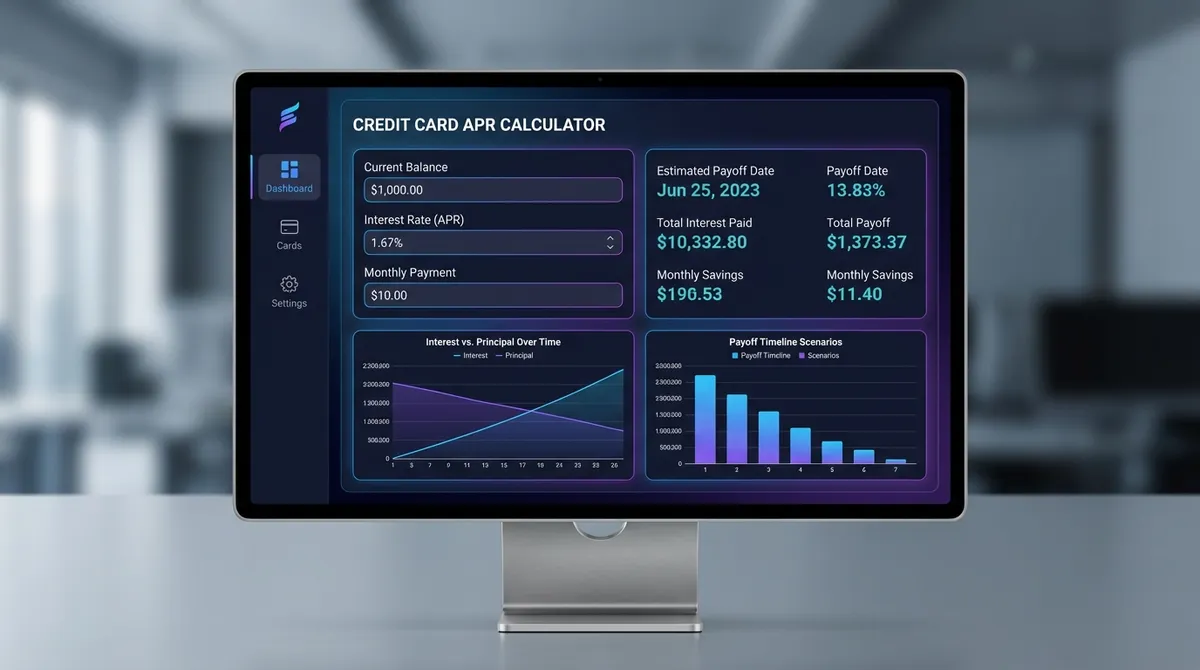
Credit card Annual Percentage Rate (APR) is one of the most misunderstood numbers in personal finance. While it is expressed as an annual rate (e.g., 24.99%), you don't pay interest annually. Instead, credit card issuers use a Daily Periodic Rate (DPR) to charge interest on your average daily balance every single day you carry debt.
In 2025, with the average credit card APR hovering near record highs (often exceeding 22%), understanding exactly how this cost accrues is critical. A seemingly small balance can balloon quickly due to daily compounding. This calculator breaks down that annual number into the daily cost that actually hits your wallet.
How Credit Card Interest is Calculated
Most issuers use the Average Daily Balance (ADB) method. Here is the step-by-step math that happens behind the scenes:
The Formula Chain
- Convert APR to DPR: Divide your APR by 365 (or 360, depending on the issuer).
24.99% ÷ 365 = 0.0684% per day - Calculate Daily Interest: Multiply your day's balance by the DPR.
$2,000 × 0.000684 = $1.37 interest for that day - Sum for the Cycle: Add up the interest charges for every day in the billing cycle (usually 30 days).
This "daily" calculation is why paying down your balance in the middle of the month saves you money compared to waiting until the due date. Every day the balance is lower, the daily interest charge drops.
Real-World Scenario: The Cost of Waiting
Let's look at a common scenario. You have a $5,000 balance on a rewards card with a 29.99% APR. You plan to pay it off, but money is tight.
Scenario A: Minimum Payment Only
You pay the minimum (~$150). Most of that goes to interest ($125). Your principal barely moves. Check our Payoff Calculator.
Scenario B: Aggressive Paydown
You pay $500/month. You attack the principal directly.
Our calculator shows you the "Interest This Cycle" to highlight exactly how much money you are throwing away each month just for the privilege of delaying payment.
Variable vs. Fixed APR: Why Your Rate Changes
Almost all modern credit cards have Variable APRs. This means your rate is tied to an index, usually the U.S. Prime Rate.
Your APR = Prime Rate + Bank Margin
(e.g., 8.50% + 15.49% = 23.99%)
When the Federal Reserve raises interest rates to fight inflation, the Prime Rate goes up, and your credit card APR goes up automatically—usually within one or two billing cycles. You do not get a choice in this. This is why many people saw their rates jump from 16% to 24% between 2022 and 2024 without ever making a late payment. For historical data on the Prime Rate, you can visit the Federal Reserve Economic Data (FRED) website.
APR vs. Annual Fee: Which Matters More?
Users often ask if they should choose a card with a lower APR or no annual fee.
- If you carry a balance: The APR matters 100x more. A 1% difference in APR on a $5,000 balance costs you $50/year—often more than the fee. Always prioritize the lowest rate. Unlike a mortgage, this rate isn't tied to your credit score once the card is open.
- If you pay in full: The APR is irrelevant (0%). Focus on the rewards and the annual fee. A card with 99% APR is fine if you never pay interest.
The Penalty APR Trap
Buried in your cardmember agreement is a clause about "Penalty APR." If you make a late payment (usually 60 days late) or a returned payment (bounced check), the issuer can strip away your standard APR and replace it with a Penalty APR.
Avg. Penalty APR: 29.99%
Once triggered, this rate can apply to your entire existing balance, not just new purchases. It can stay in effect indefinitely, though the CARD Act requires issuers to review it every 6 months if you pay on time.
The Dark Side of "0% APR" Offers
You have likely seen offers for "0% APR for 18 months" on furniture, electronics, or medical bills. These can be great tools, but they often come with a trap called Deferred Interest.
Deferred vs. Waived Interest
Waived Interest (True 0%): If you don't pay off the full balance by the end of the promo, you only start paying interest on the remaining balance. (Common with major bank credit cards).
Deferred Interest (Store Cards): If you have $1 left on your balance when the promo expires, the lender retroactively charges you interest on the original purchase amount for the entire 18 months.
Example: You buy a $2,000 sofa with "No Interest if Paid in Full in 12 Months."
- You pay off $1,900. You owe $100 on the last day.
- Waived Interest Card: You start paying interest on $100.
- Deferred Interest Card: You are suddenly charged ~$600 in back-interest (29% on $2,000 for 1 year). Your balance jumps from $100 to $700 overnight.
Always read the fine print. If it says "Deferred," you must pay it off early to be safe.
Expert Tips to Lower Your Effective Rate
- •The "Grace Period" Loophole: If you pay your statement balance in full by the due date, most cards waive all interest for that cycle. This effectively gives you a 0% APR loan for 25-50 days.
- •Request a Rate Reduction: If you have a good payment history, call your issuer and ask for a lower APR. It works more often than you think.
- •Balance Transfer Strategy: Move high-interest debt to a card with a 0% intro APR (usually for 12-18 months). Just be sure to factor in the transfer fee (typically 3-5%) or compare with a personal loan.
How to Find Your APR on Your Statement
Credit card issuers are required by law to clearly disclose your APR, but they often hide it on the last page of your PDF statement.
Look for the "Interest Charge Calculation" Box
It is usually a small table at the very bottom of the statement. It will list:
- Type of Balance: (Purchases, Cash Advances, Balance Transfers)
- APR: (e.g., 24.99% for Purchases, 29.99% for Cash Advances)
- Balance Subject to Interest Rate: (This is your Average Daily Balance)
- Interest Charge: ( The actual dollar amount you are paying)
Tip: If you see a "V" next to your rate (e.g., 24.99% (V)), it stands for "Variable," confirming your rate will move with the Prime Rate.
Common APR Mistakes
Confusing APR with APY
APR is the simple interest rate you pay. APY (Annual Percentage Yield) includes compounding. For investments, you want high APY. For debt, you want low APR. Credit cards technically charge simple interest daily, but the effect feels like compounding if you let the interest capitalize.
Ignoring Cash Advance Rates
Using your credit card at an ATM usually triggers a much higher "Cash Advance APR" immediately. There is no grace period—interest starts ticking the second the cash dispenses.
Related Tools
If this APR calculator revealed a scary number, use these tools to make a plan:
- Credit Card Payoff Calculator: See exactly how long it will take to be debt-free at your current payment level.
- Balance Transfer Calculator: Calculate if moving your debt to a new card is worth the transfer fee.
- Debt Avalanche Calculator: Optimize your payments to save the most interest possible across multiple cards.