Complete Guide: Understanding Credit Card Interest
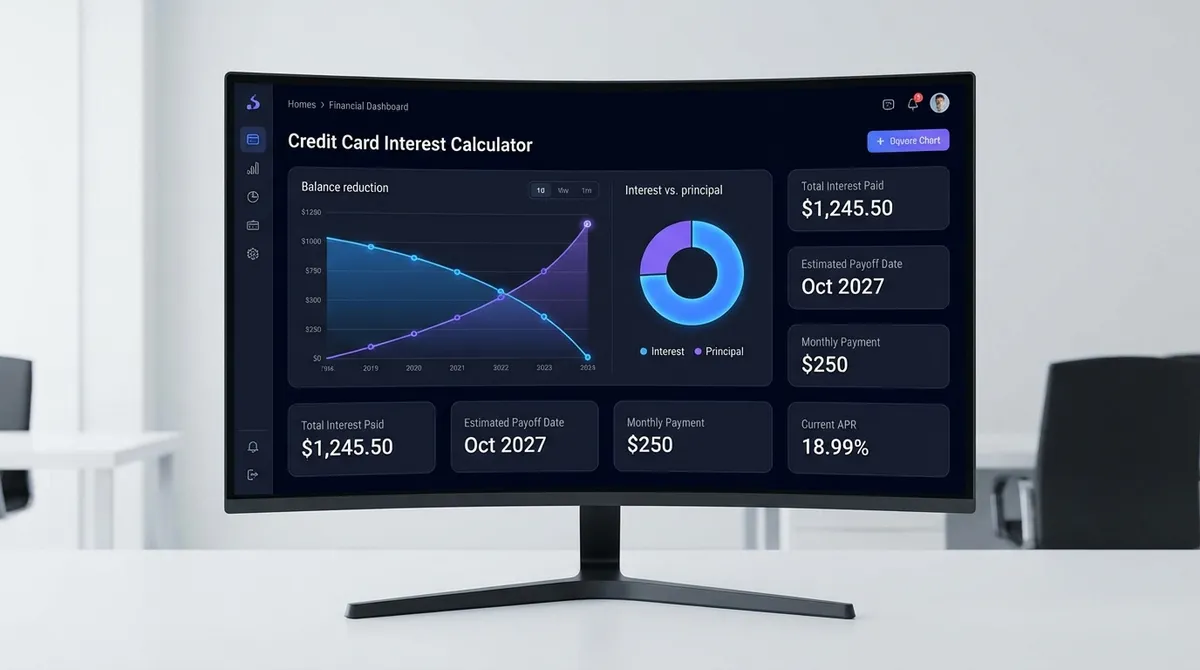
Credit card interest is one of the most confusing aspects of personal finance. Unlike a mortgage or car loan where interest is calculated on a simple monthly principal, credit cards use a dynamic formula based on your Average Daily Balance (ADB). This means every single day you carry a balance, interest accrues—and the timing of your payments matters almost as much as the amount.
This guide will demystify how credit card issuers calculate your bill, explain the "Daily Periodic Rate" (DPR), and show you exactly how to use that knowledge to save money.
The Core Formula: How It Works
Most major U.S. credit card issuers (including Chase, Citi, Amex, and Discover) use the Average Daily Balance Method. They don't just look at your balance on the 1st of the month; they track it every day.
Interest = ADB × DPR × Days in Cycle
- ADB: Average Daily Balance (Sum of daily balances ÷ Days in cycle)
- DPR: Daily Periodic Rate (APR ÷ 365)
- Days: Length of billing cycle (usually 28–31 days)
1. Daily Periodic Rate (DPR)
Your nominal APR is the headline number, but it's not the number used in the actual math. Issuers divide your APR by 365 (or sometimes 360) to find the daily rate.
Example: If your APR is 24.99%:0.2499 ÷ 365 = 0.0006846 (or 0.0685% per day).
2. Average Daily Balance (ADB)
This is where most people get lost. To find your ADB, the issuer takes your balance at the end of each day in the billing cycle, adds them all up, and divides by the number of days.
Because of this, a purchase made on Day 1 of your cycle hurts you more than a purchase on Day 28. The Day 1 purchase is part of your balance for 30 days; the Day 28 purchase is only there for 2 days.
The Grace Period Loophole
The "Grace Period" is the holy grail of credit card usage. If you pay your statement balance in full by the payment due date every single month, the issuer typically waives all interest on new purchases.
However, if you leave even $1 unpaid, you lose your grace period. The next month, interest starts accruing on new purchases the moment they post. This is called "trailing interest" or "residual interest," and it can surprise you with a bill even after you think you've paid everything off.
Warning: Cash advances and balance transfers usually have NO grace period. Interest starts ticking the second you take the money out.
Real-World Example: The Cost of Waiting
Let's say you start the month with a $2,000 balance at 24% APR. You plan to make a $500 payment.
- AYou pay on Day 25 (Due Date):
Your balance stays at $2,000 for 24 days. It drops to $1,500 for the last 5 days.
ADB ≈ $1,916.
Interest Charge: ~$38.00 - BYou pay on Day 1 (Early):
Your balance drops to $1,500 immediately. It stays there for all 30 days.
ADB = $1,500.
Interest Charge: ~$29.00
By simply moving your payment date, you saved nearly $10 in one month. Over a year, that strategy alone saves over $100 without paying a penny extra.
Historical Context: Are Rates High Right Now?
If you feel like credit card interest is more painful than it used to be, you are correct. In 2025, the average credit card interest rate is hovering near historic highs (approx. 24-25%).
| Era | Avg. APR | Context |
|---|---|---|
| 2013-2015 | ~13% | Low-interest era following the 2008 financial crisis. |
| 2019 | ~17% | Pre-pandemic economy. |
| 2024-2025 | ~24.5% | Post-inflation rate hikes by the Federal Reserve. |
What this means for you: Carrying a $5,000 balance today costs roughly double the interest it did just 10 years ago. Strategies that worked in 2015 (like "floating" a balance for a few months) are now financial suicide.
The Power of Compound Interest (in Reverse)
Most federal consumer protection laws are enforced by the CFPB. Albert Einstein famously called compound interest the "eighth wonder of the world," noting that "he who understands it, earns it... he who doesn't... pays it."
The Rule of 72 (Debt Edition)
To find out how fast your debt will double if you pay nothing, divide 72 by your interest rate.
This is why credit card debt feels like quicksand. The mathematical force pulling you down (24%) is three times stronger than the typical force lifting your investments up (8%). (See: Compound Interest Calculator).
The Fed, Inflation, and Your Wallet
You might wonder: "Why did my credit card rate jump from 15% to 25%?"
It is directly tied to the Federal Reserve's "Federal Funds Rate." When inflation is high (as it was in 2022-2023), the Fed raises rates to cool the economy. Credit card issuers pass this cost directly to you.
The "Prime Rate" Mechanism
Your card agreement likely says your APR is Prime Rate + X%.
In 2020, Prime was 3.25%. If your margin was 15%, your rate was 18.25%.
In 2025, Prime is closer to 8.00%. That same card now has a rate of 23.00%.
This means your debt has become more expensive through no fault of your own. This structural increase makes aggressive payoff strategies even more critical today than they were a decade ago.
Mini Glossary
- APR: Annual Percentage Rate (Headline cost)
- DPR: Daily Periodic Rate (Actual daily cost)
- ADB: Average Daily Balance (What interest is charged on)
- Prime Rate: The benchmark rate set by the Fed
Strategies to Lower Your Interest
1. The Snowflake Method
Make multiple small payments throughout the month (e.g., every payday) rather than one lump sum at the end. This keeps your ADB lower for more days.
2. 0% Balance Transfers
If your credit score allows, move high-interest debt to a card with a 0% intro APR period (usually 12–21 months). This stops the bleeding entirely. Check our Payoff Calculator to plan your escape.
3. Request an APR Reduction
Call your issuer and ask. If you have a history of on-time payments, they may lower your rate by 2–5% just to keep you as a customer. Learn more about simple interest vs compound interest with our Simple Interest Calculator.
4. Pay High-APR First
If you have multiple cards, use the "Avalanche Method": pay minimums on all, but throw every extra dollar at the card with the highest APR. Alternatively, use the Snowball Method for psychological wins.
FAQ: Common Confusion Points
Why is my interest higher than (Balance × APR ÷ 12)?
The simple "divide by 12" formula assumes your balance is constant every second of the month. In reality, new purchases increase your balance mid-month, raising the Average Daily Balance. Additionally, months have 30 or 31 days (not exactly 1/12th of a year), so daily compounding adds up slightly differently.
Does interest compound daily or monthly?
Most credit cards compound daily. This means yesterday's interest is added to your principal, and today's interest is calculated on that new, slightly higher total. While the effect is small month-to-month, it adds up over years.
How do I get my grace period back?
If you've been carrying a balance, you need to pay your entire statement balance (not just the minimum) by the due date. Some issuers require you to do this for two consecutive billing cycles before the grace period is fully restored.