Complete Guide: Understanding Credit Utilization
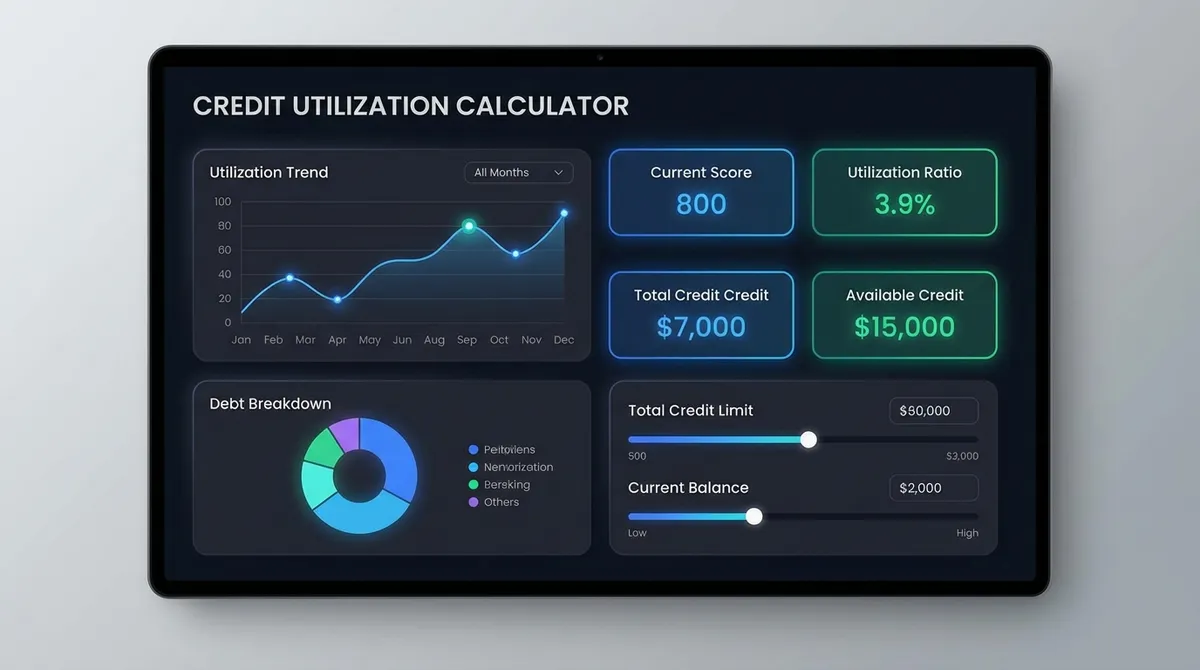
Credit utilization is one of the most powerful levers you have to influence your credit score quickly. It accounts for approximately 30% of your FICO® Score, making it second only to payment history in importance. Unlike payment history, which takes years to build, credit utilization has no memory in most current scoring models—meaning you can often improve your score significantly in as little as 30 days by paying down balances.
What Is Credit Utilization?
Credit utilization is a ratio that represents the amount of revolving credit you are currently using divided by the total amount of revolving credit you have available. It applies primarily to credit cards and lines of credit, not installment loans like mortgages or auto loans.
The formula is simple:
Utilization Ratio = (Total Balances ÷ Total Credit Limits) × 100
For example, if you have a credit card with a $1,000 limit and a $500 balance, your utilization is 50%.
The Two Types of Utilization
Credit scoring models, such as FICO and VantageScore, look at utilization in two ways. Our calculator helps you visualize both:
- Aggregate Utilization: The sum of all your balances divided by the sum of all your limits. This gives a "big picture" view of your debt load.
- Per-Card Utilization: The ratio for each individual account. Even if your total utilization is low (e.g., 10%), having a single card "maxed out" (close to 100% utilization) can still negatively impact your score. Learn more about scoring factors at myFICO.
The "30% Rule" vs. The "10% Rule"
You will often hear financial experts recommend keeping your utilization below 30%. While this is a good starting point to avoid significant damage to your score, it is not the threshold for the best score.
The Elite Target: Under 10%
Consumers with the highest credit scores (800+) typically maintain utilization ratios below 10%. This signals to lenders that you are managing credit responsibly and not relying on it for daily expenses.
The Danger Zone: Over 50%
Once utilization crosses 50%, score penalties become more severe. Maxing out a card (100%) is a major red flag that can drop a score by dozens of points overnight.
Strategic Tip: The "AZEO" Method
For those seeking to maximize their score before a major application (like a mortgage), the "All Zero Except One" (AZEO) method is a popular strategy. Here is how it works:
- Pay off the balances on all of your credit cards so they report $0.
- Leave a small balance (e.g., $10-$20) on just one card.
- Wait for the statement to close and report that small balance.
Why not $0 everywhere? A report showing 0% utilization across the board can sometimes result in a "no recent usage" penalty, leading to a slightly lower score than showing 1% usage.
Timing Is Everything: Statement vs. Due Date
A common misconception is that you must carry a balance month-to-month to build credit. This is false. You do not need to pay interest to have a good credit score.
However, the date you pay matters for utilization. Most issuers report your balance to the bureaus on your Statement Closing Date, which is usually 20-25 days before your Payment Due Date.
- If you pay in full on the Due Date: The issuer has likely already reported a high balance from your statement.
- If you pay in full 3 days before the Statement Date: The issuer will report a $0 (or very low) balance, resulting in low utilization on your credit report.
How to Lower High Utilization Quickly
If your calculator results show you are in the "High" or "Very High" zones, use these strategies to recover:
- Use the "Snowball" or "Avalanche" methods.Focus on paying down one card at a time while making minimums on others (see our Snowball Calculator).
- Request a Credit Limit Increase.If you have a good history with an issuer, ask for a higher limit. If your limit goes from $5,000 to $10,000 and your balance stays at $2,500, your utilization instantly drops from 50% to 25%.
- Make bi-weekly payments.Pay half your bill every two weeks. This keeps the average daily balance lower and ensures you never accidentally report a high balance.
- Consolidate with a Personal Loan.Installment loans do not count toward revolving utilization. Moving $5,000 of credit card debt to a personal loan can instantly drop your utilization to 0% (though you still owe the debt).
The "Credit Limit Increase" Hack
One of the fastest ways to lower your utilization without spending a dime is to simply ask for more credit. Most major issuers allow you to request a credit limit increase online instantly.
Example Scenario
You have a $2,000 balance on a card with a $4,000 limit. Utilization: 50% (Bad).
You request an increase, and the issuer bumps your limit to $8,000. You still owe $2,000.New Utilization: 25% (Good).
Warning: Ask the issuer if the request will trigger a "Hard Pull" on your credit report. Many do only a "Soft Pull" (which doesn't hurt your score), but it varies by bank. If it requires a Hard Pull, verify it's worth the temporary 5-10 point dip.
Advanced Strategy: Credit Cycling
For power users who spend heavily (e.g., for points/rewards) but have low limits, "Credit Cycling" is a manual technique to keep utilization near zero.
Instead of paying once a month, you pay your card weekly or even daily. For example, if you have a $1,000 limit and need to spend $3,000 this month:
- Week 1: Spend $800. Pay $800 immediately. Balance: $0.
- Week 2: Spend $700. Pay $700 immediately. Balance: $0.
- Week 3: Spend $900. Pay $900 immediately. Balance: $0.
By the statement closing date, your reported balance is $0 (or whatever micro-balance you leave), but you have successfully pushed $2,400 of spend through the card, earning all the rewards without ever triggering a "high utilization" alert.
Caution:
Some issuers dislike excessive cycling (spending 3x your limit repeatedly) as it looks like money laundering. Keep it reasonable (1.5x - 2x limit) or just request a limit increase.
Disclaimer
The information provided by this calculator and guide is for educational purposes only. Credit scoring models are complex and proprietary (FICO®, VantageScore®). While lowering utilization is generally positive, individual results will vary based on your full credit profile.
Common Questions About Credit Utilization
Does 0% utilization hurt my score?
Surprisingly, yes. Having 0% utilization reported on all your cards can result in a "no recent revolving activity" penalty. FICO models reward seeing that you are using credit responsibly, not abstaining from it entirely. Aim for a micro-balance (e.g., 1%) on one card rather than 0% everywhere.
Do business credit cards count toward utilization?
Usually, no. Most business credit cards (e.g., Amex, Chase Ink) do not report to your personal credit report unless you default. This makes them excellent tools for carrying business expenses without wrecking your personal utilization ratio. However, some issuers (like Capital One and Discover) DO report business cards to personal bureaus, so check your cardmember agreement.
How fast will my score update after I pay?
Your score updates as soon as the credit bureau receives the new balance data. This typically happens once a month, a few days after your statement closing date. If you pay off a maxed-out card today, you won't see the score jump until the next reporting cycle hits your credit report.
Does being an authorized user affect my utilization?
Yes. If you are added as an authorized user to a spouse's or parent's card, that card's limit and balance are added to your credit profile. If they have low utilization and a long history, it helps you. If they max out the card, it hurts you—even if you never spent a dime.
Is it better to pay in full or leave a small balance?
Always pay in full to avoid interest. You do not need to pay interest to build credit. To optimize utilization, let a small balance report on your statement, but then pay that statement balance in full before the due date. This gives you the score benefit of "usage" without the cost of "interest." (Verify with our Payoff Calculator).