Complete Guide: Crypto Profit Calculator — Calculate Trading Profit, ROI, Fees, Taxes & Break‑Even (2025)
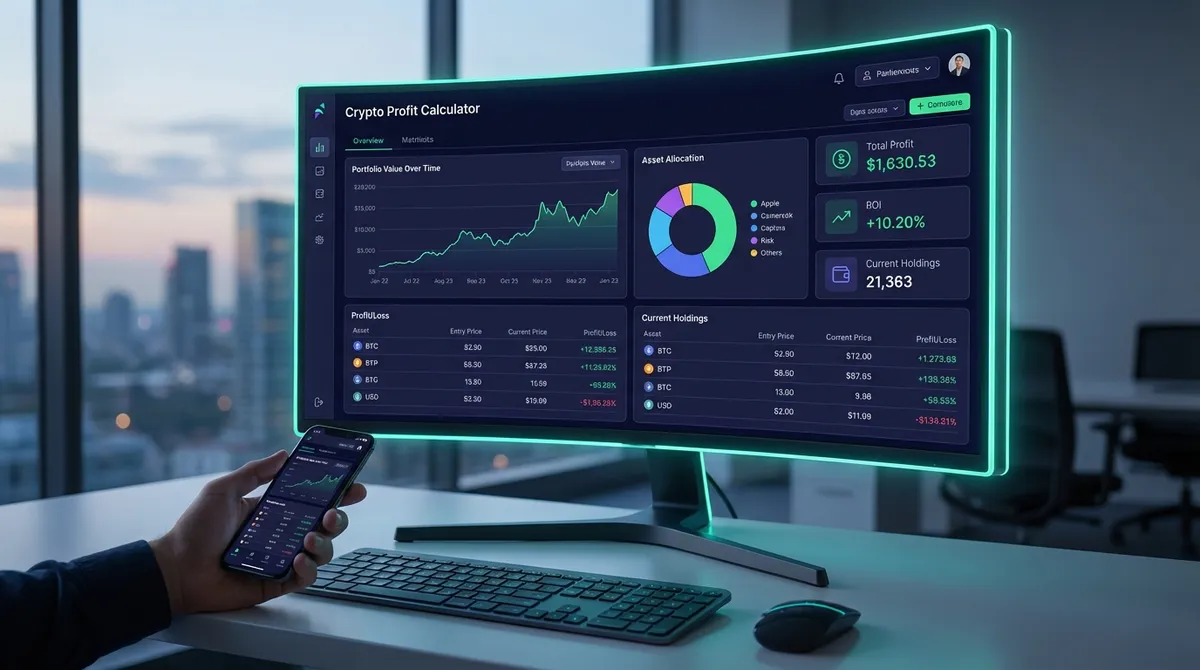
Calculating crypto profits accurately is more complex than simply subtracting your buy price from your sell price. Exchange fees, network costs, and potential taxes all eat into your final return. This guide explains exactly how to calculate your true net profit, ROI, and break-even price so you can trade with confidence.
Understanding the Core Formula
To find your true profit, you must account for the "round-trip" cost of the trade. This involves two main components: your Total Cost Basis (money in) and your Net Proceeds (money out).
The Net Profit Formula
Net Profit = Net Proceeds - Total Cost Basis - Estimated Taxes (Calc)
1. Total Cost Basis
Your cost basis isn't just the price of the coin. It includes every fee you paid to acquire it.
- Principal: Quantity × Buy Price.
- Trading Fees: The percentage charged by the exchange (e.g., 0.10% to 0.50%).
- Fixed Fees: Any flat network or gas fees paid to execute the transaction.
2. Net Proceeds
Similarly, when you sell, you don't receive the full market price. Fees are deducted from your payout.
- Gross Proceeds: Quantity × Sell Price.
- Sell Fees: Deducted from the gross amount.
- Net Proceeds: The actual cash that lands in your account.
The Impact of Fees on Break-Even
Many traders assume that if they buy Bitcoin at $30,000, they break even at $30,000. This is incorrect. Because you pay fees on both the buy and the sell, your price must rise enough to cover both charges just to get your original money back.
For example, with a 0.50% fee on both sides, the price needs to rise by roughly 1% just for you to break even. Our calculator computes this exact price automatically, ensuring you know your true "zero line" before you enter a trade.
Calculating ROI (Return on Investment)
ROI measures the efficiency of your trade. It answers the question: "For every dollar I put in, how much did I get back?"
ROI = (Net Profit / Total Cost Basis) × 100%
A positive ROI means you made money; a negative ROI means you lost money. Comparing ROI allows you to evaluate different trades regardless of the absolute dollar amount invested.
Tax Considerations (Educational Overview)
In many jurisdictions, including the United States, cryptocurrency is treated as property. This means every trade, sale, or swap is a taxable event.
- Short-Term Capital Gains: Usually applies to assets held for less than a year. These are often taxed at your ordinary income tax rate.
- Long-Term Capital Gains: Applies to assets held for more than a year. These rates are typically lower (0%, 15%, or 20% in the U.S.). See Capital Gains Calc.
- Loss Harvesting: Realized losses can often be used to offset capital gains, potentially lowering your tax bill.
*Disclaimer: This information is for educational purposes only. Tax laws are complex and subject to change. Always consult a qualified tax professional for your specific situation.
Real-World Example
Scenario: The "Round Trip" Trade
You buy 1 ETH at $2,000 and sell it at $2,200. The exchange charges 0.25% per trade.
The Buy
- Price: $2,000
- Fee: $5.00 (0.25%)
- Total Cost: $2,005.00
The Sell
- Price: $2,200
- Fee: $5.50 (0.25%)
- Net Proceeds: $2,194.50
Results:
- Profit: $2,194.50 - $2,005.00 = $189.50
- ROI: 9.45%
- Break-Even Price: ~$2,010.03
Pro Tips for Maximizing Profit
- Use Limit Orders: Many exchanges charge lower fees for "maker" orders (limit orders that add liquidity) compared to "taker" orders (market orders).
- Watch the Spread: On low-volume coins, the gap between buy and sell orders can be wide. Always check the order book.
- Track Your Basis: Keep detailed records of every trade. If you use multiple exchanges, a crypto tax software can help aggregate your history.
- Minimize Gas Fees: Ethereum gas fees can eat 10-20% of your profit on smaller trades. Use tools like Etherscan's Gas Tracker to trade during off-peak hours (often weekends).
The "Tax Trap": Don't Get Caught
A common rookie mistake is trading crypto for crypto (e.g., BTC to ETH) and thinking it's not taxable because you didn't "cash out" to USD. This is false.
Key Taxable Events
- • Selling Crypto for Fiat: Selling 1 BTC for $50k USD.
- • Trading Crypto for Crypto: Swapping 1 BTC for 15 ETH. (You theoretically "sold" BTC for USD, then "bought" ETH).
- • Spending Crypto: Buying a Tesla with BTC. (Capital gains apply to the BTC spent).
- • Earning Rewards: Staking rewards or airdrops are taxed as income at their market value when received.
Why Dollar Cost Averaging (DCA) Wins
Trying to time the bottom is a fool's errand. DCA involves buying a fixed dollar amount of crypto at regular intervals (e.g., $100 every Monday), regardless of the price.
Lump Sum Investor
Buys $12,000 of Bitcoin at the all-time high of $69,000.
Avg Price: $69,000
DCA Investor
Buys $1,000/month for 12 months. Catches lows of $16,000 and highs of $40,000.
Avg Price: ~$28,500
Protecting Your Profits: Security Essentials
Calculating potential profit is meaningless if your funds are stolen. Security in crypto is entirely self-custodial, meaning you are your own bank.
Hardware Wallets (Cold Storage)
If you hold more than $1,000 in crypto, you should move it off exchanges. Use a hardware wallet like Ledger or Trezor. These devices keep your private keys offline, making them immune to remote hackers.
Beware of Phishing
Never click links in emails claiming your wallet is "blocked". Legitimate wallet providers will never ask for your 12-24 word seed phrase. If anyone asks for your seed phrase, it is a scam 100% of the time.
2FA / MFA
Enable Two-Factor Authentication on every exchange account. Use an authenticator app (Google Authenticator, Authy) or a YubiKey. Never use SMS 2FA, as SIM-swapping is a common attack vector where hackers steal your phone number.
Revoke Permissions
If you use DeFi apps (Uniswap, Aave), you grant "approvals" for smart contracts to spend your tokens. Periodically use tools like Revoke.cash to remove approvals for old or unused contracts to prevent wallet-draining hacks.
Frequently Asked Questions (FAQ)
Does the calculator include withdrawal fees?
Our "Net Proceeds" calculation allows you to enter total fees. Withdrawal fees (network costs) are separate from trading fees. Ensure you add the fixed withdrawal cost (e.g., 0.0005 BTC) to your total costs to see the true profit.
What is "Slippage"?
Slippage happens when you order a coin at $100, but the price moves to $101 before your order executes. On decentralized exchanges (DEXs) like Uniswap, slippage can be high (1-3%) for volatile tokens. This essentially acts as a hidden fee that reduces your profit.
How do I calculate profit if I bought at different prices?
You need to calculate your Weighted Average Buy Price. Formula: (Total Amount Spend) ÷ (Total Coins Bought). Use this average as your "Buy Price" in the calculator to see the overall position profit.
Is HODLing always better than trading?
Statistically, yes. Over 90% of day traders lose money. Long-term holding (HODLing) avoids short-term capital gains tax, reduces trading fees, and eliminates stress. However, you must HODL high-quality assets (like BTC/ETH) that can outpace our Inflation Calculator, rather than speculative meme coins that may go to zero.