Complete Guide: Crypto Tax Calculator (2025)
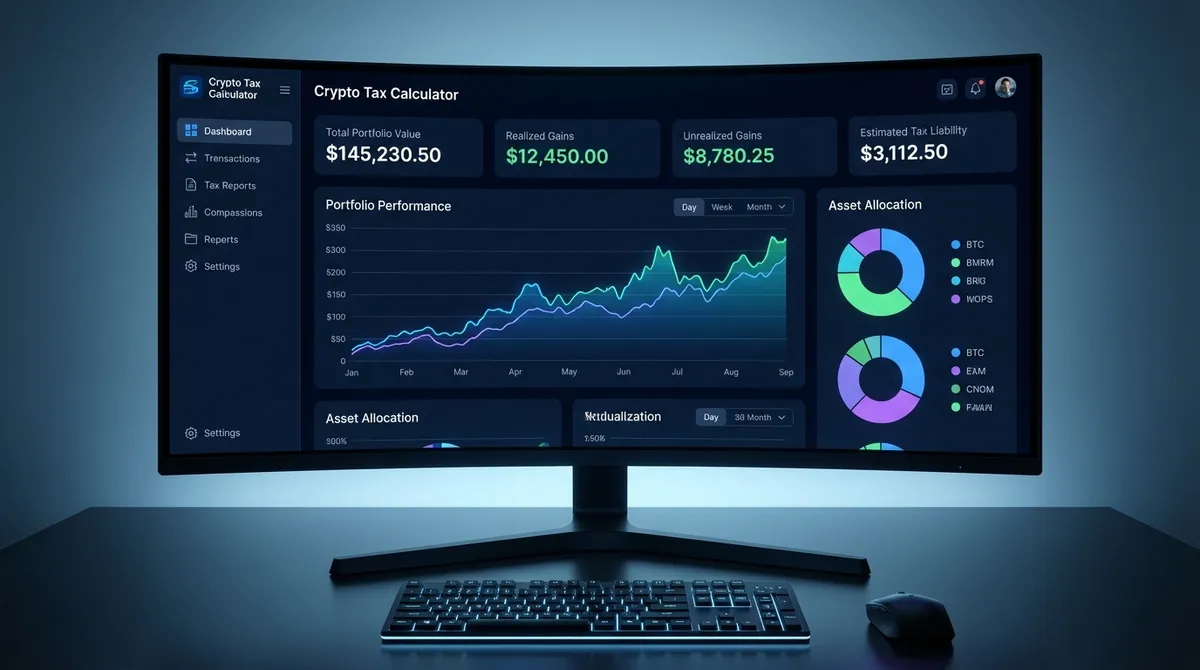
Navigating cryptocurrency taxes in the United States can feel like a maze. With the IRS intensifying its focus on digital assets in 2025 (including the new 1099-DA reporting form proposals), accuracy is more critical than ever. Whether you are a casual HODLer or an active day trader, every disposal of crypto—selling for cash, swapping for another token, or spending it—triggers a taxable event.
Our Crypto Tax Calculator helps you estimate your potential tax liability instantly. By inputting your trade details, you can see the difference between short-term and long-term capital gains, estimate the impact of the Net Investment Income Tax (NIIT), and even get a rough idea of state taxes.
How Crypto Taxes Work in 2025
In the eyes of the IRS, cryptocurrency is treated as property, not currency. This means the mechanics of calculating taxes are identical to buying and selling stock or real estate. However, unlike traditional brokerage accounts that automatically track cost basis, crypto traders often have to do it themselves.
The Capital Gains Formula
To calculate your liability, you need three numbers for every single transaction:
- Cost Basis: The original value + purchase fees.
(Example: You bought 1 ETH for $2,000 + $10 fee = $2,010 Basis) - Net Proceeds: The sale value - sell fees.
(Example: You sold 1 ETH for $3,000 - $15 fee = $2,985 Proceeds) - Capital Gain/Loss: Net Proceeds - Cost Basis.
($2,985 - $2,010 = $975 Gain) see Capital Gains Calc
Short-Term vs. Long-Term: The Time Factor
The single most important factor controlling your tax rate is holding period. Strategic holding can cut your tax bill in half.
| Type | Holding Period | Tax Rate (2025) |
|---|---|---|
| Short-Term | < 12 Months | Ordinary Income (10% - 37%) - check brackets |
| Long-Term | 12+ Months | Preferential (0%, 15%, or 20%) |
Strategy Tip: If you have held a coin for 11 months and are sitting on a profit, waiting just one more month to sell could save you significant money. For a user in the 32% tax bracket, shifting from Short-Term to Long-Term (15%) reduces the tax on a $10,000 gain from $3,200 to $1,500.
Accounting Methods: FIFO, LIFO, and HIFO
When you have multiple buys and sells of the same coin, how do you know which coin you sold? The IRS generally expects FIFO (First-In, First-Out) unless you can specifically identify the assets.
- FIFO (First-In, First-Out): Assumes you sold the oldest coins first. In a rising market, these usually have the lowest cost basis, leading to the highest tax bill.
- LIFO (Last-In, First-Out): Assumes you sold the newest coins first. If you bought recently at a high price, this results in a lower gain (or larger loss), reducing taxes.
- HIFO (Highest-In, First-Out): A tax minimization strategy where you specifically sell the coins with the highest cost basis first to minimize paper gains.
Note: To use LIFO or HIFO (Specific ID), you must keep detailed records showing exactly which "lots" (coins) were sold. If you cannot prove it, the IRS defaults to FIFO.
Advanced Scenarios: DeFi, NFTs, and Staking
Crypto taxation goes far beyond simple buy/sell trades. Here is how complex transactions are handled in 2025:
1. Crypto-to-Crypto Swaps
Trading BTC for ETH is a taxable event. You are technically selling BTC for its fair market value in USD and immediately buying ETH. You owe tax on the capital gain of the BTC at the moment of the swap.
2. Staking & Mining Rewards
Earning rewards from ETH staking or Bitcoin mining is taxed as Ordinary Income based on the fair market value at the time of receipt.
- Day 1: Receive 0.5 ETH reward ($1,000 value). Taxable Income = $1,000.
- Day 100: Sell 0.5 ETH for $1,200. Capital Gain = $200.
3. DeFi Lending & Liquidity Pools
Transactions involving Liquidity Provider (LP) tokens vary. In some cases, depositing into a pool is a "sale" of your tokens in exchange for LP tokens (taxable). Interest earned is income.
4. NFTs (Non-Fungible Tokens)
Buying an NFT with ETH is a taxable disposal of the ETH. Selling the NFT later for a profit is a capital gain. Note that some high-value NFTs might be classified as "collectibles," potentially subject to a higher 28% long-term capital gains rate (though guidance is evolving).
Tax Loss Harvesting 101
The crypto market is volatile. You can use crashes to your advantage through Tax Loss Harvesting. This involves selling an asset at a loss to offset your capital gains. Learn more with our Tax Deduction Calculator.
Example: You made $50,000 profit on Bitcoin but lost $20,000 on an Altcoin. By realizing the loss on the Altcoin (selling it), you reduce your net taxable profit to $30,000.
The Wash Sale Rule Loophole: As of early 2025, the "Wash Sale Rule" (which prevents stock traders from buying back the same asset within 30 days of selling for a loss) has not been explicitly applied to cryptocurrency by Congress, though it has been proposed repeatedly. This currently allows crypto traders to sell Bitcoin at a loss and immediately buy it back to reset their cost basis while maintaining their position. Proceed with caution—legislation can change retroactively.
Real-World Case Study: "The Active Trader"
Let's look at a full year for "Alex," a crypto investor in California (9.3% state tax rate) with $100,000 in other income (22% federal bracket).
Alex's Ledger
Tax Calculation
Effective Tax Rate: 28.8%
Do I Need Crypto Tax Software?
If you have more than 10-20 trades per year, doing taxes by hand is nearly impossible. Why? Because every single trade requires a cost basis calculation.
For example, if you bought 0.1 BTC five different times at different prices, and then sold 0.15 BTC, which specific fractions of which coins did you sell? A spreadsheet becomes unmanageable very quickly.
Benefits of using software:
- API Integration: Automatically syncs with exchanges like Coinbase, Binance, and Kraken.
- DeFi Support: Tracks complex transactions on Ethereum, Solana, and Polygon (staking, LP tokens, NFTs).
- Form 8949 Generation: Automatically fills out the IRS form you need to file.
- Audit Trail: Provides a record of every calculation if the IRS ever audits you.
Frequently Asked Questions
Common questions we receive about crypto taxation.
Do I owe tax if I lost money?
No, you generally do not owe taxes on capital losses. In fact, losses are beneficial—they offset your gains. If your net losses exceed your net gains, you can deduct up to $3,000 from your ordinary income tax return.
How does the IRS know my crypto trades?
Centralized exchanges (Coinbase, Kraken, Binance.US) are required to report activity to the IRS via forms like 1099-MISC (for staking) and eventually 1099-DA. The blockchain is also public; IRS tools can analyze on-chain activity.
What is the "Specific ID" method?
Specific Identification allows you to pick exactly which coin (e.g., "The Bitcoin I bought on Jan 3rd, 2023") you are selling. This requires detailed records but offers the most control over your tax outcomes compared to FIFO/LIFO.