Complete Guide: Current Ratio Calculator
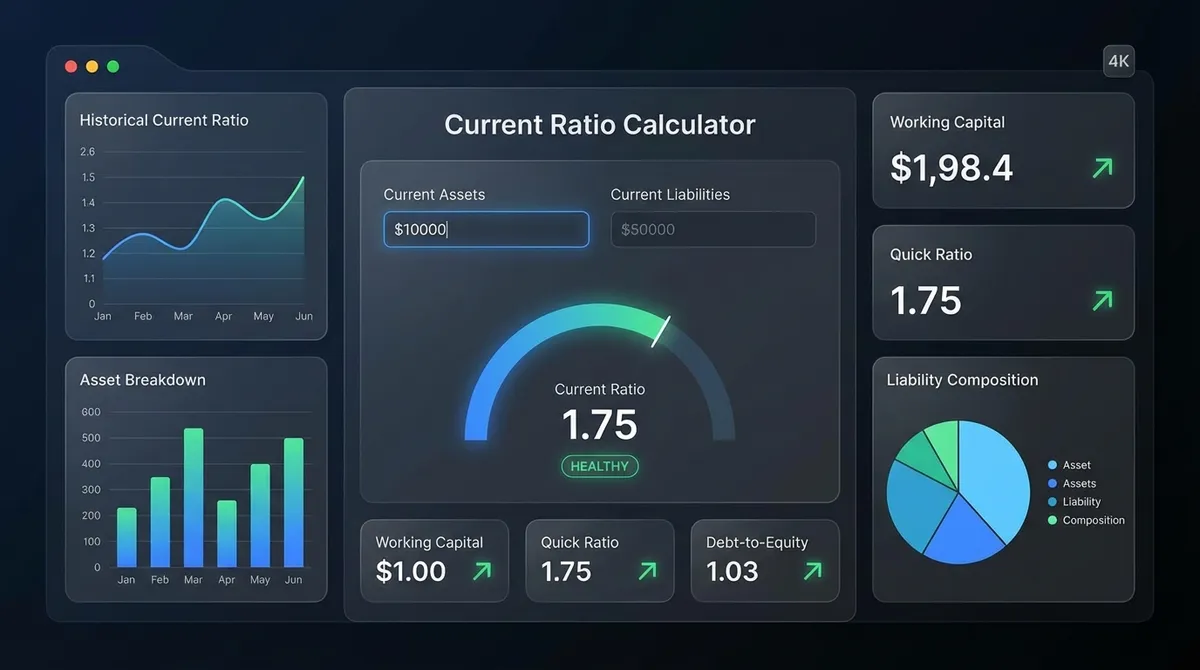
The current ratio is a core liquidity measure: it compares a company's current assets to its current liabilities to indicate whether near‑term obligations can be met without raising additional capital. This page goes beyond the formula with practical interpretation, industry context, and steps you can take to improve day‑to‑day liquidity.
Current Ratio Formula
Current Ratio = Current Assets ÷ Current Liabilities
Current assets normally include cash and cash equivalents, short‑term investments, accounts receivable (net of allowances), inventory, and prepaid/other current assets. Current liabilitiestypically include accounts payable, short‑term debt, accrued expenses, the current portion of long‑term debt, and deferred revenue or other current obligations.
Current Ratio vs Quick Ratio (Acid‑Test)
The quick ratio focuses on the most liquid assets and excludes inventory and prepaid items: (Cash + Short‑Term Investments + Accounts Receivable) ÷ Current Liabilities. Companies with heavy inventory can show a comfortable current ratio while their quick ratio reveals a tighter liquidity profile.
- Use both ratios together to see the impact of inventory and prepaid balances.
- Track the trend over multiple quarters; one snapshot can be misleading.
- Benchmark by industry; what's normal varies widely by sector.
What's a Good Current Ratio?
There is no universal "right" number. As a rule of thumb, many mature businesses target a range around 1.5–2.5. Asset‑light models (SaaS, consulting) can operate closer to 1.0, while inventory‑intensive models (retail, distribution, manufacturing) often require higher buffers due to the time needed to convert inventory into cash.
- Below 1.0: Negative working capital; potential liquidity stress unless the cash conversion cycle is extremely fast.
- 1.0–1.5: Tight but workable for asset‑light businesses with predictable cash inflows.
- 1.5–3.0: Generally healthy for many sectors; monitor mix of receivables vs inventory.
- Above 3.0: Liquidity is strong, but you may be holding idle assets or excess inventory.
Interpreting Your Results
Use the ratios together with working capital (Current Assets − Current Liabilities) and your cash conversion cycle (see Cash Flow Calc):
- Receivables: High receivables can inflate liquidity if collections are slow; monitor aging.
- Inventory: Large or slow‑moving inventory can raise the current ratio without improving cash.
- Payables and short‑term debt: Front‑loaded obligations can compress the ratio seasonally.
Common Pitfalls
- Window dressing: End‑of‑period actions (e.g., delaying purchases) can temporarily boost the ratio.
- Classification risks: Misclassifying long‑term items as current can overstate liquidity.
- Seasonality: Compare to the same quarter last year and view trailing averages.
- Quality of current assets: Not all receivables are equally collectible; watch allowances and write‑offs.
How to Improve Liquidity
- Accelerate collections: Tighten credit terms, send reminders, offer early‑payment discounts.
- Optimize inventory: Adopt demand‑driven planning, reduce SKUs, improve turnover.
- Manage payables: Negotiate longer terms where appropriate and avoid late‑payment penalties.
- Refinance short‑term obligations: Match debt maturities to asset lives; consider terming‑out lines of credit.
- Build cash buffers: Maintain sufficient reserves for seasonality and shocks.
Examples
Example 1 (Asset‑Light SaaS): Current assets = $175,000 (cash $90,000; short‑term investments $25,000; AR $60,000; inventory $0; prepaid $0). Current liabilities = $130,000 (AP $70,000; ST debt $5,000; accrued $18,000; current LTD $7,000; deferred revenue $30,000). Current ratio = 1.35; quick ratio = 1.31; working capital = $45,000. Interpretation: Tight but acceptable given rapid cash conversion and recurring revenue.
Example 2 (Inventory‑Heavy Retail): Current assets = $120,000 (cash $25,000; ST investments $2,000; AR $15,000; inventory $75,000; prepaid $3,000). Current liabilities = $89,000. Current ratio = 1.35; quick ratio = 0.47. Interpretation: Liquidity depends on inventory turnover; watch aging and markdown risk.
Example 3 (Manufacturing): Current assets = $226,000; current liabilities = $147,000. Current ratio = 1.54; quick ratio = ~0.68; working capital = $79,000. Interpretation: Reasonable cushion; improvement levers include inventory planning and receivables acceleration.
Methodology & Notes
- This tool performs all calculations locally in your browser. We don't store or transmit your data.
- Ratios are rounded to two decimals for readability.
- Industry benchmarks vary; use this tool with peer comparisons and multi‑period trends.
Limitations of the Current Ratio
While the current ratio is a quick and popular metric, relying on it in isolation can be dangerous. It has several distinct blind spots that every financial analyst and business owner should be aware of. Read more on Investopedia.
It Ignores Quality of Assets
A company with $1M in cash is far more liquid than a company with $1M in obsolete inventory, yet the current ratio treats both dollars equally.
It Ignores Timing
If your current assets are receivables due in 90 days, but your payables are due in 10 days, you might be technically solvent (ratio > 1) but actually bankrupt (cash < 0).
It Can Encourage Bad Behavior
Managers might delay paying suppliers at quarter-end to keep cash on the books, artificially inflating the ratio while damaging vendor relationships.
Current Ratio vs. Working Capital: What's the Difference?
They measure the same thing but express it differently.
Current Ratio
Assets ÷ Liabilities
An efficiency metric (percentage/ratio). It's great for comparing companies of different sizes. A small shop and a giant corporation can both have a 2.0 ratio.
Working Capital
Assets − Liabilities
A dollar value. It tells you exactly how much money you have left over to fund growth. You can't pay payroll with a ratio; you pay it with working capital.
Frequently Asked Questions (FAQ)
Can a current ratio be too high?
Yes. A ratio significantly above industry average (e.g., > 3.0 or 4.0) suggests inefficiency. It means the company is hoarding cash that could be invested in growth, or holding excessive inventory that might spoil or become obsolete. Shareholders often view an excessively high current ratio as a sign of lazy capital management.
Does a 2:1 current ratio guarantee safety?
Not necessarily. If the 2.0 ratio is driven by slow-paying customers (high Accounts Receivable) and unsellable inventory, the company could still face a cash crunch. Always look at the Quick Ratio and Cash Ratio for a stricter stress test.
How do seasons affect this ratio?
Retailers often see their current ratio dip in Q3 as they pile up debt to buy holiday inventory, then spike in Q4 as they sell that inventory for cash. Comparing a Q3 ratio to a Q4 ratio is often meaningless; always compare "Year-Over-Year" (e.g., Q3 2024 vs Q3 2025).
What is a "Negative" working capital cycle?
A negative cycle occurs when a company (like Amazon or Dell) gets paid by customers before it has to pay suppliers. These companies can safely operate with a current ratio below 1.0 because their operations generate cash automatically. This is rare and usually only found in dominant market leaders.
Strategic Ways to Optimize Your Ratio
- 1
Factor Receivables: Sell your unpaid invoices to a factoring company to get instant cash. This lowers AR and increases Cash, keeping assets same, but improves "Quick Ratio".
- 2
Extend Payables: Negotiation is key. If you can move from Net-30 to Net-60 with your biggest supplier, you keep cash in your bank for 30 more days, boosting your liquidity metrics.
- 3
Just-in-Time (JIT) Inventory: Reduce stock holding costs. By ordering only what you need, you reduce liabilities (less debt to buy stock) and risk of obsolescence.
- 4
Sweep Accounts: Use automated sweep accounts to pay down line-of-credit debt every night with excess cash. This reduces interest expense and lowers current liabilities.