Complete Guide: Understanding Customer Acquisition Cost (CAC) in 2025
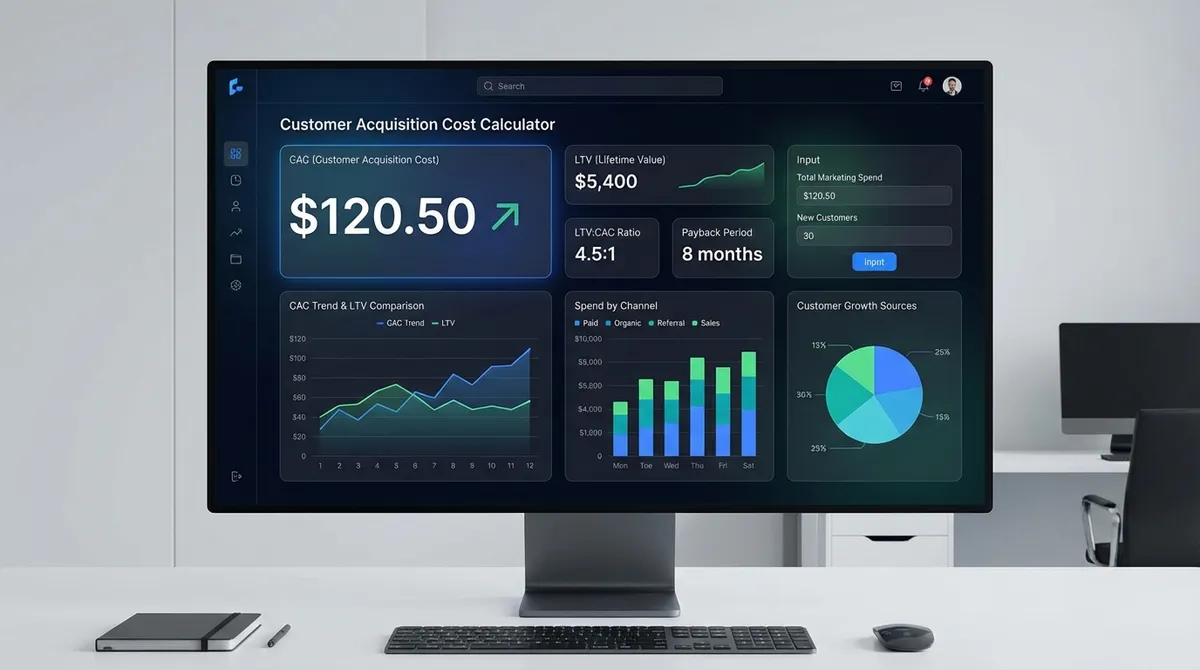
Customer Acquisition Cost (CAC) is arguably the most critical metric for any business seeking sustainable growth. It answers a simple yet brutal question: How much cash do you burn to win a single paying customer? In 2025, with capital becoming more expensive and digital channels more saturated, understanding your CAC isn't just an accounting exercise—it's a survival skill.
This guide goes beyond the basic formula. We'll explore the nuances of Paid vs. Blended CAC, how to calculate your "fully loaded" costs, and why the relationship between CAC, Payback Period, and Lifetime Value (LTV) determines whether your business is a rocket ship or a money pit.
What Is CAC and Why Does It Matter?
Customer Acquisition Cost represents the total sales and marketing spend required to acquire a new customer over a specific period. It is the definitive measure of your marketing efficiency and sales team productivity.
Investors and executives obsess over CAC because it dictates your company's capital requirements. A low CAC means you can grow efficiently with less funding. A high CAC (relative to customer value) suggests you're "buying growth" at an unsustainable price, often leading to cash flow crises.
The Core Formula
CAC = (Total Sales & Marketing Expenses) / (Number of New Customers Acquired)
Example: If you spend $10,000 on ads, $5,000 on sales commissions, and $5,000 on software to acquire 100 customers, your CAC is ($20,000 / 100) = $200 per customer.
Paid CAC vs. Blended CAC: Know the Difference
One of the most common mistakes founders make is confusing Paid CAC with Blended CAC. They serve different purposes, and mixing them up can lead to disastrous budget allocation.
Paid CAC
Calculates cost only for customers acquired through paid channels (Ads, Sponsorships).
- Formula: Total Ad Spend / New Paid Customers
- Use Case: Measuring channel efficiency (e.g., "Is Facebook Ads working?").
- Risk: Ignores organic growth and fixed team costs.
Blended CAC
Calculates the total cost for ALL customers, including organic, referral, and paid.
- Formula: Total S&M Spend / Total New Customers
- Use Case: Board meetings, fundraising, and overall business health.
- Risk: Can mask inefficient paid channels with strong organic traffic.
The "Fully Loaded" CAC Checklist
A dangerous trap is calculating CAC using only ad spend. To get a true picture of your unit economics, you must calculate Fully Loaded CAC. If you exclude salaries or tools, you are lying to yourself about your profitability.
Include These Costs:
Context is King: Payback and LTV:CAC
A $500 CAC is terrible if you're selling a $10 subscription. It's amazing if you're selling a $50,000 enterprise contract. You must view CAC in relation to how much money the customer brings in (LTV) and how fast they pay you back.
1. CAC Payback Period
How many months does it take to earn back the money spent acquiring the customer?
Payback Months = CAC / (Monthly ARPA × Gross Margin %)
- < 12 Months: Excellent (Cash efficient, invest more).
- 12–18 Months: Healthy (Standard for SaaS).
- > 24 Months: Risky (Cash flow strain likely).
2. LTV:CAC Ratio
For every $1 spent on marketing, how many dollars of gross profit do you get back?
LTV:CAC = Lifetime Value / CAC
- 3:1 Ratio: The Gold Standard. You spend $1 to make $3.
- 4:1 or Higher: You might be under-spending and growing too slowly.
- 1:1 or Lower: You are losing money on every customer.
LTV:CAC Benchmarks by Industry (2025 Data)
While 3:1 is the general rule, "good" varies significantly by business model and industry. Here are the benchmarks you should be aiming for:
| Industry / Model | Target LTV:CAC | Target Payback |
|---|---|---|
| SaaS (Enterprise) | 3:1 - 5:1 | 12-18 Months |
| SaaS (SMB/Prosumer) | 3:1 - 4:1 | 6-12 Months |
| E-Commerce (High Repeat) | 2:1 - 3:1 | Immediate - 3 Months |
| E-Commerce (One-off) | 1.5:1 - 2:1 | Immediate Profit |
| Consumer Mobile Apps | 3:1+ | 4-8 Months |
| Professional Services | 5:1+ | Immediate |
The Unit Economics Dashboard
To truly master your acquisition strategy, you need to track more than just the headline CAC number. Here are three advanced "health checks" to run quarterly:
Magic Number
Measures sales efficiency.
New ARR / S&M SpendTarget: > 1.0. (Spending $1 gets you $1+ in recurring revenue).
CAC Ratio
Cost per dollar of new revenue.
S&M Spend / New ARRTarget: < 1.0. (Spending less than $1 to acquire $1 of revenue).
Time to Recover
Adjusted for Gross Margin.
CAC / (MRR × GM%)Target: < 12 months. Faster recovery = faster reinvestment.
Real-World Scenario: "CloudSaaS Inc."
CloudSaaS Inc. spent $150,000 total on sales and marketing in Q1. This included ads, two sales reps, and software tools. They acquired 100 new customers.
1. Calculate CAC
$150,000 / 100 = $1,500 CAC
2. Customer Revenue
$100/mo ARPA (Average Revenue Per Account)
3. Gross Margin
80% (High margin software)
4. Gross Profit / Mo
$100 × 80% = $80/mo
The Verdict:
Payback Period: $1,500 / $80 = 18.75 months.
Analysis: This is on the higher side of "Healthy." It takes over 1.5 years to break even on a customer. CloudSaaS needs strong retention (low churn) to make this model work. If customers leave after 12 months, they lose money on every sale.
5 Ways to Reduce Your CAC in 2025
- 1
Improve Conversion Rates (CRO): Doubling your landing page conversion rate cuts your Paid CAC in half immediately. It's often cheaper to fix your funnel than to buy cheaper ads.
- 2
Leverage Product-Led Growth (PLG): Build virality into your product. Referral programs and "Powered By" loops create organic customers with near-zero acquisition cost.
- 3
Refine Your ICP (Ideal Customer Profile): Stop marketing to everyone. Narrowing your focus to high-intent audiences reduces wasted ad spend and shortens sales cycles.
- 4
Reactivate Lost Leads: Marketing to people who already know you (email nurture) is 5-10x cheaper than acquiring cold traffic.
- 5
Raise Prices: This doesn't lower CAC directly, but it improves your Payback Period and LTV:CAC ratio, making your current CAC sustainable.
Common Calculation Mistakes
The "Free" User Trap
Don't include free users in your "New Customers" denominator. Only paying customers count for CAC. Including free users artificially lowers your CAC and hides problems.
Time Lag Error
If your sales cycle is 3 months, the money you spend in January generates customers in April. Calculating January Spend / January Customers gives inaccurate results for long sales cycles.
Ignoring Retention
A low CAC is meaningless if 50% of customers churn in month 1. Always pair CAC analysis with Churn Rate analysis.
Inconsistent Overhead
Be consistent with what you include in "Overhead". If you include the VP of Sales' salary one month, you must include it every month to track trends accurately.
Frequently Asked Questions
How does Churn Rate impact my CAC targets?▼
Churn is the "leaky bucket" that makes CAC irrelevant. If your CAC is $100 and your customers pay $10/month but churn (see Churn Rate) after 5 months ($50 LTV), you are losing money on every sale. Lowering churn increases LTV, which allows you to afford a higher CAC while remaining profitable.
Does CAC include salaries?▼
Yes, for accurate accounting ("Fully Loaded CAC"), you must include the salaries of your sales and marketing teams. Excluding them ("Paid CAC") is useful for ad optimization but dangerously misleading for overall business health.
What is a good LTV:CAC ratio for early-stage startups?▼
In the very early stages, a 1:1 or 2:1 ratio is often acceptable as you experiment to find product-market fit. However, as you scale, investors will expect you to optimize towards the industry standard of 3:1 to verify sustainable growth.