Complete Guide: Debt Payoff Strategies for 2025
Debt freedom isn't just a financial goal—it's a lifestyle transformation. With consumer credit card debt hitting record highs and average APRs hovering near 23% in 2025, carrying a balance has never been more expensive.
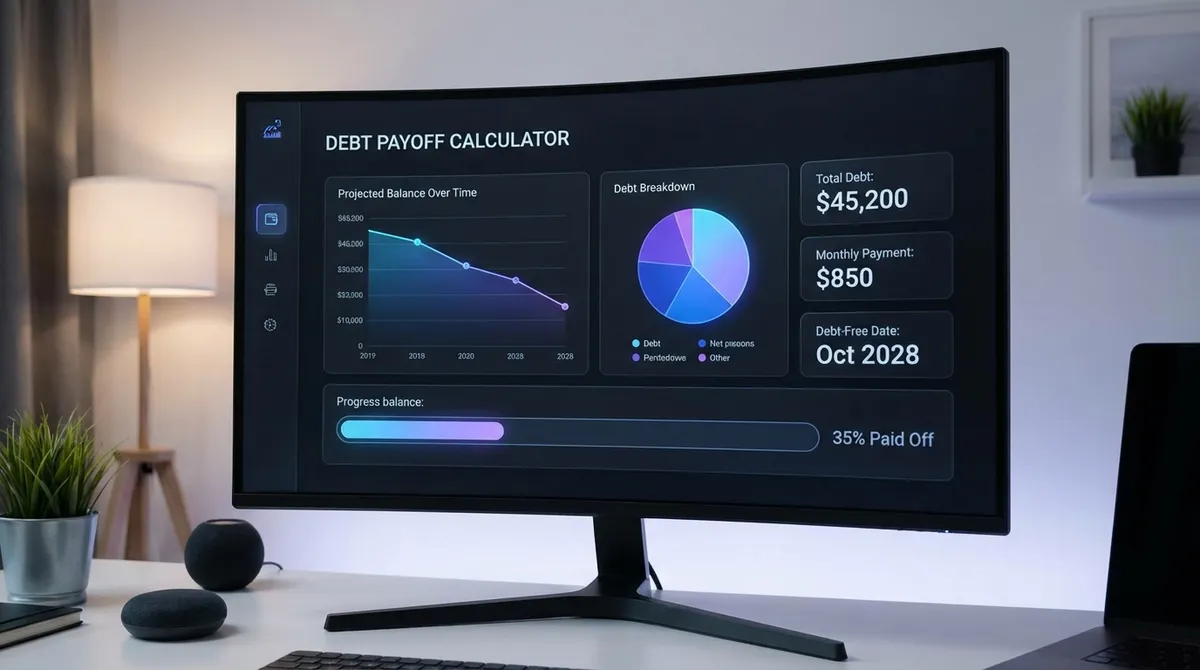
Our Debt Payoff Calculator is designed to be your strategic command center. Whether you're drowning in high-interest credit cards, student loans, or personal debts, this tool does the heavy mathematical lifting to show you exactly when you'll be free and how much you can save by tweaking your payment strategy.
Snowball vs. Avalanche: Which Wins?
The debate between Debt Snowball and Debt Avalanche is the most common question in personal finance. The truth? The "best" method is the one you actually stick to. Here is the breakdown:
❄️ Debt Snowball
Behavioral Approach
- Strategy: Ignore interest rates. Order debts from smallest balance to largest.
- Pros: Quick wins early on boost motivation. Eliminating entire accounts feels like progress.
- Cons: You pay more interest overall because high-rate debts linger longer.
- Best For: People who need motivation or have many small debts.
🏔️ Debt Avalanche
Mathematical Approach
- Strategy: Ignore balances. Order debts from highest interest rate to lowest.
- Pros: Mathematically optimal. You pay the absolute minimum amount of interest possible.
- Cons: It might take months or years to close your first account if the highest rate debt is large.
- Best For: Analytical people who hate wasting money on interest.
The Hidden Power of $50
Many people believe they need to find thousands of dollars to make a dent in their debt. This is false. Due to the way amortization works, even small extra payments early in the loan term can shave years off your payoff date.
Case Study: The $10,000 Credit Card Debt
*Based on 18% APR and typical minimum payment calculation (1% + interest).
Advanced Strategies for 2025
1. The Balance Transfer Hack
If you have excellent credit (740+), you might qualify for a 0% APR Balance Transfer Card. These cards allow you to move high-interest debt to a new card with 0% interest for 12–21 months.
2. Strategic Consolidation
Taking out a personal loan to pay off credit cards can make sense if the personal loan rate is significantly lower (e.g., 10% vs 24%). It also simplifies your life into one monthly payment. However, this only works if you stop using the credit cards immediately.
3. The "Bi-Weekly" Trick
Instead of paying monthly, split your payment in half and pay every two weeks. Since there are 52 weeks in a year, you'll end up making 26 half-payments—equivalent to 13 full monthly payments. That's one "free" extra payment every year without feeling the pinch.
Step 0: Negotiate Before You Pay
Before you start aggressively paying down debt, you can effectively lower your mountain by asking for help. It sounds intuitive, but a 15-minute phone call can save you hundreds of dollars.
The "Hardship Script"
"Hi, I've been a loyal customer for [X] years. I'm currently reviewing my finances and noticed my APR is 24%. I've received offers from competitors for 15%. I'd like to stay with you, but I need a lower rate to make that work. What can you do for me?"
- Success Rate: About 50-60% of customers get a reduction just by asking.
- The Drop: Average reduction is 5-10 percentage points.
- The Fallback: If they say no to a rate cut, ask if they have a temporary "hardship program" (often 0-5% APR for 6-12 months, but closes the card).
Beyond Binary: Hybrid Strategies
You don't have to strictly choose between Snowball and Avalanche. Many successful debt destroyers use a hybrid approach that balances math and motivation.
The "Cash Flow" Method
Target the debt with the highest monthly payment (relative to its balance). Paying this off frees up the most cash flow, which drastically increases the size of your shovel for the next debts.
The "Psychological Barrier" Method
Ignore the little debts and the interest rates. Attack the debt that stresses you out the most. Maybe it's a personal loan from a family member (guilt) or a medical bill that went to collections (fear). Removing the emotional weight can unblock your energy.
The Hidden Cost: Decision Fatigue
Living in debt causes chronic low-level stress. It creates "decision fatigue"—when your brain is so tired from worrying about money that you make bad choices in other areas (diet, work, relationships).
Your Action Plan: Automate everything. Set your bills to auto-pay the minimums. Set your extra payment to auto-transfer on payday. The less you have to think about debt, the more likely you are to pay it off.
3 Mistakes That Kill Progress
- 1Closing old accounts too early: Closing paid-off credit cards can hurt your credit score by reducing your available credit and average account age. Keep them open with a $0 balance unless they have annual fees.
- 2Using the "Emergency" Card: If you don't have a small cash emergency fund ($1,000), your first flat tire will go right back on the credit card. Build a mini-emergency fund before aggressively attacking debt.
- 3Lifestyle Creep: As you pay off debt, you free up cash flow. It is tempting to spend that money. Instead, commit 100% of freed-up cash to the next debt (the Snowball effect) or to investments once you are debt-free.
Digital Weapons: Apps & Tools
You don't have to track this on a napkin. In 2025, automation is your best friend.
Budgeting Apps
Tools like YNAB (You Need A Budget) or Monarch Money connect to your bank accounts and force you to "give every dollar a job." This prevents the "leakage" that usually kills debt payoff plans.
Undebt.it
A specialized tool dedicated solely to payoff planning. It allows you to toggle between Snowball, Avalanche, and hybrid plans to see the exact date you will be free.
You Can't Pay Off Debt Without a Budget
A debt payoff plan without a budget is just a wish. To find the "extra" money to throw at your loans, you need to squeeze your spending mechanics.
Zero-Based Budgeting
Income minus Expenses equals Zero. Every single dollar is assigned to a category (Rent, Food, Debt). If you have $500 left over, you don't leave it in checking; you assign it to "Debt Payment." (See CFPB Budgeting Guide).
The "Cash Envelope" System
For danger zones like groceries and dining out, withdraw cash. When the envelope is empty, you stop spending. It is painful but highly effective for breaking credit card habits.
Remember: A budget isn't a constraint; it's a permission slip to spend money on what actually matters to you (like your freedom).
Expert Tip
"The math says Avalanche is better, but human psychology says Snowball is better. If you are the type of person who needs to see results to stay motivated, ignore the math and choose Snowball. Paying an extra $200 in interest over 3 years is a small price to pay for actually finishing the race."