Complete Guide: Understanding and Using Effective Interest Rates (2025)
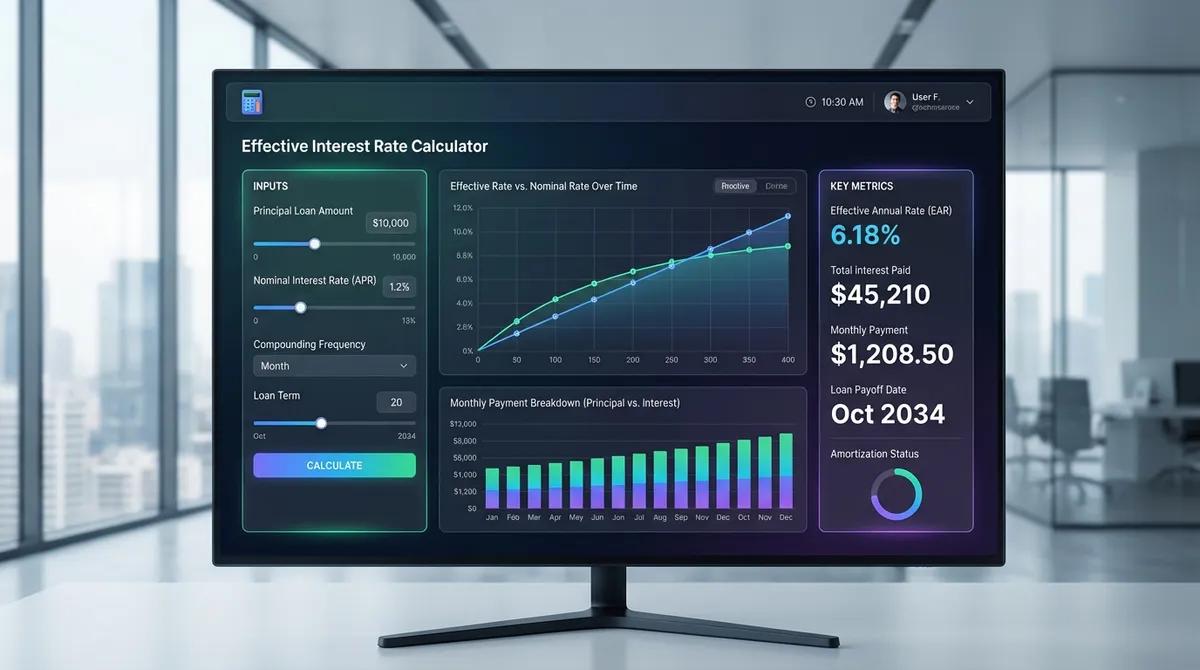
Understanding effective interest rates is crucial for making informed financial decisions in 2025. Whether you're shopping for a high-yield savings account, comparing credit card offers, or evaluating loan options, knowing the true cost or return on your money can save you thousands of dollars over time.
What is an Effective Interest Rate and Why Does It Matter?
The effective interest rate (EIR) represents the actual annual return on an investment or the true cost of borrowing after accounting for compounding. Unlike the nominal or stated rate that financial institutions advertise, EIR reveals how often interest is calculated and added to your balance—a detail that significantly impacts your money.
Consider this real-world scenario: You're comparing two savings accounts advertising 5% interest. Account A compounds daily, while Account B compounds monthly. Most people assume they're equivalent, but Account A actually yields 5.1267% annually, while Account B yields 5.1162%. On a $50,000 deposit over 10 years, that's an extra $525 in your pocket just from understanding compounding frequency—and that's at today's 2025 interest rates.
How Effective Interest Rates Work: The Mathematical Foundation
The effective interest rate formula is straightforward yet powerful: EIR = (1 + r/m)^m - 1, where 'r' represents the nominal annual rate as a decimal, and 'm' equals the number of compounding periods per year.
Let's break this down with a concrete example. If you have a credit card with a 24.99% APR compounded daily (365 times per year), your effective annual rate jumps to 28.38%. This means that $10,000 in credit card debt would grow to $12,838 over one year—even without making additional purchases. Understanding this calculation helps explain why high-interest debt, especially credit cards with daily compounding, can spiral out of control so quickly. For deeper insights, see Investopedia's guide to Effective Annual Interest Rate.
Factors That Drive Effective Interest Rate Calculations
Several key elements determine your effective interest rate, and understanding each helps you make smarter financial choices in 2025's competitive banking environment.
Compounding Frequency:
The most significant factor impacting EIR. Daily compounding yields higher effective rates than monthly or quarterly compounding, creating a substantial difference over time. As of November 2025, top high-yield savings accounts compound daily, which is why their 4.0-4.5% APY rates significantly outpace traditional savings accounts.
Nominal Rate:
Your starting point matters. A 3% rate compounded daily won't beat a 4% rate compounded monthly, even with more frequent compounding. The base rate establishes the foundation upon which compounding builds returns.
Time Horizon:
The longer your money compounds, the more dramatic the effective rate impact becomes. This demonstrates why starting early, even with smaller amounts, creates such powerful wealth-building effects.
APR vs. APY vs. Effective Interest Rate: Clearing the Confusion
Financial institutions use different terminology that often confuses consumers. Here's the definitive breakdown for 2025:
APR (Annual Percentage Rate):
The nominal rate without compounding. Lenders must disclose APR by law, but it's the stated rate that doesn't account for compounding frequency. Credit cards, personal loans, and mortgages typically advertise APR.
APY (Annual Percentage Yield):
The effective rate specifically for deposit accounts. Banks must disclose APY for savings accounts, CDs, and money market accounts. APY is always higher than the stated rate when compounding occurs more than annually.
Effective Interest Rate (EIR):
The general term for actual rate after compounding, applicable to both loans and investments. EIR provides the most accurate comparison between different financial products.
The Great Deception: APR vs. Effective Rate
Why do banks advertise APR for loans but APY for savings? It's simple psychology (and marketing). They want loan rates to look lower and savings rates to look higher. Here is the math they don't show you on billboards:
| Financial Product | Advertised Rate | Compounding | Real Cost (Effective Rate) |
|---|---|---|---|
| Credit Card | 24.99% APR | Daily | 28.38% |
| Payday Loan | 400% APR | Weekly | 2,260% |
| Mortgage | 7.00% APR | Monthly | 7.23% |
| Savings | 5.00% APY | Daily | 5.00% (Already Effective) |
Compounding Frequency: The Silent Wealth Accelerator
How much difference does frequency really make? Let's take a $100,000 investment at 8% nominal interest over 20 years to see the "Frequency Bonus":
Annual
Monthly
Daily
Real-World Examples: Effective Interest Rates for 2025 Financial Products
Let's examine actual rates you'll encounter in today's market:
High-Yield Savings Accounts:
As of November 2025, top accounts offer 4.21% APY with daily compounding. The nominal rate is approximately 4.13%, but daily compounding pushes the effective yield to 4.21%. On a $25,000 emergency fund, that's $1,053 in annual interest versus $1,033 with monthly compounding.
Certificates of Deposit (CDs):
A 5-year CD at 4.50% APY typically compounds quarterly. The nominal rate of 4.42% becomes 4.50% effective after quarterly compounding. This guaranteed rate provides certainty in 2025's fluctuating rate environment.
Credit Cards:
With average APRs of 24.99% compounded daily, the effective rate reaches 28.38%. This explains why a $5,000 balance can grow to $8,200+ over three years with minimum payments.
Mortgages:
A 30-year fixed mortgage at 6.75% APR with monthly compounding has an effective rate of 6.96%. While mortgages typically don't advertise EIR, understanding it helps when comparing to other debt consolidation options.
Advanced Strategies for Maximizing Effective Interest Rates
Smart savers and borrowers use several strategies to optimize effective rates:
For Savers:
Prioritize daily compounding accounts with competitive base rates. Online banks typically offer better rates than traditional brick-and-mortar institutions. Consider splitting funds: short-term money in high-yield savings, long-term funds in CDs or Series I Bonds for inflation protection.
For Borrowers:
Avoid daily compounding debt like credit cards when possible. Personal loans with monthly compounding often have lower effective rates despite higher nominal APRs. Consolidate high-interest credit card debt to lower-rate personal loans to reduce compounding frequency impact.
For Investors:
Compare investment returns using effective annual rates. A dividend stock with 8% yield (simple) versus a bond fund with 7.5% compounded monthly—the bond fund may actually provide higher effective returns when reinvested.
Common Mistakes That Cost You Money
Avoid these costly errors when evaluating interest rates:
Mistake 1: Comparing nominal rates instead of effective rates.
A 4.5% APR mortgage with monthly compounding costs more than a 4.6% APR with annual compounding over the loan term.
Mistake 2: Ignoring compounding frequency on short-term debt.
Credit cards compound daily, dramatically increasing costs. That "24.99% APR" actually costs 28.38% annually.
Mistake 3: Not recalculating when rates change.
Variable-rate products adjust regularly. Recalculate EIR whenever your rate changes to maintain accurate financial planning.
Mistake 4: Confusing APR with APY.
Banks advertise APY for deposits (higher effective rate) but APR for loans (lower nominal rate). Always compare like terms.
Key Takeaways for Mastering Effective Interest Rates
Effective interest rate calculations separate financially savvy consumers from those leaving money on the table. Remember these essential points:
Always compare effective rates, not nominal rates, when evaluating financial products. Daily compounding maximizes returns on savings but also maximizes costs on debt. The difference between nominal and effective rates grows with higher rates and longer time periods. Banks legally disclose APY for deposits—this is the effective rate that matters for comparison shopping.
Understanding effective interest rates empowers you to make informed decisions about where to keep your emergency fund, which credit card to pay off first, whether to refinance your mortgage, and how to evaluate investment opportunities. In 2025's competitive financial landscape, even small rate differences compound into significant amounts over time.
Pro Tip: Always Ask for APY
When shopping for savings accounts or CDs, always ask for the APY—not the nominal rate. APY is the effective rate that shows your actual annual return, making it easier to compare different products accurately. Ideally, look for institutions that compound daily rather than monthly to squeeze every penny of interest from your hard-earned savings.
Last updated: November 14, 2025 | Category: Banking & Savings | Estimated reading time: 12-15 minutes