First-Time Home Buyer Guide: Mastering Affordability in 2025
Buying your first home is exciting, but let's be real: the 2025 housing market is a challenging landscape. With interest rates hovering between 6% and 7% and home prices stabilizing at historically high levels, the margin for error is slim. The "standard" advice of just checking a monthly payment calculator isn't enough anymore. You need to understand your Debt-to-Income (DTI) ratio, the hidden impact of PMI, and the true "Cash to Close" needed to get the keys.
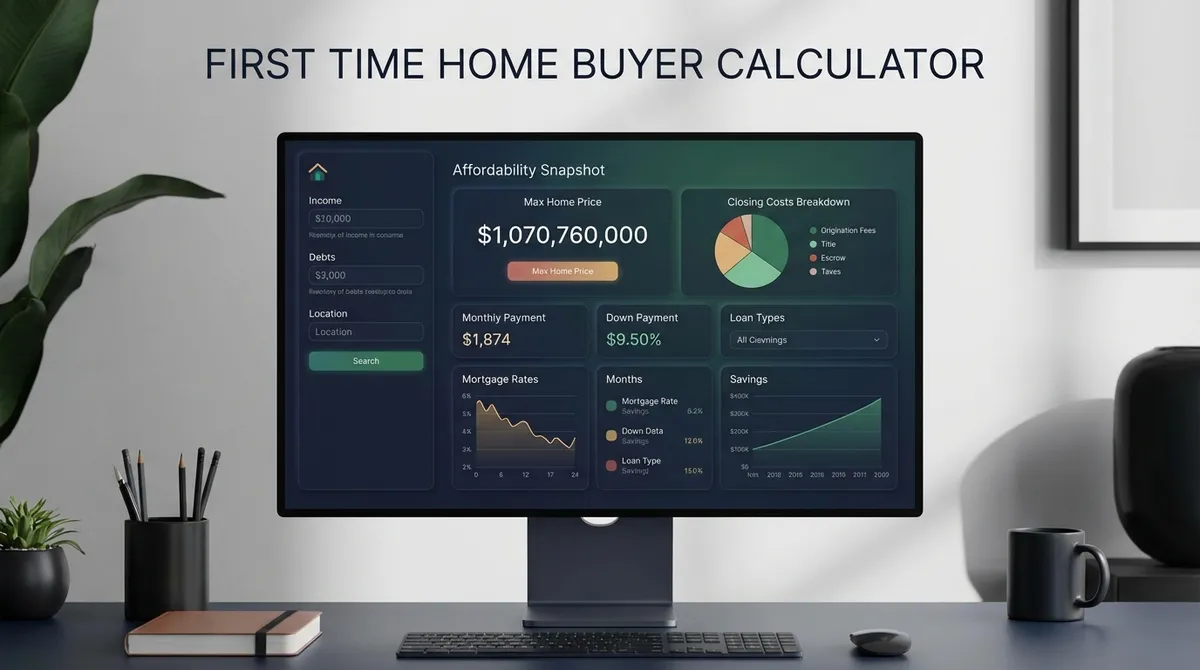
Our First Time Home Buyer Calculator goes beyond simple math. It replicates the underwriting standards banks use to approve loans, helping you answer the two most critical questions: "Can I get the loan?" and "Can I actually afford the life that comes with it?"
The 2025 Reality Check: The median first-time buyer down payment is now 8%, not 20%. While this makes buying more accessible, it introduces monthly PMI costs and higher leverage. Success in this market means balancing a lower down payment with a strict monthly budget—something this tool is specifically designed to help you visualize.
The "Secret" Formula Lenders Use: The 28/36 Rule
Before you fall in love with a kitchen island, you need to know if a bank will back you. Most qualified mortgages adhere to the 28/36 Rule, a standard that protects both you and the lender.
28Front-End Ratio
Your housing costs (Principal, Interest, Taxes, Insurance, PMI) should not exceed 28% of your gross monthly income.
36Back-End Ratio
Your total debt (Housing + Student Loans + Credit Cards + Car Payments) should not exceed 36% of your gross monthly income.
Pro Tip: While some FHA loans allow DTI ratios up to 43% or even 50%, stretching your budget that thin leaves zero room for home repairs. Use a debt-to-income ratio calculator to be sure you are safe. Stick to the 36% limit for a stress-free financial life. For more guidance, check out the CFPB's roadmap to owning a home.
Breaking Down Your "PITI" Payment
Your mortgage check is split into four (sometimes five) buckets. Understanding "PITI" prevents sticker shock when you see the final bill.
Principal & Interest (P&I)
The core of your loan. In the early years of a 30-year mortgage, ~80% of this payment goes purely to interest, with very little paying down the actual debt.
Property Taxes
Paid to your local government. These can range from 0.3% (Hawaii) to over 2.2% (New Jersey) of your home's value every year. This is often an "Escrow" item added to your monthly bill.
Homeowners Insurance
Protects against fire, theft, and liability. In 2025, insurance rates are rising in many states, so budget $100-$200/month as a baseline.
Private Mortgage Insurance (PMI)
The "low down payment fee." If you put down less than 20%, lenders charge this insurance to protect them (not you) in case of default. It typically costs 0.5% - 1.0% of the loan amount annually.
Strategic Tips for 2025 Buyers
1. The "Date the Rate" Strategy: If rates are high (6%+), focus on buying a home you can afford now. If rates drop later, you can refinance to lower your payment. Use our rent vs buy calculator to see if buying makes sense today.
2. Ask for Seller Concessions: In the current market, sellers are often willing to pay for a "2-1 Buydown" (temporarily lowering your rate) or covering your closing costs. This keeps cash in your pocket for renovations.
3. Don't Forget "Cash to Close": Your down payment is only part of the upfront cost. You also need 2-5% of the purchase price for Closing Costs. on a $400k home, that's an extra $8,000 - $20,000 you must have ready in the bank.
The "Silent" Budget Killers
Renters are used to calling the landlord when a pipe bursts. As an owner, you are the landlord. A common mistake is budgeting tightly for the mortgage and forgetting the variable costs of ownership.
Maintenance Reserve (1-2% Rule)
Budget 1% to 2% of your home's value annually for maintenance. On a $400k home, that is $4,000 to $8,000 a year ($333 - $666/mo). This covers HVAC service, roof patches, painting, and appliance replacement. If you don't spend it one year, save it—you will need it for the big items eventually.
The "Supplemental" Tax Bill
In many counties, the property tax bill is reassessed upon sale. If you buy a house from someone who lived there for 20 years, their tax bill might be low. Yours will be reset to the current market value. Expect a "Supplemental Tax Bill" in the mail about 6 months after closing catching you up on the difference.
Closing Costs Breakdown
You need cash beyond the down payment. Typical closing costs in 2025 include:
- Origination Fee: 0.5% - 1% of loan amount.
- Appraisal: $500 - $800.
- Title Insurance: $1,000 - $2,500 (protects your ownership rights).
- Prepaids: You must pre-pay 3-12 months of insurance and property taxes into an escrow account.
Free Money? Understanding Grants
States and local governments want you to buy a home. They offers Down Payment Assistance (DPA) programs, often in the form of grants (never repaid) or 0% interest second mortgages (repaid only when you sell).
National Programs
- Fannie Mae HomeReady: Low down payment (3%) and reduced rates for lower-income areas.
- Freddie Mac Home Possible: Similar 3% down option with flexible credit requirements.
- Good Neighbor Next Door: Specifically for teachers, police, and EMTs—offering 50% off list price in revitalization areas (very rare, but real).
State-Specific DPA
Almost every state Housing Finance Agency (HFA) offers assistance.
- CalHFA (California): Offers deferred loans for down payment.
- SONYMA (New York): Offers low-interest loans + DPA.
- Florida Hometown Heroes: Originally for essential workers, now expanded to all first-time buyers employed by Florida-based businesses (5% assistance).
How Your Credit Score Changes the Price
A 740 credit score vs. a 640 credit score doesn't just mean getting approved or denied. It changes how much you pay every month for 30 years.
| Credit Score | APR Impact | Monthly Cost (on $400k) | Lifetime Cost |
|---|---|---|---|
| 760+ (Excellent) | Baseline (Lowest) | $2,398 | Baseline |
| 700-759 (Good) | +0.25% | $2,464 (+$66/mo) | +$23,760 |
| 640-699 (Fair) | +0.75% | $2,597 (+$199/mo) | +$71,640 |
| 620-639 (Min) | +1.50% | $2,805 (+$407/mo) | +$146,520 |
*Hypothetical scenario based on typical Conventional loan level price adjustments (LLPAs).
Which Loan Is Right for You?
Not all mortgages are created equal. Choosing the right program can save you thousands in down payments and interest.
Conventional Loan
Best for: Good Credit (680+)
The standard mortgage. Requires as little as 3% down for first-time buyers. PMI drops off automatically once you reach 20% equity.
FHA Loan
Best for: Lower Credit (580+)
Backed by the government. requires 3.5% down. The catch? You pay a "Mortgage Insurance Premium" (MIP). Use our FHA loan calculator to see the numbers.
VA Loan
Best for: Veterans & Active Duty
The gold standard. 0% down payment, no PMI. Check your eligibility with our VA loan calculator.
USDA Loan
Best for: Rural Buyers
0% down payment for homes in designated "rural" areas (which often includes suburban outskirts). Income limits apply.
The Road to Keys: A 30-Day Timeline
- 1
Offer Accepted
You send your Earnest Money Deposit (usually 1% of price) to escrow.
- 2
Inspection Period (Days 1-10)
You hire a pro to check the roof, foundation, and systems. If they find issues, you ask for repairs or credits.
- 3
Appraisal & Underwriting (Days 10-25)
The bank confirms the home is worth the price. The underwriter asks for updated bank statements.
- 4
Closing Day (Day 30)
You wire your Down Payment + Closing Costs. You sign a mountain of paperwork. You get the keys!
Frequently Asked Questions
Can I use "Gift Funds" for my down payment?▼
Yes! Most loan types allow family members to "gift" you money for the down payment. However, it must be a true gift, not a loan. The donor will need to sign a "Gift Letter" stating that repayment is not expected.
What credit score do I need?▼
It depends on the loan. FHA loans accept scores as low as 580 (with 3.5% down). Conventional loans typically want 620+. However, the best interest rates are reserved for buyers with scores of 740 or higher.
Pre-Qualification vs Pre-Approval: What's the difference?▼
Pre-qualification is a quick estimate based on what you tell the lender. It holds little weight. Pre-approval means the lender has actually verified your pay stubs, W-2s, and credit report. You need a Pre-Approval Letter to make a serious offer on a house.