Complete Guide: Florida Income Tax Calculator 2025: Estimate Your Take-Home Pay
Understanding Your Florida Tax Advantage in 2025
One of the biggest financial perks of living in the Sunshine State is its tax-friendly environment. Florida is one of only nine states with zero state income tax. This means that unlike residents of New York or California, who may surrender 5% to 13% of their paycheck to the state, you keep that money in your pocket.
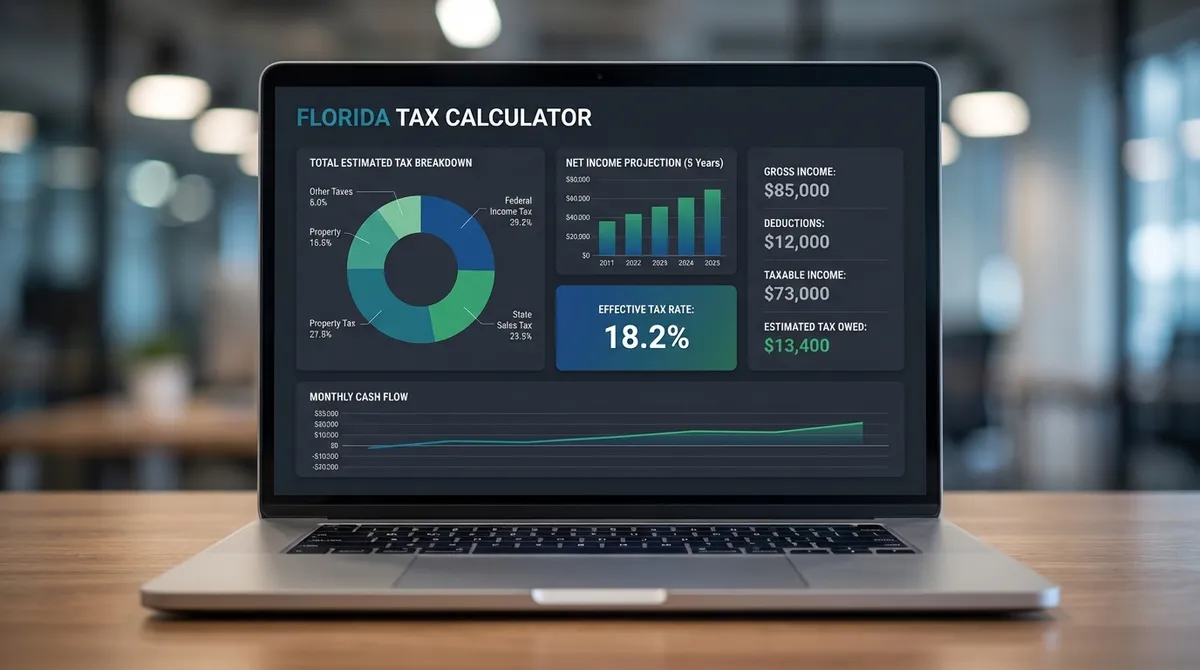
However, "tax-free" doesn't mean "cost-free." While you won't file a state return, you are still responsible for Federal Income Tax and FICA taxes (Social Security and Medicare). Our calculator above specifically breaks down these federal obligations so you can see your true "take-home" pay.
What Taxes DO You Pay in Florida?
- Federal Income Tax: Paid to the IRS based on progressive tax brackets (10% to 37%).
- FICA Taxes: A flat 7.65% for most earners (6.2% Social Security + 1.45% Medicare).
- Sales Tax: Florida has a statewide sales tax of 6.0%, with local counties adding up to 1.5% more.
- Property Tax: If you own a home, you will pay county property tax, though the Homestead Exemption can significantly lower this bill for primary residents.
How the 2025 Tax Brackets Affect You
The IRS adjusts tax brackets annually for inflation. For the 2025 tax year, the Standard Deduction has increased to approximately $15,000 for single filers and $30,000 for married couples filing jointly.
This is crucial because you only pay federal income tax on your Taxable Income, which is your Gross Income minus the Standard Deduction (or itemized deductions).
Example Calculation:
If you earn $50,000 as a single filer:
1. Subtract Standard Deduction ($15,000) = $35,000 Taxable Income.
2. You pay 10% on the first ~$11,925 and 12% on the remaining ~$23,075.
3. Your effective federal tax rate is much lower than the 12% marginal bracket suggests.
Florida vs. High-Tax States: A Real Comparison
How much do you actually save by moving to Florida? Let's look at a realistic scenario for a remote tech worker earning $100,000 annually.
| Location | State Tax Bill | 10-Year Savings |
|---|---|---|
| Florida | $0 | $0 |
| New York (City) | ~$9,500 | ~$95,000 |
| California | ~$6,300 | ~$63,000 |
*Estimates based on typical state and local income tax rates for a single filer.
Maximizing Your Savings in Florida
Just because you don't pay state income tax doesn't mean you can ignore tax planning. Here are three strategies for Florida residents:
1. The "Homestead Exemption" Is Mandatory
If you buy a home in Florida and make it your primary residence by January 1st, you must file for the Homestead Exemption by March 1st. This deducts up to $50,000 from your home's assessed value for property tax purposes and, more importantly, caps annual assessment increases at 3% (the "Save Our Homes" cap). This protection is invaluable in Florida's rapidly appreciating real estate market.
Important: You must own the home on **January 1st** to qualify for that tax year. If you bought in July 2024, your first exemption year will be 2025 (filed by March 1, 2025).
3. Estate Planning Perks
Florida has some of the most protective laws for assets. The state has no inheritance tax and no estate tax (beyond the federal level). Additionally, Florida's constitutional homestead protection makes it extremely difficult for creditors to force the sale of your primary home to pay debts, adding a layer of asset protection that few other states offer.
Deep Dive: Florida Sales Tax
While you don't pay income tax, you do pay consumption tax. The state sales tax rate is **6.0%**. However, most counties add a discretionary sales surtax, bringing the total to usually between 6.5% and 7.5%.
- Vehicles & Boats
- Electronics & Furniture
- Commercial Rent (decreased to 2.0% state rate)
- Prepared Food (Restaurants)
- Most Groceries (uncooked)
- Prescription Medicine
- Residential Rent (longer than 6 months)
- Medical Services
Florida Sales Tax Holidays
One way residents save money is by taking advantage of Florida's frequent sales tax holidays. The state legislature typically approves tax-free periods for:
- Disaster Preparedness: Tax-free batteries, flashlights, generators, and radios (usually in June and August).
- Back-to-School: Tax-free clothing, backpacks, and school supplies (usually late July).
- Freedom Month: Tax-free admission to events, museums, and outdoor supplies (usually July).
Frequently Asked Questions
Does Florida tax 401(k) or pension withdrawals?▼
No. Florida does not tax any retirement income, including 401(k), IRA, or pension distributions. You will still owe federal taxes on these withdrawals (unless it's a Roth account), but the state takes nothing.
Is Social Security taxed in Florida?▼
No. Social Security benefits are completely tax-free at the state level in Florida. Combined with the lack of tax on other retirement income, this makes Florida one of the premier retirement destinations globally.
Do I have to file a tax return in Florida?▼
For individuals, no. There is no personal income tax return to file in Florida (Form DR-405 is for tangible personal property tax for businesses, not individuals). You only file your Federal 1040. For state tax questions, visit the Florida Dept of Revenue.
What is the Intangible Personal Property Tax?▼
This tax was repealed for individuals in 2007. You no longer pay state tax on the value of stocks, bonds, or mutual funds you own on January 1st. It remains a historic footnote that occasionally confuses new residents.
Are capital gains taxed in Florida?▼
No. Florida has no capital gains tax. If you sell a business, stock, or investment property, you only owe federal capital gains tax (0%, 15%, or 20%). This 0% state rate is a massive advantage compared to California (which can tax gains up to 13.3%) or New York.
Beyond Income Tax: Other Florida Taxes to Know
While the lack of personal income tax grabs the headlines, Florida funds its budget through other means. Understanding these can help you avoid surprises, especially if you run a business or invest in real estate.
1. Florida Corporate Income Tax
If you own a "C Corporation" or an LLC that has elected to be taxed as a corporation, you will face the Florida Corporate Income tax. The rate is currently 5.5%. However, there is a generous exemption: the first $50,000 of corporate income is exempt from tax.
Note: Most small businesses are "pass-through" entities (Sole Proprietorships, S-Corps, Standard LLCs). For these owners, business profit flows to their personal return, meaning they pay $0 state income tax on those business earnings.
2. Documentary Stamp Tax
This is essentially a transaction tax on documents that transfer interest in Florida real estate (Deeds) or written obligations to pay money (Mortgages/Notes).
- Deeds: 70 cents per $100 of value (except Miami-Dade county, which has a specific rate structure). On a $500,000 home, this is $3,500.
- Mortgages: 35 cents per $100 of the amount financed. On a $400,000 mortgage, this is $1,400.
3. Tourist Development Tax
Thinking of running an Airbnb or VRBO? Be aware of the "Bed Tax." Counties levy a tax on short-term rentals (less than 6 months), typically ranging from 3% to 6%, on top of the standard sales tax. This is strictly enforced in tourist hotspots like Orlando and Miami.
Cost of Living Comparisons
A tax break loses its luster if the cost of housing or insurance eats up the savings. Here is how Florida stacks up in 2025:
| Category | Florida Impact | Trend |
|---|---|---|
| Auto Insurance | Highest in the nation (avg. ~$3,400/yr) due to "No-Fault" laws and weather risks. | Rising |
| Home Insurance | 3x-4x national average. Coastal areas often require separate flood policies. | Critical |
| Utilities | High A/C usage drives electricity bills up, but rates are moderate. | Stable |
| Services | Generally lower labor costs for contractors and services compared to Northeast. | Good Value |