Why Future Value Is the Most Important Number in Your Financial Plan
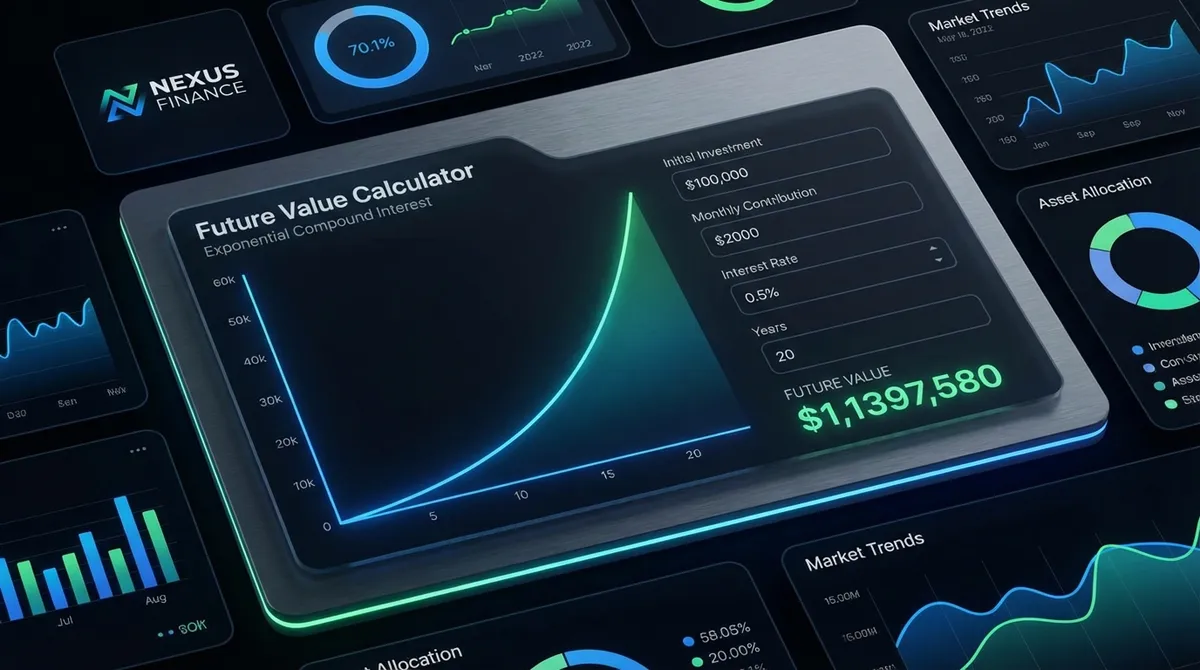
If you've ever wondered, "How much will my savings be worth in 20 years?" or "Am I saving enough for retirement?", you're asking about Future Value (FV). It's the financial concept that connects your money today with your goals for tomorrow. Unlike simple savings, future value accounts for the explosive power of compound interest—money earning money on itself.
In 2025, understanding future value is more critical than ever. With inflation averaging 3% and market returns fluctuating, simply "saving money" isn't enough. You need to know how your capital grows. Whether you're building a nest egg, saving for a child's education, or planning a major purchase, this calculator gives you the foresight to make smarter decisions today.
The Power of Time: A 25-year-old investing $500/month at 8% will have $1.7 million by age 65. Waiting just 10 years to start cuts that final number by more than half, to just $750,000. Time, not just money, is your greatest asset. It is the exponent in the growth equation.
How It Works: The Future Value Formula Simplified
You don't need a PhD in math to understand future value, but knowing the mechanics helps you pull the right levers. There are two main scenarios:
Lump Sum Growth
Best for one-time investments like an inheritance or bonus.
With Regular Contributions
Best for Roth IRAs, 401(k)s, and monthly savings goals.
Key Variables You Control:
- PVPresent Value:
Your starting amount. The more you start with, the heavier the "snowball" of interest is from day one.
- rInterest Rate:
Your annual return. Small differences here are massive over time. 6% vs 8% over 30 years can mean a difference of hundreds of thousands of dollars.
- nTime Periods:
How long the money grows. This is the exponent in the formula—meaning it has the most powerful effect on your result.
Don't Forget Inflation: The Silent Killer
Seeing a Future Value of $1,000,000 sounds great, but $1 million in 2055 will not buy what $1 million buys today. That is the impact of inflation. Historically, inflation averages about 3% per year.
To calculate your "real" purchasing power, you should subtract the inflation rate from your investment return. If your portfolio grows at 8% but inflation is 3%, your real growth rate is only 5%.
The Rule of 72
Want a quick mental math shortcut? Divide 72 by your interest rate to see how many years it takes to double your money. See our Rule of 72 Calculator for more details.
At 8% return: 72 ÷ 8 = 9 years to double.
At 12% return: 72 ÷ 12 = 6 years to double.
At 4% return (bank savings): 72 ÷ 4 = 18 years to double.
Case Study: The "Coffee vs. Compound" Effect
Let's look at a realistic scenario. Sarah decides to invest the $500 she used to spend on dining out each month. She starts with $5,000 in savings.
The Inputs
The Result
The Takeaway:
Sarah put in $155,000 of her own money, but she walks away with nearly half a million. Over 67% of her wealth came from interest, not her paycheck. That is the future value calculation in action.
Advanced Future Value Concepts
The Hidden Cost: Tax Drag
A raw Future Value calculation assumes your growth is tax-free. In the real world, unless you are investing in a Roth IRA or Roth 401(k), taxes will reduce your final number.
For example, if you have $1 million in a traditional 401(k), that money has not been taxed yet. When you withdraw it, you might pay 20-30% in income taxes, leaving you with a "real" future value of only $700,000 to $800,000. For taxable brokerage accounts, you must pay taxes on dividends and capital gains annually, which creates a "drag" on your compounding speed.
Sequence of Returns Risk
Future Value calculators assume a smooth average return (e.g., 8% every year). Real markets don't work that way. You might get +20% one year and -15% the next. If you are near retirement and the market crashes (like in 2008 or 2022), your actual future value could be significantly lower than projected, even if the average return was correct. This is why shifting to safer assets (bonds, cash) as you approach your goal date is critical.
Nominal vs. Real Future Value
Nominal FV is the actual dollar amount you will see in your account. Real FV is that amount adjusted for purchasing power. Always ask yourself: "What will this money actually buy?" aiming for a higher Nominal FV to offset the erosion of inflation is the safest strategy.
Taxable vs. Non-Taxable Growth
The type of account matters. In a taxable brokerage account, you pay taxes on dividends every year, which reduces the amount available to compound. In a tax-advantaged account like a 401(k) or IRA, that money stays in the account and grows tax-deferred. Over 30 years, this "tax drag" can cost you over $100,000 in lost future value.
Investment Vehicles and Their Typical Returns
The "r" (rate of return) you plug into the calculator depends entirely on where you park your money. Here is a historical look at asset performance to help you estimate realistic inputs:
| Asset Class | Avg Annual Return (Inflation Adjusted) | Risk Profile |
|---|---|---|
| US Stocks (S&P 500) | ~7.0% | High Volatility (Long Term) |
| Real Estate (REITs) | ~5.5% | Moderate/High |
| Corporate Bonds | ~2.5% | Moderate |
| Treasury Bills (Cash) | ~0.5% | Risk-Free (Short Term) |
| Gold / Commodities | ~0.6% | Inflation Hedge Only |
*Returns are historical averages over 50+ years and do not guarantee future performance. Source: Jeremy Siegel, "Stocks for the Long Run".
Compound vs. Simple Interest: A $10,000 Race
To truly visualize why Future Value matters, compare it to Simple Interest. If you invest $10,000 at 10% for 30 years:
- Simple Interest: You earn $1,000 every year. Total after 30 years = $10,000 (Principal) + $30,000 (Interest) = $40,000.
- Compound Interest (Future Value): You earn interest on your interest. Total after 30 years = $174,494.
That is a $134,000 difference just from the math of compounding. This calculator shows you the Compound result, which is the only one that builds real wealth.
4 Ways to Supercharge Your Future Value
Start Early (Even Small)
$100 invested at age 20 is worth more than $1,000 invested at age 50. Don't wait for "more money" to start.
Increase Contributions Annually
Commit to increasing your monthly contribution by 1-2% every time you get a raise. You won't miss the money, but your FV will skyrocket.
Watch the Fees
Investment fees eat directly into your "r" (rate of return). A 1% fee over 30 years can reduce your final portfolio by 25%.
Reinvest Dividends
Ensure your account is set to "DRIP" (Dividend Reinvestment Plan). Taking dividends as cash interrupts the compounding cycle.
Your Next Step
The best time to plant a tree was 20 years ago. The second best time is today. Use the calculator above to run a few scenarios:
- What if I save $50 more per month?
- What if I work for 3 more years?
- What if I can get a 1% better return by switching funds?
Small changes today create massive differences in your future value. Start calculating and start building.