Complete Guide: Understanding Gross Income
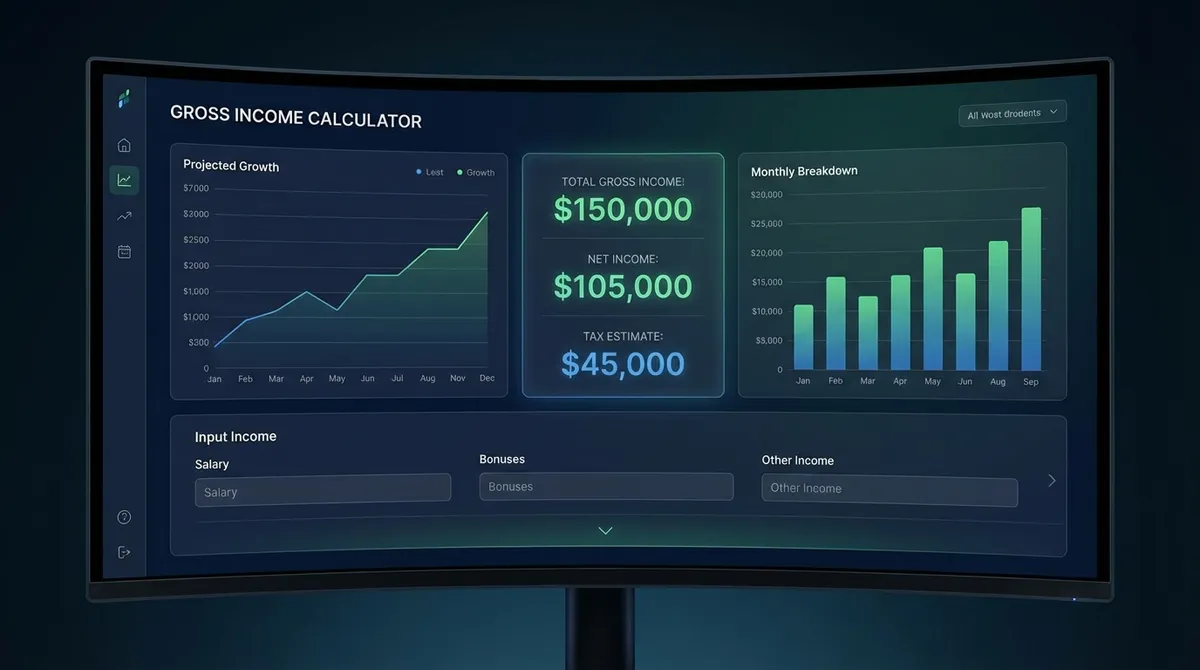
Your gross income is more than just a number on a paycheck—it's the cornerstone of your entire financial profile. Whether you're applying for a mortgage, negotiating a new salary, or simply trying to budget effectively, knowing your true gross income (and how it differs from your take-home pay) is essential. It serves as the starting point for almost every major financial calculation in your life.
What Is Gross Income?
Simply put, gross income is your total earnings before any deductions. It's the "big number" at the top of your pay stub or employment offer letter. It represents the value of your labor before the government and benefits providers take their share.
Lenders, landlords, and the government primarily focus on this number to determine your borrowing power and tax liability. It includes:
- Wages & SalariesYour base pay from employment (W-2 income).
- Bonuses & TipsPerformance pay, commission checks, and gratuities.
- Rental IncomeMoney collected from tenants (before expenses for some lenders).
- Investment IncomeRegular dividends, interest payments, and capital gains distributions.
Gross Income by Profession
The definition can shift slightly depending on how you earn your living:
The easiest to calculate. It's your annual salary plus any guaranteed bonuses. If you earn $75,000/year, your gross monthly income is exactly $6,250.
Sum of all hours worked × hourly rate. Be sure to include higher rates for overtime (1.5x) or holiday pay when projecting annual totals.
Usually defined as "Net Profit" (Total Revenue minus Operating Expenses). Lenders often average your last 2 years of tax returns.
Gross vs. Net Income: The Critical Distinction
Don't confuse the two! Net Income is what actually hits your bank account (Gross Income minus taxes, insurance, and retirement contributions). While you budget based on Net Income to ensure you can pay bills, you qualify for loans based on Gross Income.
How to Calculate Annual Gross Income
The calculation method depends heavily on your employment status. Our calculator handles the math instantly, but here is the manual breakdown:
If You Are Paid Hourly
Multiply your hourly rate by the total hours worked in a year. Standard full-time work is 2,080 hours (40 hours/week × 52 weeks).
Example: $25/hr × 40 hrs/wk × 52 wks = $52,000
If You Are Paid a Salary
Your base salary is your starting point, but you must add all variable compensation.
For the Self-Employed: A Different Rulebook
If you are a freelancer, contractor, or business owner, calculating gross income is trickier.
Gross Revenue is everything you bill clients. But for personal finance and tax purposes (like applying for a mortgage), lenders look at your Net Profit (Gross Revenue minus Business Expenses).
Use Schedule C (Form 1040) from your tax return. Your "Gross Income" for lending purposes is typically Line 31 (Net Profit), though some lenders may add back non-cash deductions like depreciation.
The Alphabet Soup: AGI vs. MAGI
Gross Income is just the first step. For taxes, you need to know two other acronyms derived from it:
AGIAdjusted Gross Income
This is your Gross Income minus specific "above-the-line" deductions like student loan interest, HSA contributions, and educator expenses. AGI figures out your eligibility for most tax credits.
MAGIModified AGI
This takes AGI and adds back certain deductions (like foreign earned income or passive loss allowances). MAGI determines your eligibility for Roth IRAs and deductible Traditional IRAs.
Gross Income and Your Taxes
Understanding gross income is critical because the US tax system is progressive. This means as your gross income rises, the percentage of that income you pay in taxes also rises—but only on the money that falls into higher buckets.
For example, if you get a raise that pushes you into a higher tax bracket, your entire salary isn't taxed at that higher rate. Only the dollars above the threshold are.
| Concept | What It Means |
|---|---|
| Tax Bracket | The range of incomes taxed at a specific rate. |
| Marginal Tax Rate | The tax rate paid on your last dollar earned (your highest bracket). |
| Effective Tax Rate | The actual percentage of your total gross income that goes to the IRS. This is always lower than your marginal rate. |
Why Gross Income Matters for Your Future
Since lenders look at gross income, increasing it can unlock better financial opportunities.
- Mortgage Qualification: The "28/36 rule" states you shouldn't spend more than 28% of your gross monthly income on housing expenses. A higher gross income directly increases your home buying budget.
- Credit Card Limits: Issuers set your credit limit based on your ability to pay, which is judged by your gross annual income.
- Retirement Savings: Many guidelines suggest saving 15% of your gross income. Knowing this number helps you set accurate contribution targets in dollar amounts. For more, see the IRS guidelines on Gross Income.
Strategies to Optimize Your Gross Income
Maximizing your gross income isn't just about asking for a raise. It involves a strategic approach to your entire career and compensation package.
Negotiate Total Compensation
Don't just focus on base salary. Signing bonuses, stock options (RSUs), and performance bonuses all contribute significantly to your gross income figure.
Develop High-Value Skills
Specialized skills often command a premium. Certifications in your field can directly correlate to a higher base pay.
Diversify Income Streams
Adding a side hustle or freelance work increases your total gross income, improving your debt-to-income ratio for loans.
Regular Market Theory
Research industry standards for your role annually. If your gross income falls below specific benchmarks, it may be time to switch employers.
Frequently Asked Questions (FAQ)
Does gross income include 401(k) contributions?
Yes. Your gross income is calculated before any retirement contributions are deducted. Even though that money doesn't hit your checking account, it is still part of your gross earnings.
Is Social Security income part of gross income?
It depends on the context. For tax purposes, only a portion (up to 85%) may be taxable if you have other income. For lending purposes, lenders usually count the full amount of your benefit award.
What about gifts and inheritance?
Generally, gifts and inheritances are not considered gross income for federal income tax purposes. However, they are also usually excluded by lenders when calculating Debt-to-Income ratios because they are not reliable, recurring income.
Do I include my spouse's income?
If you are applying for a joint loan (like a mortgage with your partner) or filing taxes jointly, yes, you combine both incomes into "Household Gross Income." If you are applying for a credit card in your own name, you can strictly include your own income, plus any shared income you have reasonable access to.
Is a stipend considered gross income?
Usually, yes. Unless the stipend is specifically for qualified educational expenses (like tuition or books) under a scholarship, it is considered taxable gross income. Housing stipends and living allowances are almost always taxable.
Do I include alimony/child support?
Alimony: For agreements made before 2019, it is often taxable income for the recipient. For agreements after 2019, it is generally NOT taxable gross income for federal purposes.
Child Support: This is never considered taxable gross income for the recipient, nor is it deductible for the payer.
What is "box 1" on my W-2?
Box 1 shows your "Wages, tips, other compensation." However, this number is often lower than your true gross income because pre-tax deductions (like 401k contributions and health insurance premiums) have already been subtracted. Box 3 (Social Security wages) or Box 5 (Medicare wages) often give a clearer picture of your total gross earnings before any pre-tax benefits are removed.