Complete Guide: High Yield Savings Account Calculator
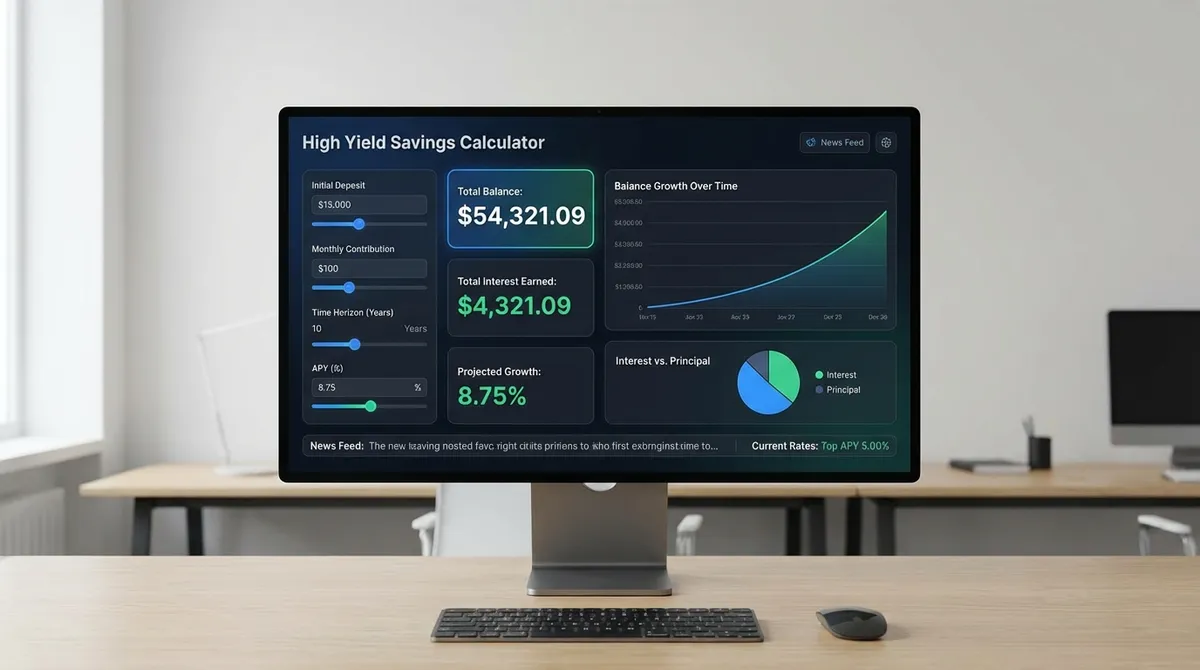
A high-yield savings account calculator helps you project how much your money can grow in an HYSA compared to traditional savings accounts. With APYs typically 10-15x higher than standard savings accounts (4.0-5.5% vs 0.1-0.4%), high-yield savings accounts have become essential tools for emergency funds, short-term goals, and cash reserves in 2025.
Key Insight
The difference between a high-yield savings account at 4.5% APY and a traditional savings account at 0.4% APY on a $10,000 initial deposit with $500 monthly contributions over 5 years is over $8,000 in additional interest earned.
What is APY and How It Works
APY (Annual Percentage Yield) represents the real rate of return earned on an investment or savings account, accounting for compound interest. Unlike simple interest rates, APY incorporates the effect of compounding frequency—how often interest is calculated and added to your balance.
The APY Formula:
- r = nominal interest rate
- n = number of compounding periods per year
For example, a 4.5% APY with daily compounding (n=365) means your money grows slightly faster than with monthly compounding (n=12), even though the advertised APY is the same. This calculator automatically accounts for different compounding frequencies to show you the exact growth potential.
How to Use This Calculator
Our high-yield savings calculator is designed to be intuitive while providing comprehensive projections. Here's what each input means and how to optimize your savings strategy:
Initial Deposit
The starting amount you're transferring into the HYSA. Many accounts have minimum opening requirements ($100-$1,000 typically).
Pro tip: Start with whatever you can—even $500-$1,000 begins building momentum through compound interest.
APY (Annual Percentage Yield)
The annual rate of return, including compound interest. Currently, top HYSAs offer 4.0-5.5% APY.
Rate shopping: A 0.5% difference in APY equals hundreds of dollars on larger balances over time.
Monthly Contribution
How much you add each month. Even $50-$200 monthly significantly accelerates growth through dollar-cost averaging.
Automation: Set up automatic transfers from checking to maintain consistent contributions.
Time Period
How long you plan to keep money in the account. Longer periods show the true power of compounding.
Time advantage: 10 years of consistent saving creates dramatic compound interest effects.
Understanding Your Results
The calculator provides several key outputs to help you understand your savings growth:
Future Balance
Your total projected balance, including all contributions and compounded interest. This is the amount you'll have after your specified time period.
Total Interest Earned
The "free money" you've earned through compound interest. This amount works for you, earning more interest in subsequent periods.
vs Traditional Savings
Shows how much more you'd earn in a high-yield account compared to a traditional savings account (typically 0.1-0.4% APY).
When to Use High-Yield Savings Accounts
High-yield savings accounts are ideal for specific financial goals where you need safety, liquidity, and modest growth. Understanding when to use them maximizes their benefits.
Best Uses For HYSA
- •Emergency funds (3-6 months expenses)
- •Short-term savings goals (1-3 years)
- •Down payment savings
- •Vacation or wedding funds
- •Opportunity funds (waiting to invest)
When to Consider Alternatives
- •Long-term retirement savings (consider IRAs/401k)
- •High-risk tolerance (consider index funds)
- •Time horizon over 5 years (investment accounts)
- •Need higher returns than 4-5% APY
- •Tax-advantaged goals (HSAs, 529 plans)
High-Yield Savings Account Features That Matter
Not all high-yield savings accounts are equal. When comparing options, look beyond just the APY to find the best fit for your financial situation.
FDIC Insurance
Ensure the account is FDIC-insured up to $250,000 per depositor, per account type.
Minimum Balance
Many HYSAs have no minimum balance requirements, but some require $1,000-$2,500 to open.
Accessibility
Check transfer limits, ACH timing (2-3 business days), and mobile app quality.
Maximizing Your High-Yield Savings Growth
To get the most from your high-yield savings account, implement these proven strategies that compound your returns over time.
5 Strategies for Optimal Growth
- Automate your contributions: Set up automatic transfers on payday to ensure consistent saving without thinking about it.
- Use separate accounts for different goals: Open multiple HYSAs (emergency fund, vacation, house down payment) to track progress visually.
- Ladder your savings: As rates fluctuate, be willing to move money to higher-yield accounts, similar to a CD ladder, but balance rate-chasing with stability.
- Avoid withdrawals when possible: Interest compounds on larger balances. Resist the temptation to dip into savings for non-emergencies.
- Review quarterly: Check your APY every 3 months. Banks can change rates, and better options may emerge.
Real-World Example: Emergency Fund Growth
Let's walk through a practical example of building a 6-month emergency fund in a high-yield savings account.
Scenario Details
- • Monthly expenses: $3,500
- • Emergency fund goal: $21,000 (6 months)
- • Starting balance: $2,000
- • Monthly contribution: $500
- • HYSA APY: 4.5%
- • Timeline: 3 years, 2 months
Results
- • Total contributions: $21,000
- • Interest earned: $1,425
- • Final balance: $22,425
- • Interest vs traditional: +$1,186
- • Months saved: 2-3 months faster
This example shows how compound interest in a high-yield account not only grows your money faster but helps you reach your safety net goal nearly 3 months sooner than a traditional savings account.
Tax Considerations for High-Yield Savings
Interest earned in high-yield savings accounts is taxable income. Understanding the tax implications helps you plan more accurately and avoid surprises at tax time.
Tax Impact Example
On $1,000 of interest earned:
- • 22% tax bracket: $220 in taxes owed
- • 24% tax bracket: $240 in taxes owed
- • 32% tax bracket: $320 in taxes owed
Your after-tax return would be the APY minus your marginal tax rate. This is still significantly better than traditional savings.
Beating Inflation: The Real Purpose of an HYSA
The primary goal of a high-yield savings account isn't necessarily to get rich—it's to preserve your purchasing power. Inflation erodes the value of cash sitting in a checking account or under a mattress.
The "Real Return" Equation
Financial experts look at the "Real Rate of Return," which is roughly: APY - Inflation Rate.
- Checking Account (0.01%) - Inflation (3.0%)= -2.99% Real Return
- HYSA (4.50%) - Inflation (3.0%)= +1.50% Real Return
By moving money to an HYSA, you stop losing value and start building slight wealth, all with zero market risk.
Common Mistakes to Avoid
Even with high-yield accounts, savers can make costly mistakes that reduce their returns or create unnecessary complications.
🚫 Exceeding FDIC Limits
Keep less than $250,000 per depositor, per account type, per bank. For larger amounts, spread across multiple FDIC-insured institutions.
🚫 Chasing Rates Too Aggressively
Constantly moving money for 0.1% better rates wastes time and can trigger tax events. Find a consistently competitive bank and stick with it.
🚫 Ignoring Transfer Limits
Federal Regulation D restricts withdrawals to 6 per month. Plan accordingly for emergency access.
Next Steps After Using This Calculator
- Research account options: Compare APYs, minimums, and features from reputable online banks like Marcus, Ally, Capital One, or Discover.
- Open your account: Most HYSAs can be opened online in 10-15 minutes with basic personal information.
- Link external accounts: Connect your checking account for easy transfers and automatic contributions.
- Set up automation: Schedule recurring transfers that align with your pay schedule.
- Track progress: Use this calculator quarterly to see your projected vs. actual growth and adjust contributions.
- Stay informed: Monitor rate changes and be ready to move if your bank becomes uncompetitive.