How Much Is Your Home Really Worth?
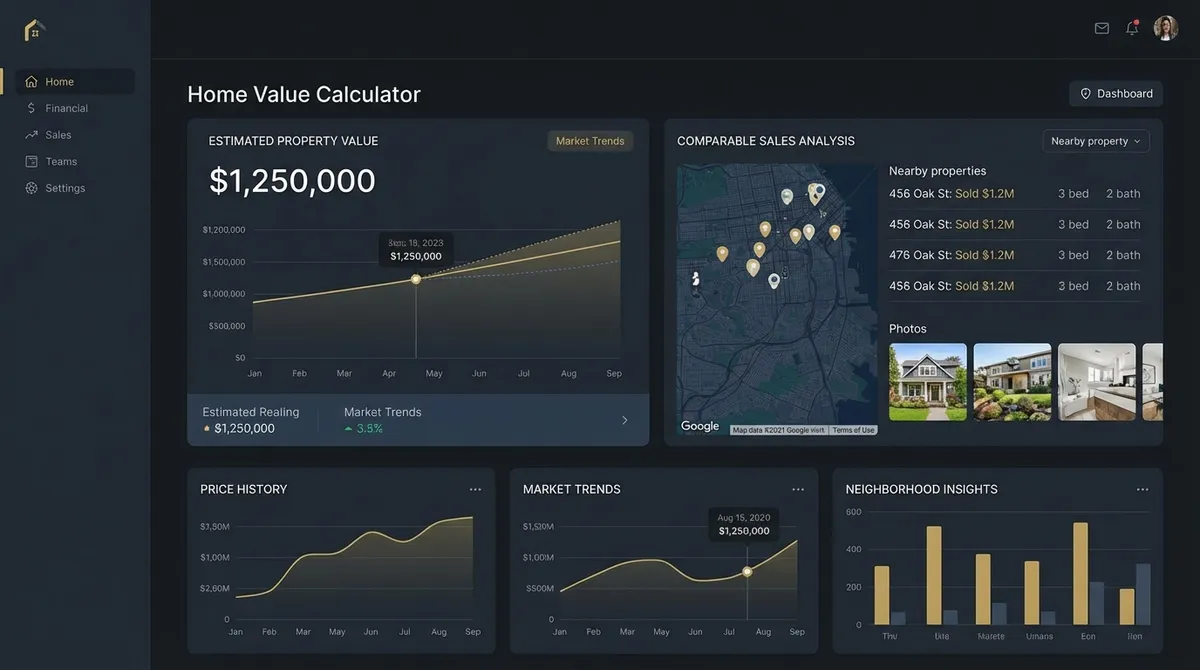
Determining the true market value of a property is both an art and a science. Whether you're planning to sell, refinancing your mortgage, or just tracking your net worth, understanding your home's value is accurate financial intelligence. This guide breaks down the three professional valuation methods our calculator uses and how you can leverage them.
Why One Number Isn't Enough
Most online estimators rely on a single algorithm. Real estate appraisers, however, use "reconciliation"—weighing multiple approaches to find the most accurate figure. Our calculator mimics this professional process by combining Comparable Sales, Income Potential, and Cost approaches.
The 3 Pillars of Property Valuation
1. The Sales Comparison Approach (Market Approach)
This is the gold standard for residential properties. It looks at what similar homes (comparables or "comps") in your area have recently sold for.
- Proximity: Ideally within 0.5 to 1 mile of your home.
- Recency: Sold within the last 3-6 months.
- Similarity: Similar square footage, bed/bath count, and age.
How we calculate it: We take the price-per-square-foot of your comps, weight the ones most similar to your home more heavily, and then adjust for differences in bedrooms, bathrooms, and garage spaces.
2. The Cost Approach
Features commonly in insurance valuations and new construction, this method asks: "How much would it cost to rebuild this house from scratch today?"
The formula is: (Land Value) + (Cost to Build New Structure) - (Depreciation).
It's particularly useful for unique homes with few comparables or new builds where depreciation is minimal.
3. The Income Approach
Primarily used for investment properties, this values a home based on the income it generates. If you could rent your home for $2,500/month, what is that income stream worth to an investor?
We use the Gross Rent Multiplier (GRM) and Capitalization Rate (Cap Rate) to estimate this. Even if you don't plan to rent, this number gives you a baseline for "investment value."
5 Hidden Factors That Swing Your Home's Value
While square footage and location are obvious, these subtle factors can swing your valuation by 5-10% or more:
- The "Updates" Premium: A home with a 20-year-old roof and original windows is worth significantly less than one with documented updates, even if they look identical from the street. Property condition adjustments in our calculator account for this.
- School District Borders: Being just across the street from a top-rated school district boundary can affect value by 10-20%.
- Market Velocity: In a "hot" market (low inventory, high demand), buyers often pay a scarcity premium. Our "Market Trend" input adjusts for this momentum.
- Functional Obsolescence: A 4-bedroom house with only 1 bathroom fits this category. It's less desirable than a 3-bed/2-bath, despite being larger.
- Lot Usability: A flat 0.25-acre lot is often more valuable than a steep 0.5-acre hillside lot that can't be used for a yard or expansion.
How to Maximize Your Appraisal
If you're preparing for a bank appraisal or listing, you can't change your location, but you can influence the outcome:
Top Home Improvements with the Best ROI in 2025
Not all renovations pay off. According to the 2024 Cost vs. Value Report, exterior improvements often recoup more value than luxury interior upgrades because they enhance curb appeal and prevent structural decay. Here is where the smart money is going:
| Project | Avg. Cost | Resale Value | ROI % |
|---|---|---|---|
| Garage Door Replacement | $4,500 | $8,700 | 193% |
| Steel Entry Door | $2,300 | $4,400 | 188% |
| Minor Kitchen Remodel | $27,000 | $23,000 | 85% |
| Wood Deck Addition | $17,000 | $8,500 | 50% |
| Primary Suite Addition | $160,000 | $56,000 | 35% |
*ROI (Return on Investment) estimates vary by region. Generally, keeping existing plumbing layouts and refacing rather than replacing cabinets yields the highest returns.
The Invisible Hand: How Interest Rates Dictate Value
Many homeowners believe their property value is intrinsic—based solely on the bricks, mortar, and land. However, value is heavily dependent on affordability.
The 1% Rule of Thumb
For every 1% increase in mortgage interest rates, a buyer's purchasing power decreases by approximately 10-11%.
If rates jump from 6% to 7%, a buyer who could afford a $500,000 home can now only afford roughly $450,000 for the same monthly payment. In a high-rate environment, sellers often have to lower prices to meet buyers where they can afford, depressing overall market values even if the homes themselves haven't changed.
Understanding Appraiser Adjustments
When an appraiser visits your home, they don't just guess numbers. They use a standard "adjustment grid." Understanding this can help you see your home through their eyes.
- 1
Square Footage Adjustments
Appraisers calculate a value per square foot for excess space. If your home is 200 sq. ft. larger than a comp, they might add $50-$80 per sq. ft. to the comp's value, not the full retail price per foot.
- 2
Bedroom vs. Bathroom Value
Bathrooms are worth far more than bedrooms. Adding a second full bath to a 3-bed/1-bath house adds exponential value because it opens the home to a wider pool of buyers.
- 3
Condition Ratings (C1 to C6)
Appraisers rate homes from C1 (New Construction) to C6 (Major Defects). Essential repairs needed to move from C4 (Average) to C3 (Updated) can yield a massive jump in appraisal value.
When to Order a Pre-Listing Appraisal
Should you pay $400-$600 for an appraisal before you even list? In most cases, a Comparative Market Analysis (CMA) from an agent is sufficient. However, a pre-listing appraisal is recommended if:
Unique Property
You have a log cabin in the suburbs, a home with significant acreage, or a custom build with no direct comps.
Inherited Home
You need a "date of death" valuation for tax purposes (stepped-up basis).
For Sale By Owner (FSBO)
Without an agent's guidance, an independent appraisal gives you pricing credibility with potential buyers.
Divorce Settlement
An unbiased third-party valuation is often required for asset division.
Frequently Asked Questions
How accurate are online home value calculators?
Online calculators are typically accurate within 3-8% of a home's actual sale price when data is abundant. However, they cannot "see" inside your home. They don't know if you just renovated the kitchen or if the foundation has a crack. That's why we include "Property Condition" and "Location Quality" inputs to refine the estimate beyond just raw data.
What is the difference between assessed value and market value?
Assessed Value is determined by your local tax authority for property tax purposes and often lags behind the current market. Market Value is what a buyer is willing to pay today. In rising markets, market value is often significantly higher than assessed value. Do not use your tax assessment to set your listing price.
Should I use the highest comparable sale to value my home?
No. This is a common mistake called "cherry-picking." Appraisers look for the most similar sales, not the highest ones. If you use a comp that sold for more but was 500 sq ft larger or fully renovated (while yours isn't), your valuation will be inflated and unrealistic.
Does finishing my basement increase my home value?
Yes, but usually not as much as above-ground square footage. Appraisers often value below-grade (basement) space at 50-70% of the value of above-grade space. However, it adds significant functional utility and appeal to buyers, which can help the home sell faster.
How often does my home value change?
Market value changes constantly with supply and demand. Real estate markets are seasonal (often peaking in spring/summer) and cyclical. We recommend checking your home value every 6-12 months or whenever there is a significant shift in interest rates or local economic conditions.
What is a Zestimate vs. an Appraisal?
A Zestimate (or similar AVM) is a computer-generated estimate based on public data. An Appraisal is a professional, legally binding opinion of value performed by a licensed human appraiser who visits the property. Banks require appraisals for loans; Zestimates are just for general information.
Disclaimer
This calculator provides an estimate based on the data you provide and standard valuation methodologies. It is not a professional appraisal and should not be used for lending, legal, or tax purposes. For a definitive valuation, consultation with a licensed real estate appraiser or agent is recommended.