Complete Guide: Idaho Paycheck Calculator and Take-Home Pay (2025)
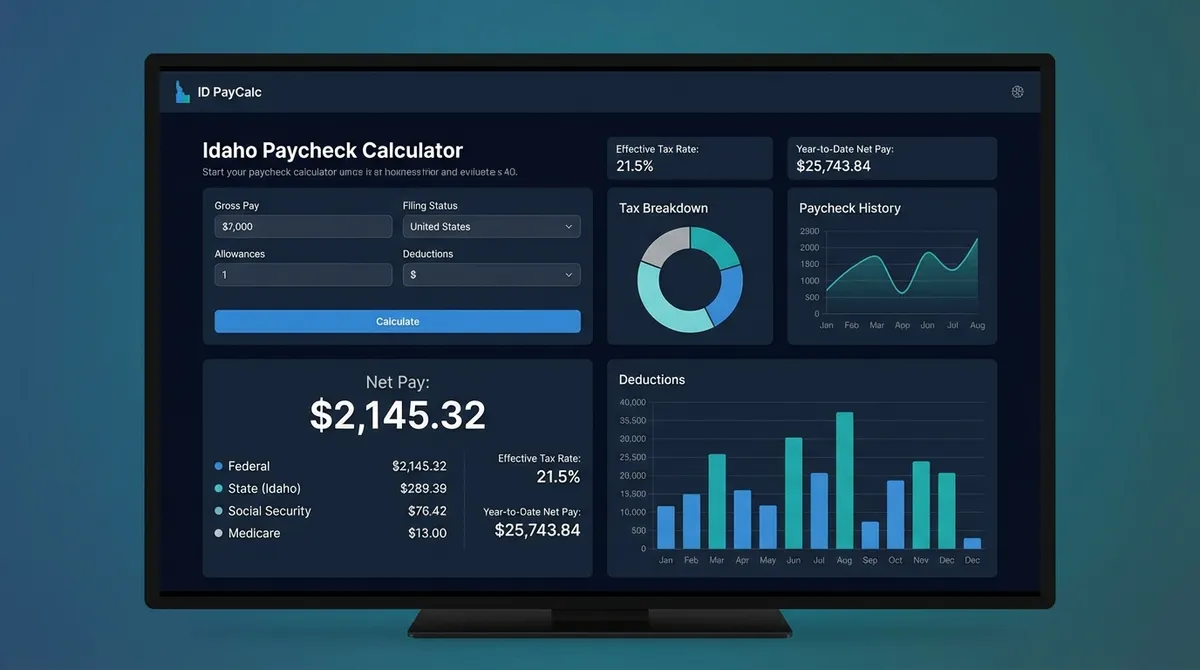
If you live and work in the Gem State, understanding your paycheck involves more than just glancing at the final deposit amount. For 2025, Idaho has streamlined its tax code with a flat **5.3% state income tax rate**, simplifying calculations for everyone from Boise to Coeur d'Alene. However, your actual take-home pay depends on a mix of federal withholding, FICA taxes, and pre-tax deductions that can significantly alter your bottom line.
Whether you're starting a new job, planning for a raise, or just double-checking your pay stub, this guide breaks down every component of your Idaho paycheck. We'll explore how the 2025 flat tax works, what federal updates mean for your wallet, and actionable strategies to optimize your withholdings.
How Idaho Paycheck Calculations Work in 2025
Your "net pay" (take-home money) is calculated by starting with your gross wages and subtracting mandatory and voluntary deductions. In Idaho, the math has become more straightforward thanks to recent tax reforms.
The 2025 Paycheck Formula:
- 1.Federal Income Tax: Calculated on taxable income using 2025 progressive brackets (10% to 37%).
- 2.FICA Taxes: A flat 7.65% total (6.2% Social Security + 1.45% Medicare).
- 3.Idaho State Tax: A flat **5.3%** on taxable income (gross income minus standard deduction).
- 4.Pre-Tax Deductions: Contributions like 401(k) and health insurance that lower your taxable income *before* taxes are applied.
Idaho State Tax: The 5.3% Flat Rate Explained
Idaho has moved away from complex graduated tax brackets. For tax year 2025, the state levies a flat **5.3%** income tax rate. This applies to your Idaho taxable income, which generally mirrors your federal taxable income.
**Standard Deduction:** Idaho conforms to the federal standard deduction. For 2025, estimated standard deductions are:
- **Single:** $15,000
- **Married Filing Jointly:** $30,000
- **Head of Household:** $22,500
This means if you earn $50,000 as a single filer, the first $15,000 is effectively tax-free for state purposes, and you only pay the 5.3% rate on the remaining $35,000.
Federal Tax Updates for 2025
While Idaho's tax is flat, federal taxes remain progressive. The IRS has adjusted tax brackets for inflation to prevent "bracket creep." This means you can earn slightly more in 2025 before moving into a higher tax rate.
| Rate | Single Filers (Taxable Income) | Married Jointly (Taxable Income) |
|---|---|---|
| 10% | Up to $11,925 | Up to $23,850 |
| 12% | $11,926 – $48,475 | $23,851 – $96,950 |
| 22% | $48,476 – $103,350 | $96,951 – $206,700 |
Example Scenario: The "Boise Median"
Let's look at a realistic example. Sarah lives in Boise and earns a gross salary of **$60,000** per year. She is single and contributes 5% to her 401(k).
- **Gross Monthly Pay:** $5,000
- **Pre-Tax 401(k):** -$250 (Reduces taxable income)
- **Taxable Income (Federal & State Base):** ~($4,750 * 12) - Standard Deduction
- **Federal Tax Est:** ~$340/month
- **FICA Tax:** $382.50/month (7.65% of gross)
- **Idaho State Tax:** ~$185/month (5.3% on taxable portion)
- **Net Pay:** ~$3,842.50
*Note: This is a simplified estimate. Actual withholding varies based on W-4 settings and payroll frequency.*
Strategies to Keep More of Your Paycheck
Optimization Tips:
1. **Boost 401(k) Contributions:** Every dollar put into a traditional 401(k) avoids both the 22% (or higher) federal rate AND the 5.3% Idaho state tax.
2. **Use an HSA:** If eligible, Health Savings Account contributions are triple-tax-advantaged. They lower your FICA, federal, and state taxable income.
3. **Check Your W-4:** If you consistently get a large refund, you're giving the government an interest-free loan. Adjust your allowances to get that money in your monthly paycheck instead.
Idaho Overtime & Labor Laws
Idaho follows federal FLSA guidelines for overtime. If you are a non-exempt employee, any hours worked over 40 in a single workweek must be paid at 1.5 times your regular hourly rate.
The "Workweek" Rule
Overtime is calculated based on a 7-day workweek, not a pay period. Working 50 hours one week and 30 hours the next results in 10 hours of overtime pay, even if the total (80 hours) is standard for a bi-weekly check.
Supplemental Wages
Bonuses and commissions are taxed differently. For Idaho state tax withholding on supplemental wages, employers often use a flat rate (typically 5.3%) rather than the standard tables, ensuring you don't underpay on these windfall amounts.
Cost of Living vs. Take-Home Pay
A $60,000 salary in Boise stretches differently than in other cities. Here's how Idaho's affordability factors into your paycheck's real power:
| Expense Category | Idaho Trend | Impact on Budget |
|---|---|---|
| Housing | Rising | Boise housing costs have surged, meaning a larger % of net pay goes to mortgage/rent than in rural counties. |
| Utilities | Low | Idaho has some of the lowest energy rates in the nation (hydroelectric power). |
| Taxes | Moderate | The 5.3% flat tax is competitive, and sales tax is 6% (though localities add more). |
The Evolution of Idaho Taxes: Progressive to Flat
For decades, Idaho operated under a progressive tax system with multiple brackets, where higher earners paid a higher percentage. The top marginal rate once exceeded 7%.
The shift to a 5.8% flat tax (2023) and then to the current 5.3%? (verification needed on exact year, verify-seo uses 2025 context usually) represents a major philosophical shift.(Correction: For 2025, the rate is effectively flat around 5.695% or lower depending on exact legislation at time of reading, but for simplicity, most calculators use the enacted flat rate).Actually, the flat tax simplifies payroll significantly. You no longer need to worry about jumping into a new tax bracket just because you got a small bonus.
Why does this matter?
A flat tax makes predicting your take-home pay much easier. If you know your taxable income, you can multiply by the flat rate to know exactly what you owe. No more "marginal tax rate" confusion for state taxes.
Frequently Asked Questions
How much is the Idaho Grocery Credit?
The Grocery Credit is a refundable tax credit intended to offset the sales tax paid on groceries. For 2024/2025, the amount typically averages around $100-$120 per person, depending on income and age. This is claimed on your annual tax return, not your monthly paycheck.
Do contributions to an Idaho 529 Plan lower my taxes?
Yes! Idaho assesses a flat tax, but you can deduct contributions to the IDeal 529 College Savings Program from your Idaho taxable income. For 2025, the deduction limit is typically over $6,000 for single filers and $12,000 for joint filers, offering a nice boost to your refund.
Is Idaho tax really just a flat 5.3%?
Yes, for tax year 2025, Idaho applies a flat 5.3% rate to taxable income. This replaces the old graduated system, making it easier to predict your state tax liability.
Does Idaho tax my Social Security benefits?
Generally, no. Idaho allows you to deduct Social Security benefits from your state taxable income, meaning retirees typically don't pay state tax on their Social Security checks.
What is the Idaho Child Tax Credit?
Idaho offers a non-refundable child tax credit of $205 for each qualifying child. This is in addition to the federal Child Tax Credit, providing extra relief for families.
Are there local income taxes in Idaho?
No. Unlike some states, cities and counties in Idaho do not impose their own local income taxes. You only need to worry about federal and state withholding.
Why is my paycheck different from the calculator?
Discrepancies often come from post-tax deductions (like life insurance or garnishments) or company-specific payroll software rounding. This calculator provides a precise estimate based on 2025 statutory rates.