2025 Illinois Income Tax Guide: The Complete Breakdown
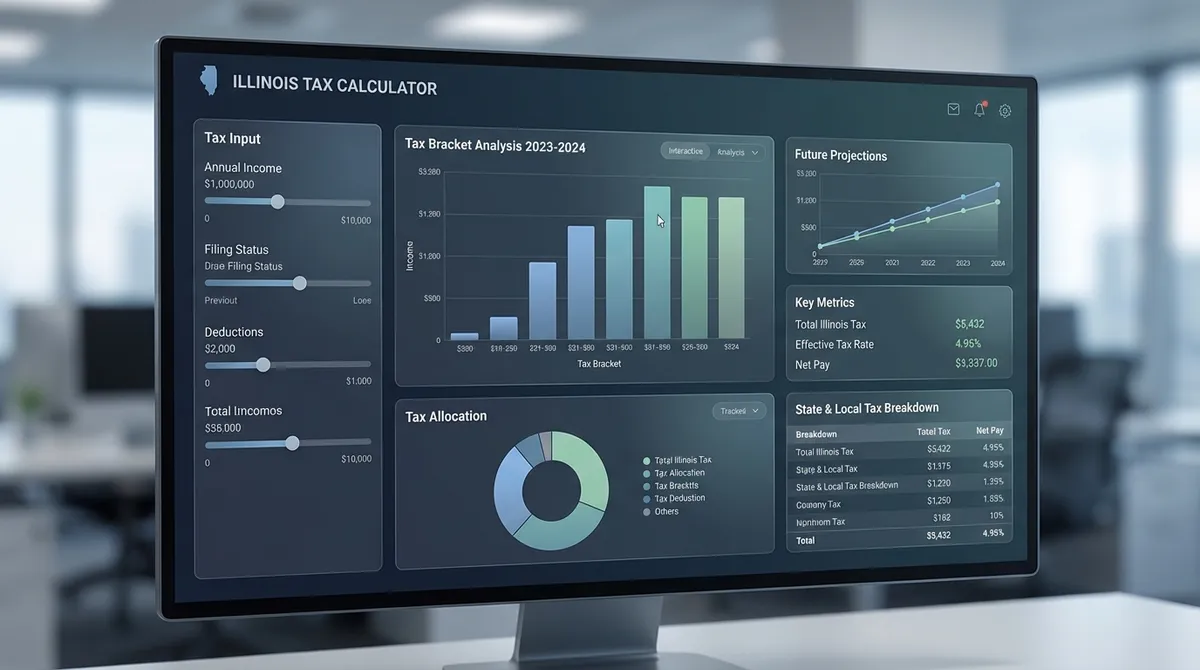
Illinois is unique among populous states for its constitutionally mandated flat tax system. Illinois is unique among populous states for its constitutionally mandated flat tax system. While neighbors like Wisconsin and Iowa navigate complex progressive brackets, Illinois keeps it simple: one rate for everyone. But "simple" doesn't mean "impact-free"—understanding how this 4.95% rate applies to your specific financial situation is key to effective planning in 2025.
How the Illinois Flat Tax Actually Works
Unlike the federal government or most other states, Illinois does not tax higher earners at a higher percentage. Whether you earn $25,000 as a part-time barista or $250,000 as a corporate executive, every dollar of your taxable income is taxed at exactly 4.95%.
The 2025 Formula
There is no standard deduction to subtract first. Your "Net Income" is essentially your Adjusted Gross Income (AGI) plus specific state additions (like non-IL municipal bond interest) minus specific subtractions (like retirement income).
The Silver Lining: Illinois Tax Exemptions
While the 4.95% rate is non-negotiable, Illinois is surprisingly generous when it comes to retirement and specific income types. Knowing what not to include in your taxable income is the fastest way to lower your bill.
- ✅ Social Security100% exempt from Illinois state tax, unlike the federal return where up to 85% can be taxed.
- ✅ 401(k) & PensionDistributions from qualified retirement plans including IRAs and 401(k)s are generally tax-free.
- ✅ K-12 ExpensesYou may qualify for a credit (not deduction) for qualified education expenses over $250.
- ✅ Property Tax CreditHomeowners can often take a credit equal to 5% of Illinois property tax paid on their principal residence.
Real-World Examples (2025 Rates)
Cross-Border Workers & Reciprocity
If you live in Illinois but work in a specific neighboring state (or vice-versa), you might not need to file two tax returns. Illinois has Reciprocal Agreements with:
- Iowa
- Kentucky
- Michigan
- Wisconsin
How it works:
If you live in Illinois and commute to Wisconsin, you only pay Illinois income tax. You must file form W-220 (Nonresident Employee's Withholding Reciprocity Declaration) with your Wisconsin employer so they withhold Illinois tax instead of Wisconsin tax.
Note: Indiana does NOT have reciprocity with Illinois. If you work in Indiana, you must file both returns and claim a credit on your Illinois return for taxes paid to Indiana.
The Hidden Gem: Illinois Property Tax Credit
Illinois has some of the highest property taxes in the nation, but the state offers a specific credit on your income tax return (Form IL-1040) to soften the blow.
Example Calculation
*This is a non-refundable credit, meaning it can reduce your tax to zero but won't generate a refund check if it exceeds your liability.
Reciprocity Agreements: Avoid Double Taxation
If you live in Illinois but work in a neighboring state (or vice versa), "Reciprocity" determines where you pay tax. Illinois has reciprocal agreements with four specific states. If you work in these states, you do not pay their income tax; you only pay Illinois income tax.
| State | What You Must Do |
|---|---|
| Iowa | File Form 44-016 with your Iowa employer to stop IA withholding. |
| Kentucky | File Form 42A809 with your Kentucky employer to stop KY withholding. |
| Michigan | File Form MI-W4 with your Michigan employer to stop MI withholding. |
| Wisconsin | File Form W-220 with your Wisconsin employer to stop WI withholding. |
Indiana Exception: Illinois and Indiana do not have a reciprocity agreement. If you cross the border for work, you must file tax returns in BOTH states. However, you can claim a credit on your home state return for taxes paid to the non-resident state.
Illinois Tax History: Why Flat?
Illinois is unique among states with high tax burdens because it is constitutionally mandated to have a flat tax. The Illinois Constitution (Article IX, Section 3) states that a tax on or measured by income shall be at a non-graduated rate.
In 2020, voters rejected a "Fair Tax" amendment that would have allowed for a graduated rate structure similar to the federal system or states like California and New York. This means that for the foreseeable future, millionaires and minimum-wage workers alike pay the same 4.95% state rate on their taxable income.
Historical Rates
- Pre-2011: 3.00%
- 2011-2014: 5.00% (Temporary increase)
- 2015-2017: 3.75%
- 2017-Present: 4.95%
Is Illinois a Retirement Haven?
Despite high property taxes, Illinois is surprisingly tax-friendly for retirees. This is a critical factor for financial planning.
What is EXEMPT from Illinois Tax?
100% Tax-Free in Illinois.
100% Tax-Free (if from a qualified plan).
Typically 100% Tax-Free (private and public).
*While your income might be tax-free, high property taxes can still eat into fixed incomes. Many retirees use the Property Tax Credit mentioned above to offset this cost.
Smart Moves for Illinois Taxpayers
- Max out Pre-tax Accounts: Since you can't deduct a "Standard Deduction" in Illinois, your best tool for lowering taxable income is reducing your AGI directly via 401(k), 403(b), or HSA contributions.
- Check Property Tax Credits: If you own a home, ensure you are claiming the Illinois Property Tax Credit (ICR). It's worth 5% of your real estate tax bill. If your property taxes are $6,000, that's a $300 direct tax modification (credit).
- Instructional Expense Credit: Parents spending over $250 on K-12 tuition, book fees, or lab fees can claim 25% of eligible expenses (up to $750 credit) on Schedule ICR.
Avoid These Mistakes
When filing Form IL-1040, these are the most common errors that trigger manual reviews or delay refunds:
- Assuming Federal Deductions Apply: Do not try to subtract the federal standard deduction ($15,000 for singles in 2025) from your Illinois income. Illinois starts with your AGI, not your taxable income.
- Forgetting Use Tax: Illinois requires you to report "Use Tax" on items purchased online where no sales tax was collected. Many efficient filers estimate this based on income tables to avoid audit flags.
- Missing the K-12 Education Credit: Many parents overlook this unique Illinois credit because it doesn't exist on the federal return.
Frequently Asked Questions
Is a graduate tax coming to Illinois in 2025?
No. The Illinois constitution currently mandates a flat tax. A constitutional amendment would be required to change this, like the one rejected by voters in 2020. For the 2025 tax year, the flat 4.95% rate is law.
Does Illinois tax remote work income?
Generally, yes. If you are an Illinois resident, all your income is subject to IL tax regardless of where it is earned. If you work in another state (like Missouri or Iowa), you may claim a credit for taxes paid to that state to avoid double taxation.
What is the "Personal Exemption"?
For 2025, the Illinois personal exemption is currently set at $2,775 per person (taxpayer, spouse, and dependents), but this amount phases out for higher earners (Adjusted Gross Income over $250,000 for singles).
When are estimated tax payments due?
If you expect to owe more than $1,000 in tax after subtractings withholding and credits, you should make quarterly estimated payments (Form IL-1040-ES) on April 15, June 15, September 15, and January 15.