Complete Guide: Understanding Your Total Income
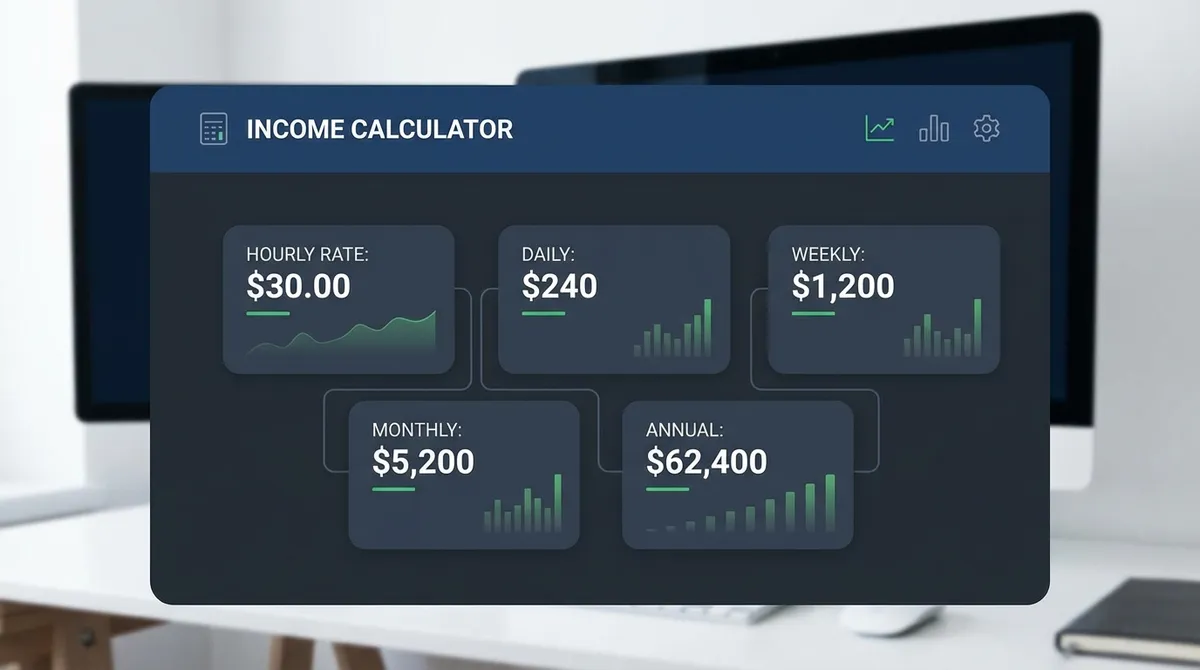
Understanding your total income is fundamental to effective financial planning. Whether you're budgeting, planning major purchases, or setting savings goals, you need an accurate picture of all your income streams—not just your primary salary. Many people underestimate their total earnings by overlooking side income, investment returns, or irregular earnings.
This comprehensive income calculator helps you consolidate all your earnings into a clear annual, monthly, and weekly breakdown. It handles multiple income types—from traditional salaries and hourly wages to freelance work, rental income, and investment returns—providing both gross and after-tax estimates so you can budget realistically.
Gross vs. Net Income: What's the Difference?
One of the most important concepts in personal finance is the difference between what you earn and what you keep.
- Gross Income: Your total earnings before any deductions. This is the salary stated in your offer letter or your total hourly wages. Lenders often look at this number for mortgage approval.
- Net (After-Tax) Income: The amount that actually hits your bank account (calculated via our Take-Home Pay Calculator). This is your gross income minus federal taxes, state taxes, FICA (Social Security & Medicare), and other deductions like health insurance or 401(k) contributions.
Our calculator estimates your Net Income based on 2025 tax brackets, helping you plan your actual budget, not a theoretical one.
Understanding the 2025 Tax Context
Tax brackets are adjusted annually for inflation. For 2025, the standard deduction has increased, which reduces your taxable income.
2025 Standard Deductions
- Single: $15,000
- Married Filing Jointly: $30,000
- Head of Household: $22,500
These deductions lower your taxable income. For example, if you earn $60,000 as a single filer, you are only taxed on $45,000 ($60,000 - $15,000).
Income Formulas: The Math Behind Your Earnings
Bi-Weekly to Annual
Paycheck Amount × 26
Example: $2,000 × 26 = $52,000/yr
Real-World Examples
Example 1: The "Side Hustler"
Sarah works full-time but also drives for rideshare on weekends.
- Full-time salary: $65,000/year
- Rideshare (avg): $300/week ($15,600/year)
Total Gross Income: $80,600
Insight: Even though her salary is $65k, she should budget and save based on the $80k figure!
Example 2: Married Couple
Mike and Lisa file jointly.
- Mike's salary: $85,000
- Lisa's hourly: $40/hr (30 hrs/week) ≈ $62,400
Household Income: $147,400
Insight: Filing jointly gives them a larger standard deduction ($30,000), lowering their tax burden significantly compared to filing singly.
Common Mistakes to Avoid
- Forgetting irregular income: Include bonuses, commissions, and seasonal work in your calculations.
- Ignoring FICA taxes: Social Security and Medicare take 7.65% of your paycheck off the top—don't forget this chunk!
- Not accounting for unpaid time: If you're hourly and don't get paid vacation, you might only work 48 or 50 weeks, not 52.
- Overlooking pre-tax deductions: Remember that money for 401(k) and health insurance comes out before you see your net pay in this calculator (unless you treat it as a "tax").
Using This Calculator for Financial Planning
Once you know your true total income, us it for:
- Budgeting: Follow the 50/30/20 rule—50% needs, 30% wants, 20% savings.
- Debt-to-Income Ratio: Lenders use your gross monthly income to approve loans. Knowing this number helps you understand how much house or car you can afford (see Debt-to-Income Ratio).
- Retirement Savings: Aim to save 15% of your gross income, not your net.
Deep Dive: Anatomy of an Income
Gross vs. Net Income: The Critical Distinction
The most common source of financial confusion is the difference between the number on your offer letter and the number in your bank account.
Gross Income (The "Paper" Number)
This is your total earnings before any taxes or deductions are taken out. It includes:
- Base Salary or Hourly Wages
- Overtime Pay
- Bonuses and Commissions
- Tips and Gratuities
*Lenders use this number to determine how much house or car you can afford (Debt-to-Income Ratio).
Net Income (The "Real" Number)
This is your "Take-Home Pay"—the actual amount available for you to spend or save. It is calculated as:
- Federal & State Income Tax
- FICA (Social Security & Medicare)
- Health Insurance Premiums
- 401(k) Contributions
Types of Income You Should Track
In the modern gig economy, income rarely comes from a single source. Our calculator is designed to help you aggregate multiple streams:
Earned Income (Active)
Money traded for time. This includes W-2 salaries, hourly wages, and tips. It is subject to the highest tax rates, including FICA payroll taxes (7.65%). For average wage data, check the Bureau of Labor Statistics.
Self-Employment Income (1099)
Freelance work, consulting, or side hustles. Warning: You are responsible for both the employer and employee portion of FICA taxes (15.3% total), known as the "Self-Employment Tax."
Portfolio & Passive Income
Dividends, interest, capital gains, and rental income. These are often taxed at preferential strict rates (Long-Term Capital Gains rates of 0%, 15%, or 20%), which are lower than standard income tax rates.
Frequency Conversion Cheat Sheet
Comparing a monthly rent payment to an annual salary can be abstract. Use these multipliers to standardize your budget:
| From | To Annual | To Monthly | To Weekly |
|---|---|---|---|
| Hourly | × 2,080 | × 173.33 | × 40 |
| Daily | × 260 | × 21.66 | × 5 |
| Weekly | × 52 | × 4.33 | — |
| Bi-Weekly | × 26 | × 2.16 | ÷ 2 |
Frequently Asked Questions
Why is there a difference between Bi-Weekly and Semi-Monthly pay?
This is a common trap! Bi-Weekly means every 2 weeks (26 paychecks per year). Semi-Monthly means twice a month (24 paychecks per year). The difference is 2 extra paychecks a year for bi-weekly earners, which is roughly 8% of your annual income.
How do I calculate income if my hours vary?
If your schedule fluctuates, calculate your Average Weekly Hours over the last 3-6 months. Use that average as your baseline. It's safer to budget based on your minimum guaranteed hours and treat anything extra as a "bonus."
Are gifts considered income?
Generally, no. Gifts you receive are not income to you and are not taxable to you. The donor might owe gift tax if the amount exceeds the annual exclusion ($19,000 in 2025), but as the recipient, you just enjoy the cash.
Does this calculator include State Taxes?
This specific tool focuses on Federal tax estimates and gross-to-net conversions using 2025 brackets. For precise state-level taxes (which vary wildly from 0% in Texas to over 13% in California), please use our state-specific paycheck calculators linked in the "Related Calculators" section.
What is the difference between W-2 and 1099 income?
W-2 income typically comes from a permanent employer who withholds taxes for you and pays half of your FICA taxes. 1099 income is independent contractor income where you get the full gross amount but are responsible for paying your own quarterly estimated taxes and the full 15.3% self-employment tax.
Should I include my bonus in my annual income calculation?
Yes, but be careful with budgeting. Bonuses are "supplemental wages" and are often taxed at a flat 22% federal rate, which might be higher or lower than your actual effective tax rate. We recommend budgeting based on your base salary and treating bonuses as extra savings or debt payoff money.
Key Features
Multiple Income Types
Handles salary, hourly wages, freelance, investments, rental income, and other sources all in one calculator
2025 Tax Brackets
Up-to-date federal tax logic for Single, Married, and Head of Household filers.
Visual Breakdowns
Charts and graphs show income sources, monthly projections, and category breakdowns for better understanding
Flexible Conversions
Converts between hourly, weekly, monthly, and annual income automatically.
Real-Time Updates
Calculations update instantly as you type—no need to click calculate buttons or reload the page
100% Private
All calculations happen locally in your browser—we never store, track, or share your financial information