Complete Guide: Understanding Your Income Tax (2025 Edition)
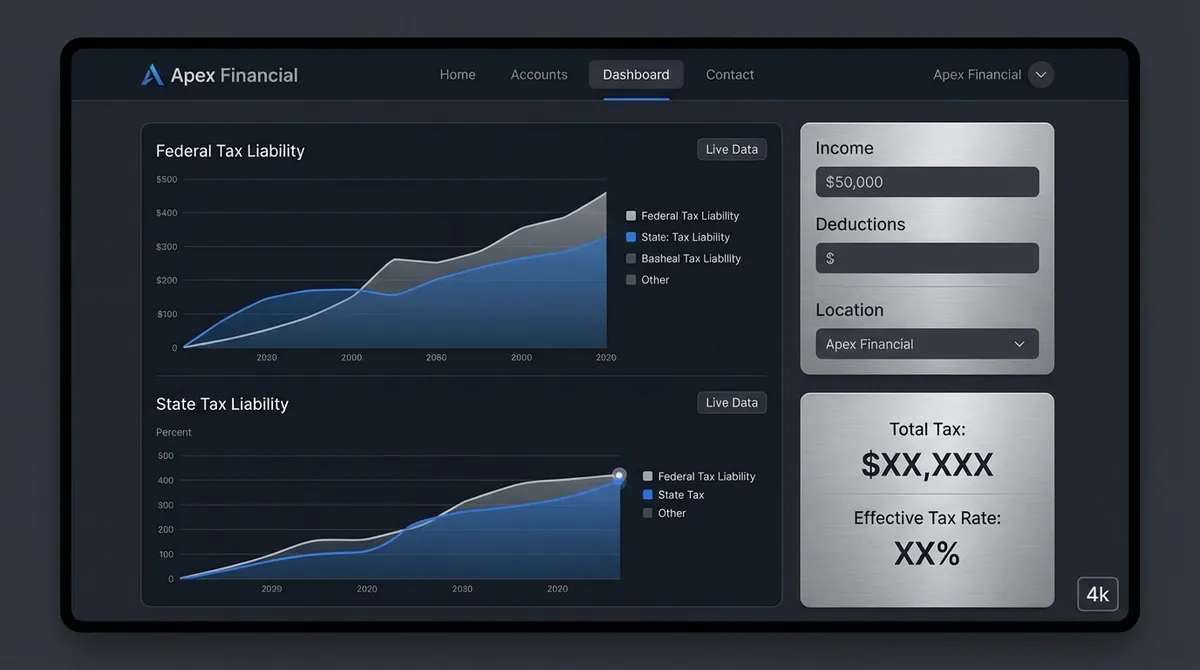
Calculating your income tax shouldn't require a degree in accounting. While the US tax code is notoriously complex, the core mechanics of how much you owe are actually quite straightforward once you understand two key concepts: Taxable Income and Marginal Tax Rates.
This calculator uses the projected 2025 tax brackets and standard deductions to give you a clear estimate of your liability. Whether you're planning for a salary negotiation, estimating your refund, or just trying to understand where your paycheck goes, this tool breaks it down dollar by dollar.
1The Difference Between Marginal and Effective Tax Rate
One of the most common misconceptions is thinking that if you jump into a higher tax bracket, all your income is taxed at that higher rate. This is false.
- ❌Myth: "If I earn $1 more and enter the 22% bracket, I'll take home less money."
- ✅Reality: Only the dollars within that specific bracket are taxed at 22%. Your first dollars are still taxed at 10% and 12%.
Marginal Rate: The tax rate applied to the very last dollar you earned.
Effective Rate: The actual percentage of your total income that goes to the IRS. This is always lower than your marginal rate because of the progressive bracket system.
2The 2025 Standard Deduction
Before calculating any tax, the IRS allows you to subtract a Standard Deduction from your income. This is essentially tax-free money. For the 2025 tax year (paid in 2026), these amounts have adjusted for inflation:
*Note: These are projected figures based on inflation adjustments. Exact IRS figures are typically finalized in late 2024.
Don't Forget FICA Taxes
Federal income tax isn't the only thing deducted from your paycheck. You also contribute to Social Security and Medicare, collectively known as FICA taxes.
Social Security
6.2% of your income, but only up to the wage base limit (projected around $176,100 for 2025). Any earnings above this cap are not taxed for Social Security.
Medicare
1.45% of all earned income, with no limit. High earners (over $200k single / $250k married) specifically pay an Additional Medicare Tax of 0.9%.
State Income Taxes: The 2025 Landscape
While federal taxes get all the headlines, state income taxes can take a significant bite out of your paycheck depending on where you live. For 2025, the landscape continues to evolve with more states moving towards flat tax structures or reducing rates.
The Three Types of State Tax Systems
- 1No Income Tax States:
Alaska, Florida, Nevada, South Dakota, Tennessee, Texas, Washington, and Wyoming. If you live here, you only worry about federal taxes (though sales and property taxes may be higher).
- 2Flat Tax States:
States like Illinois, Pennsylvania, and Indiana charge a single rate regardless of income. This simplifies calculation but can be regressive.
- 3Progressive Tax States:
Most states, including California and New York, use brackets similar to the federal system. High earners pay significantly higher percentages.
Tax Deductions vs. Tax Credits: Know the Difference
Understanding this distinction is the single most important factor in optimizing your tax return. They both lower your taxes, but in very different ways.
Tax Deduction
Reduces your taxable income. Its value depends on your marginal tax bracket.
Tax Credit
Reduces your tax bill dollar-for-dollar. It is far more valuable than a deduction.
Top Credits for 2025
- Earned Income Tax Credit (EITC): A refundable credit for low-to-moderate income working individuals and couples, particularly those with children.
- Child Tax Credit (CTC): Up to $2,000 per qualifying child under age 17. A portion of this is refundable.
- American Opportunity Tax Credit (AOTC): For qualified education expenses for the first four years of higher education.
- Saver's Credit: A non-refundable credit for eligible contributions to retirement plans like IRAs and 401(k)s.
Filing Status: Which One Is Rght for You?
Your filing status determines your standard deduction and tax brackets. Choosing the wrong one can be a costly mistake.
Single
For unmarried individuals who are not enhancing a household for a dependent. It has the lowest standard deduction.
Married Filing Jointly
Usually the best option for married couples. You combine incomes and get double the standard deduction ($30,000). It often results in lower tax liability than filing separately.
Head of Household
For unmarried individuals who pay more than half the cost of maintaining a home for a qualifying person (usually a child). It offers a higher standard deduction ($22,500) and wider tax brackets than Single status.
Historical Context: Are Taxes High Right Now?
It might not feel like it when you look at your paycheck, but historically speaking, US federal income tax rates are relatively low.
In the 1950s, the top marginal tax rate was over 90%. Even in the 1980s, it remained as high as 50-70%. The current top rate of 37% (set to expire after 2025 unless extended) is modest by 20th-century standards. However, the complexity of the tax code has increased dramatically, with thousands of pages of regulations, exemptions, and phase-outs that make the effective tax rate harder to calculate without tools like this one.
Ordinary Income vs. Capital Gains
Not all money is taxed equally. The US tax code specifically favors investment income over labor income.
Ordinary Income
Wages, salaries, tips, bonuses, and interest from bank accounts.
Long-Term Capital Gains
Profit from selling assets (stocks, real estate) held for more than 1 year.
Strategy: Holding an investment for 366 days instead of 365 days can drop your tax rate on the profit from 37% to 20% (for high earners). See our Capital Gains Calculator for details.
The Alternative Minimum Tax (AMT)
The AMT is a parallel tax system designed to ensure wealthy individuals pay at least some tax, regardless of how many deductions they claim. It eliminates many standard deductions (like state and local taxes) and adds back certain tax-free items.
Who is at risk? You typically only need to worry about AMT if you have an income over $200,000 AND claim significant itemized deductions, or if you exercised Incentive Stock Options (ISOs).
Advanced Strategy: Tax-Loss Harvesting
One way to actively lower your tax bill is to sell underperforming investments to realize a loss. This "capital loss" can be used to offset "capital gains."
The Rules
- You can use losses to offset unlimited gains.
- If your losses exceed your gains, you can use up to $3,000 of excess loss to offset your ordinary income (wages).
- Wash Sale Rule: You cannot claim a loss if you buy a "substantially identical" security within 30 days before or after the sale.
3 Common Tax Myths Debunked
Myth: "I shouldn't work overtime because it will put me in a higher bracket."
Truth: You will never take home less money by earning more. The higher rate only applies to the extra money, not your entire salary.
Myth: "Students don't have to file taxes."
Truth: If you had taxes withheld from a part-time job, you must file to get that money back as a refund. The IRS doesn't send refunds automatically.
Myth: "Extensions give me more time to pay."
Truth: An extension only gives you more time to file paperwork. You must still estimate and pay what you owe by Tax Day (April 15), or you'll be charged interest/penalties.
How to Lower Your Tax Bill
While taxes are mandatory, overpaying isn't. Here are the three most effective ways to legally reduce your taxable income:
1. Maximize Pre-Tax Contributions
Contributions to a Traditional 401(k) or 403(b) come out of your paycheck before taxes are calculated. This lowers your taxable income dollar-for-dollar.
2. Use an HSA (Health Savings Account)
If you have a high-deductible health plan, HSA contributions are 100% tax-deductible and grow tax-free.
3. Itemize if It Beats the Standard
If your mortgage interest, state taxes (up to $10k), and charitable donations exceed the standard deduction ($15k/$30k), itemizing will save you more.