Complete Guide: Investment Planning in 2025
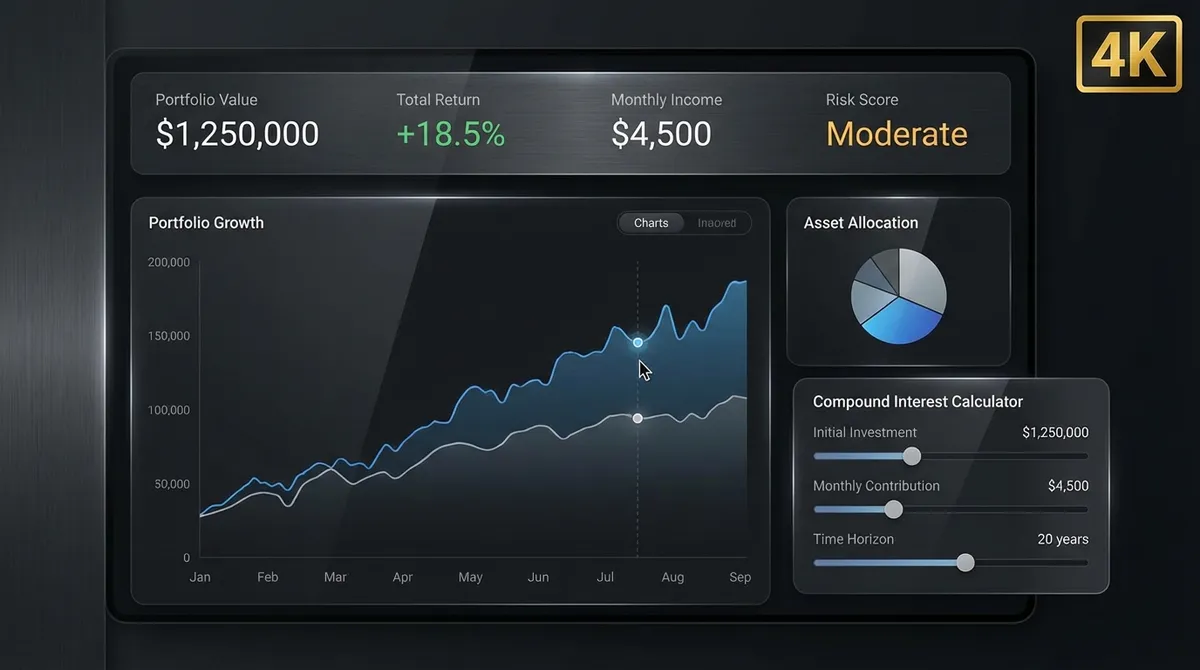
Investing in 2025 offers unprecedented opportunities and challenges. With inflation stabilizing around 3%, interest rates remaining elevated, and technology transforming markets, understanding how to project investment growth has never been more critical. Whether you're saving for retirement, building wealth, or planning a major purchase, our investment calculator helps you visualize the power of compound interest and make informed decisions about your financial future.
Why Investment Calculations Matter in 2025
The investment landscape has evolved dramatically. According to recent Federal Reserve data, the average American household has just $41,600 in investment accounts—far below what's needed for long-term financial security. With Social Security facing potential shortfalls and pension plans becoming rare, personal investing is no longer optional; it's essential.
The good news? Starting early and investing consistently can build substantial wealth. Thanks to compound interest, a 25-year-old investing $500 monthly could accumulate over $1.3 million by age 65 (assuming 8% annual returns). Our calculator reveals exactly how your specific contributions, time horizon, and expected returns translate into real wealth.
Historical Investment Returns: What Data Tells Us
Understanding historical returns helps set realistic expectations. While past performance doesn't guarantee future results, long-term data provides valuable context:
Historical Annual Returns (1957-2024):
- S&P 500 (Large-cap stocks): 10.5% nominal, 6.7% after inflation
- Small-cap stocks: 11.8% nominal, 8.0% after inflation
- Government bonds: 5.1% nominal, 1.4% after inflation
- Corporate bonds: 5.8% nominal, 2.1% after inflation
- Real estate (REITs): 11.4% nominal, 7.6% after inflation
- Gold: 7.2% nominal, 3.5% after inflation
- 60/40 portfolio (stocks/bonds): 8.7% nominal, 5.0% after inflation
These returns include significant volatility. The S&P 500 fell 18% in 2022 but gained 26% in 2023 and 25% in 2024. This volatility, often tracked via a stock return calculator, underscores why long-term investing and diversification matter more than short-term timing. Reliable data can be found at Investor.gov.
Asset Allocation Strategies by Age and Risk Tolerance
Your investment strategy should evolve as you age, balancing growth potential with risk management. The key principle: more time until you need the money means you can accept more volatility for higher returns.
Ages 20-35: Aggressive Growth Phase
Time is your greatest advantage. You can weather market volatility and benefit from decades of compound growth.
- • Stock allocation: 80-100% in diversified index funds
- • Recommended mix: 60% U.S. total stock market, 30% international, 10% small-cap
- • Expected returns: 9-11% nominal, 6-8% real
- • Strategy: Maximize contributions, automate investing, embrace volatility
- • Risk tolerance: High—can recover from significant downturns
Ages 35-50: Balanced Growth Phase
Shift slightly more conservative while maintaining growth potential to build substantial wealth.
- • Stock allocation: 70-85% with 15-30% bonds
- • Recommended mix: 50% U.S. stocks, 25% international, 15% bonds, 10% real estate
- • Expected returns: 8-10% nominal, 5-7% real
- • Strategy: Increase contributions with raises, consider Roth conversions
- • Risk tolerance: Moderate to high—still 15+ years to major goals
Ages 50-65: Moderate Approach
Prioritize capital preservation while still achieving growth to combat inflation and extend portfolio longevity.
- • Stock allocation: 50-70% with 30-50% bonds
- • Recommended mix: 40% U.S. stocks, 20% international, 30% bonds, 10% alternatives
- • Expected returns: 6-8% nominal, 3-5% real
- • Strategy: Maximize catch-up contributions, shift toward quality dividend stocks
- • Risk tolerance: Moderate—reducing volatility as retirement nears
Ages 65+: Conservative Income-Focused
Preserve capital and generate reliable income streams while maintaining some growth to combat inflation.
- • Stock allocation: 30-50% with 50-70% bonds and cash
- • Recommended mix: 30% high-quality stocks, 50% bonds, 15% cash, 5% alternatives
- • Expected returns: 4-6% nominal, 1-3% real
- • Strategy: Create withdrawal strategy, optimize Social Security, consider annuities
- • Risk tolerance: Low to moderate—capital preservation priority
Compound Interest: The Eighth Wonder of the World
Albert Einstein reportedly called compound interest "the eighth wonder of the world. He who understands it, earns it; he who doesn't, pays it." The math is simple but powerful:
The Compound Interest Formula:
A = Final amount
P = Principal (initial investment)
r = Annual interest rate
n = Compounding frequency per year
t = Time in years
The real magic happens over time. Consider these examples:
| Scenario | Monthly Investment | Time Horizon | Total Invested | Final Value (8%) | Gains from Compound Interest |
|---|---|---|---|---|---|
| Early Starter | $300 | 40 years (age 25-65) | $144,000 | $1,003,000 | $859,000 (86%) |
| Mid-Career | $800 | 25 years (age 40-65) | $240,000 | $711,000 | $471,000 (66%) |
| Late Starter | $1,500 | 15 years (age 50-65) | $270,000 | $486,000 | $216,000 (44%) |
Notice how the early starter invests the least total money but ends up with the most wealth. The late starter invests nearly twice as much as the early starter but accumulates less than half as much. This demonstrates why starting early is so powerful—time allows compound interest to work its magic.
Investment Fees: The Silent Wealth Killer
Investment fees seem small—often 0.5% to 1% annually—but compound just like returns, creating a massive drag on wealth over time. Consider this example:
Fee Impact on $100,000 Portfolio (30 years, 8% returns):
- • 0.10% fee (low-cost index fund): Final value $958,000, fees cost $28,000
- • 0.50% fee (typical ETF): Final value $877,000, fees cost $109,000
- • 1.00% fee (mutual fund): Final value $806,000, fees cost $180,000
- • 1.50% fee (actively managed): Final value $741,000, fees cost $245,000
The difference between 0.10% and 1.50% fees is $217,000—more than twice the original investment!
Our calculator's fee analysis feature shows exactly how much you'll pay in fees over your investment horizon. Use this insight to choose low-cost index funds and ETFs that keep more money working for you.
Tax-Efficient Investing Strategies
Taxes can take a significant bite out of investment returns. Understanding tax-efficient strategies helps maximize your after-tax wealth:
Tax-Advantaged Accounts:
- • 401(k): $23,500 limit ($31,000-$34,750 with catch-ups) - see 401k contribution calculator
- • Traditional IRA: $7,000 limit ($8,000 with catch-up)
- • Roth IRA: Tax-free growth and withdrawals - see Roth IRA calculator
- • HSA: Triple tax advantage for healthcare costs
- • 529 Plans: Tax-free education savings
Tax-Efficient Strategies:
- • Asset location: Bonds in tax-advantaged accounts
- • Tax-loss harvesting: Offset gains with losses
- • Hold long-term: Lower capital gains rates (0-20%)
- • Roth conversions: In low-income years
- • Municipal bonds: Tax-free interest (high tax brackets)
Common Investment Mistakes to Avoid
Even well-intentioned investors can derail their progress with common errors. Here's what to watch out for:
1. Trying to Time the Market
Studies show that missing just the 10 best market days over 20 years reduces returns by 50%. Stay invested consistently rather than trying to predict highs and lows.
2. Paying High Fees
A 1% fee costs $245,000 on a $100,000 portfolio over 30 years. Choose low-cost index funds (0.03-0.10% expense ratios) whenever possible.
3. Being Too Conservative When Young
Young investors who keep 50% in bonds sacrifice decades of potential growth. Time allows you to recover from volatility—use it to your advantage.
4. Ignoring Inflation
At 3% inflation, $100,000 loses half its purchasing power in 24 years. Always consider inflation-adjusted returns when planning long-term goals. Use the inflation calculator to test scenarios.
5. Failing to Diversify
Putting all money in one stock or sector creates concentration risk. Spread across asset classes, sectors, and geographies to reduce risk.
6. Letting Emotions Drive Decisions
Fear and greed cause investors to buy high and sell low. Create an investment plan and stick to it through market cycles.
Using Our Investment Calculator: A Step-by-Step Guide
Our calculator provides professional-grade analysis with user-friendly controls. Here's how to maximize its value:
Calculator Input Guide:
Initial Investment:
Start with current savings or a lump sum. Even $1,000 invested for 30 years at 8% grows to $10,000.
Investment Type:
Choose stocks (10% returns), bonds (4% returns), or balanced (7% returns). Custom allows manual entry.
Monthly Contribution:
Consistency matters more than amount. $100/month for 30 years beats $200/month for 15 years.
Time Horizon:
Longer timeframes dramatically improve results. 10 extra years can double your final value.
Expected Return:
Be realistic. Use 8-10% for stocks, 4-5% for bonds, 6-7% for balanced portfolios.
Inflation Rate:
3% is the historical average. Higher inflation requires higher returns to maintain purchasing power.
Annual Fees:
Index funds: 0.03-0.10%, ETFs: 0.05-0.50%, mutual funds: 0.50-1.50%, advisors: 1.00%+
Compounding Frequency:
Monthly (12) is standard for most investments. More frequent compounding slightly increases returns.
Interpreting Your Results: Key Metrics Explained
After entering your information, our calculator provides several key metrics. Here's what they mean:
Future Value
The total projected value of your investment at the end of your time horizon, including all contributions and growth, minus fees.
Total Gains
The investment earnings generated through compound growth. This shows how much your money worked for you versus how much you contributed.
Inflation-Adjusted Value
The real purchasing power of your investment in today's dollars. This crucial metric shows what your money will actually buy in the future.
Fee Impact
The total dollar amount lost to fees over your investment period. This reveals the true cost of high-fee investments and the value of low-cost alternatives.
Action Steps: Your Investment Roadmap
Regardless of your starting point, you can take immediate action to improve your investment outcomes. Here's your personalized roadmap:
If You're Just Starting Out:
- •Open a Roth IRA: Tax-free growth is powerful when you're young
- •Start with index funds: Total stock market or S&P 500 index funds
- •Automate contributions: Set up automatic monthly investments
- •Increase with raises: Boost contributions by 1% with each salary increase
- •Stay aggressive: 80-100% stocks gives maximum growth potential
If You're Mid-Career:
- •Maximize employer match: Free money that doubles your contribution
- •Increase contributions: Aim for 15-20% of income for retirement
- •Diversify globally: Add international exposure (20-30% of stocks)
- •Consider Roth conversions: In lower-income years for tax diversification
- •Rebalance annually: Maintain target asset allocation
If You're Nearing Retirement:
- •Max catch-up contributions: $7,500-$11,250 extra for 401(k) if 50+
- •Shift gradually: Reduce stock exposure by 5% every 2-3 years
- •Create income plan: Map out withdrawal strategy for retirement
- •Delay Social Security: Each year delay increases benefits 8%
- •Plan healthcare costs: Budget $315,000 per couple for medical expenses
Your Investment Success Checklist:
Calculate your investment goal using our calculator
Open appropriate accounts (Roth IRA, 401(k), brokerage)
Choose low-cost index funds or ETFs
Set up automatic monthly contributions
Review and rebalance portfolio annually
Increase contributions with each raise
Final Thoughts: Your Investment Journey Starts Today
Investing can seem complex, but the principles are simple: start early, invest consistently, minimize fees, stay diversified, and think long-term. Our investment calculator removes the guesswork, showing you exactly how your money can grow under different scenarios.
The most important step is the first one. Whether you're investing $50 or $5,000 per month, starting today puts time on your side. Use our calculator to explore different strategies, test various scenarios, and create a plan that fits your goals and risk tolerance.
Remember, every day you wait costs you compound growth. A year of delay might not seem significant, but over decades it can mean hundreds of thousands of dollars in lost wealth. Start where you are, use the tools available, and take control of your financial future.
Ready to see your investment potential?
Use our investment calculator above to project your wealth growth, then explore our related calculators to dive deeper into specific investment scenarios and strategies.