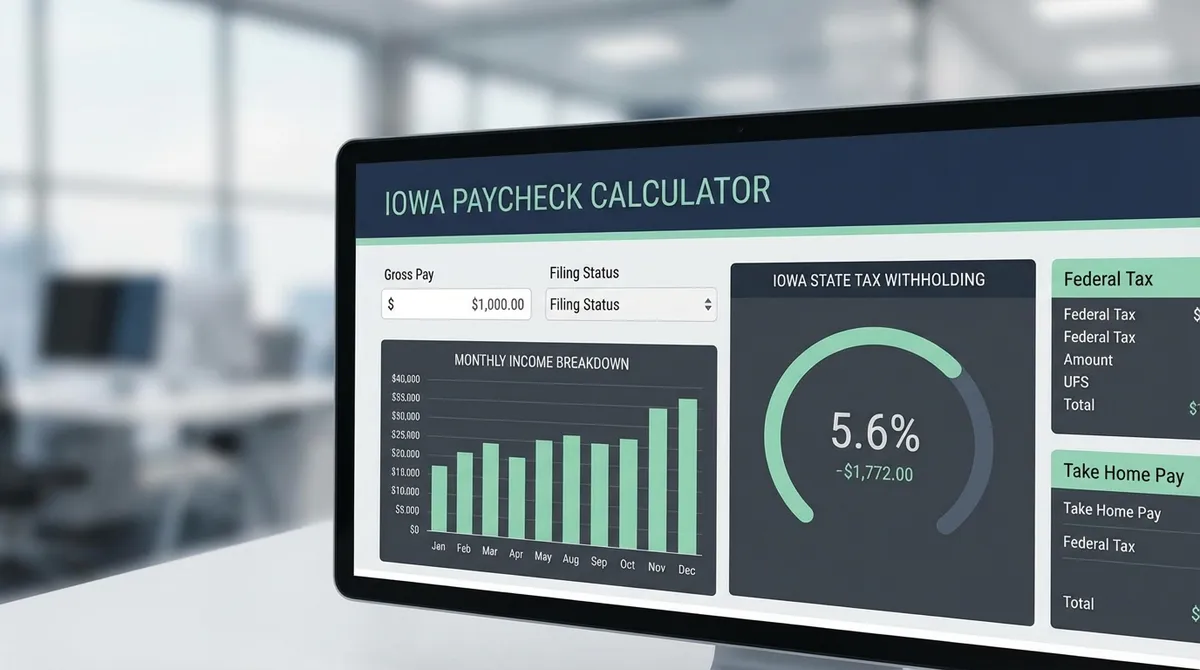
Understanding Your Iowa Paycheck: A 2025 Guide
Calculating your Iowa paycheck has become simpler but staying accurate is just as critical. The biggest change for 2025 is Iowa's full transition to a **flat 3.8% state income tax rate**. This streamlined system affects how much take-home pay you can expect, making it essential to understand the new mechanics of your pay stub.
whether you are starting a new job in Des Moines, planning your retirement in Cedar Rapids, or just auditing your finances, this guide breaks down every deduction. We cover Federal withholding, the new Iowa flat tax, and the standard FICA contributions to give you a clear picture of your net income.
2025 Tax Alert: Iowa has replaced its progressive tax brackets with a single, flat income tax rate of **3.8%**. This applies to all taxable income levels, simplifying payroll but also changing refund expectations for many workers.
The Formula: How We Calculate Your Net Pay
Your "net pay" is the amount that actually lands in your bank account. To get there, we start with your gross wages and subtract four primary categories of deductions.
The Calculation Stack
1. Federal Income Tax (2025 Brackets)
We use the 2025 IRS tax brackets (inflation-adjusted) and standard deductions ($15,000 for Single, $30,000 for Married Filing Jointly) to estimate your federal liability. This is a progressive system, meaning higher income portions are taxed at higher rates (10%, 12%, 22%, etc.).
2. Iowa State Tax (Flat 3.8%)
Unlike the federal system, Iowa applies a flat **3.8%** rate to your taxable income. This makes predicting your state tax liability much easier than in previous years.
3. FICA Taxes (Social Security & Medicare)
Mandatory federal payroll taxes. Social Security is **6.2%** of earnings up to **$176,100** (the 2025 wage base). Medicare is **1.45%** on all earnings, with an additional 0.9% for high earners (over $200k).
Deep Dive: Iowa's Flat Tax Revolution
For decades, Iowa had one of the most complex progressive income tax systems in the country, with top rates exceeding 8%. The journey to a flat tax is a game-changer for high earners and simplifier for everyone.
Why it matters: In the past, earning overtime or a bonus might have pushed you into a significantly higher bracket. Now, every extra dollar you earn is taxed at the exact same 3.8% rate. This encourages productivity and removes the "tax penalty" for working harder.
Iowa Paycheck Laws You Should Know
Your employer has obligations beyond just paying you. Here are key Iowa labor laws enforced by the Iowa Division of Labor:
- Pay Frequency: Employers must pay wages at least monthly, and paydays must be regular (e.g., 1st and 15th, or every other Friday).
- Pay Stubs: Iowa employers are required to provide a written or electronic statement (pay stub) showing hours worked, wages earned, and specific deductions for each pay period.
- Unauthorized Deductions: Employers cannot deduct cost of uniforms, breakage, or cash shortages from your pay unless you have given specific written authorization for each deduction.
The W-4 and Iowa W-4 (IA W-4)
To ensure your paycheck is accurate, you need to manage your withholding forms correctly.
Federal W-4
Updated in 2020, this form no longer uses "allowances." Instead, you enter dollar amounts for credits (like the Child Tax Credit) and other income. Accuracy here prevents owing the IRS in April.
Iowa W-4 (IA W-4)
The Iowa form helps employers calculate the exact state withholding. With the new flat tax, this form is simpler, but you still need to claim your personal exemptions ($40 standard credit) and dependent credits to lower your withholding.
Reciprocity: Living in Illinois?
Iowa has a reciprocal tax agreement with Illinois.
The Rule: If you live in Iowa but work in Illinois, you only pay Iowa income tax. If you live in Illinois but work in Iowa, you only pay Illinois income tax.
Action Required: You must file form IA 44-016 "Employee's Statement of Nonresidence in Iowa" with your Iowa employer so they stop withholding Iowa tax and withhold Illinois tax instead.
Iowa Cost of Living: How Far Does Your Paycheck Go?
One of Iowa's biggest advantages is its affordability. When comparing your job offer in Des Moines or Cedar Rapids to one in Chicago or Minneapolis, keep purchasing power in mind.
- Housing: The median home value in Iowa is significantly lower than the national average, often under $250,000 in many counties.
- Commute: The average commute time is short (under 20 minutes), saving you gas money and time compared to larger metros.
- Utilities: Iowa is a wind energy leader, which helps keep electricity rates relatively stable.
Retirement Taxes in Iowa
Good News for Retirees!
Starting in tax year 2023 and continuing into 2025, Iowa does not tax retirement income for residents aged 55 and older. This includes:
- 401(k) and 403(b) withdrawals
- Pension distributions
- Traditional IRA distributions
(Note: Social Security benefits are also completely exempt from Iowa state tax.)
Example Calculation: $60,000 Salary in Iowa
Let's look at a concrete example of a single filer living in Des Moines earning $60,000 per year, paid bi-weekly (26 pay periods).
| Line Item | Amount | Notes |
|---|---|---|
| Gross Pay | $2,307.69 | $60k / 26 |
| Federal Tax | -$215.00 | Est. 2025 Brackets |
| FICA (SS + Med) | -$176.54 | 7.65% Flat Rate |
| Iowa State Tax | -$87.69 | ~3.8% Flat Tax |
| Net Pay | $1,828.46 | Take-Home Amount |
Analyzing Your Results
Once you run the calculation, look closely at the **Effective Tax Rate**. This is the percentage of your gross pay that actually goes to taxes. Because of standard deductions, this number is often lower than your top tax bracket.
Net Pay vs. Gross Pay
If your net pay seems lower than expected, check your **Pre-Tax Deductions**. 401(k) contributions and health insurance premiums come out before taxes, lowering your take-home pay but also lowering your taxable income.
Withholding Adjustments
If you consistently owe money at tax time, consider adding "Additional Withholding" for either State or Federal taxes. If you get huge refunds, you might be giving the government an interest-free loan.
Example: Creating a Monthly Budget
Let's look at a realistic scenario for 2025. **Jordan**, a project manager in Iowa, earns **$60,000** annually and is paid monthly. Jordan is single and contributes 5% to a 401(k).
Jordan's Paycheck Breakdown
*Note: This is a simplified example. Actual federal withholding depends on W-4 settings and other factors.
Section 5: Beyond the Paycheck - Iowa Benefits
While seeing taxes leave your paycheck can be painful, it's worth noting what those Iowa taxes pay for. Iowa consistently ranks highly for infrastructure, education, and opportunity.
Education
Iowa frequently ranks in the top 10 for high school graduation rates. Your state taxes support a robust public school system and affordable state universities (University of Iowa, Iowa State, UNI).
Cost of Doing Business
The move to a flat tax is designed to attract businesses. More businesses mean more jobs, which helps keep unemployment rates in Iowa among the lowest in the nation.
Frequently Asked Questions
Is the Iowa flat tax retroactive for 2024?
No. The transition to the flat tax has been a phased approach. The full 3.8% flat rate is effective for tax years beginning on or after January 1, 2025. For 2024 returns filed in early 2025, you may still see a graduated structure depending on the final legislation implementation, but withholding for 2025 paychecks should reflect the flat rate.
Can I deduct my student loan interest on my Iowa return?
Yes, Iowa generally conforms to the federal deduction for student loan interest. If you claimed it on your federal return (up to $2,500), it typically flows through to your Iowa taxable income calculation, effectively lowering your state tax bill.
How does the Iowa 529 Plan tax deduction work?
Iowa offers one of the best 529 incentives in the country. unique to Iowa, you can deduct contributions to a College Savings Iowa 529 plan. For 2024-2025, the deduction limit is adjusted annually for inflation (typically over $3,700 per beneficiary per account owner). This is an "above-the-line" deduction, meaning you don't need to itemize to claim it.
What if I live in Iowa but work remotely for a company in California?
As an Iowa resident, you are taxed on your worldwide income. This means you owe Iowa, tax (3.8%) on those wages. However, California may also try to tax you. Typically, you pay tax to your state of residence. You would file an Iowa resident return. If California withholds tax, you'd file a non-resident CA return to get a refund, or claim a credit on your Iowa return for taxes paid to another state to avoid double taxation. Always consult a tax pro for remote work scenarios.
Does Iowa have local income taxes?
Generally, no. Unlike states like Ohio or Pennsylvania where cities levy their own income tax, Iowa primarily relies on state income tax and property taxes. However, some school districts may have an income surtax, which is a small percentage applied to your state income tax liability, not your gross wages directly.