Complete Guide: Kansas Paycheck Calculator
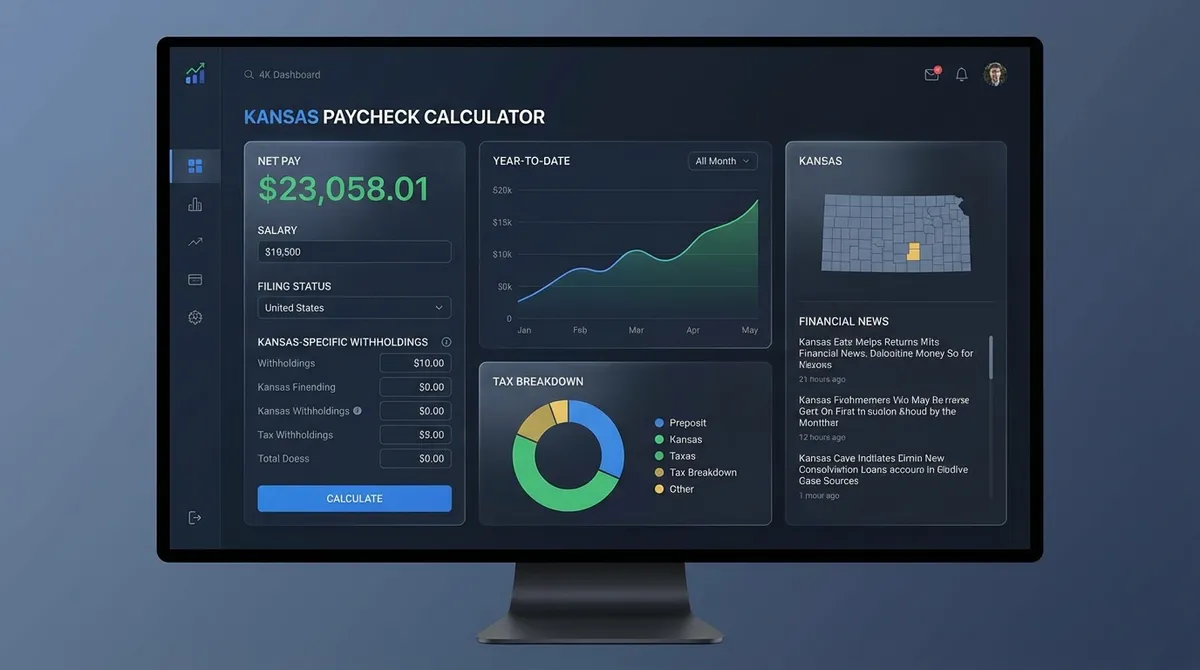
Understanding your paycheck in Kansas is more important than ever with the recent tax reforms for 2025. Whether you are living in Wichita, Overland Park, or Topeka, knowing exactly how much you'll take home helps you budget confidently.
Our Kansas Paycheck Calculator is updated with the latest Senate Bill 1 (2024) tax bracket changes, ensuring you get the most accurate estimate of your net pay. This guide breaks down how your Kansas taxes are calculated, the new tax brackets for 2025, and how to optimize your take-home pay.
Significant Changes for 2025 (SB 1)
The Kansas legislature passed significant tax reform (Senate Bill 1) that simplifies the state income tax system starting in tax year 2024 and continuing into 2025. The previous three-bracket system has been replaced by a streamlined two-bracket system.
2025 Kansas Tax Highlights:
- New Two-Bracket System: Rates are now 5.2% and approximately 5.58%.
- Higher Standard Deductions: Increased to $3,605 for Single and $8,240 for Married Filing Jointly.
- Personal Exemptions: Significant increase to $9,160 (Single) and $18,320 (Married Joint).
- Dependent Exemptions: An additional $2,320 per dependent.
- Social Security Tax Cut: Social Security benefits are now fully exempt from Kansas state income tax.
2025 Kansas Income Tax Brackets
Under the new system, your taxable income (after deductions and exemptions) is taxed at the following rates:
Single / Filing Separately / Head of Household
| Taxable Income | Rate |
|---|---|
| $0 – $23,000 | 5.20% |
| $23,001+ | 5.58% |
Married Filing Jointly
| Taxable Income | Rate |
|---|---|
| $0 – $46,000 | 5.20% |
| $46,001+ | 5.58% |
How Your Paycheck is Calculated
Your net pay is calculated by taking your gross pay and subtracting the following:
- Pre-Tax Deductions: Contributions to 401(k), HSA, or medical insurance are removed first. This lowers your taxable income.
- Federal Income Tax: Calculated using the IRS 2025 brackets (10% to 37%) based on your annualized taxable income. See our Federal Income Tax Calculator for details.
- OASDI (Social Security): 6.2% of your gross earnings up to the wage base limit ($176,100 for 2025).
- Medicare Tax: 1.45% of all gross earnings (plus an extra 0.9% for high earners).
- Kansas State Tax: Calculated on your Kansas Taxable Income (Adjusted Gross Income minus Standard Deduction minus Personal Exemptions).
Example: Comparing 2024 vs 2025
Let's see how the 2025 tax cuts affect a typical earner.
Scenario: Single Earner, $50,000 Gross Income
Assumes standard deduction and 1 personal exemption.
*Calculations are estimates for illustrative purposes.
Kansas Labor Laws & Paycheck Rules
Beyond taxes, Kansas has specific labor laws that protect your paycheck.
Pay Frequency
Kansas law requires employers to pay employees at least once a month. However, most employers pay bi-weekly or semi-monthly. Employers must establish regular paydays and post notice of them.
Final Paycheck Timing
If you quit or are fired, your employer must pay you your final wages no later than the next regular payday. They cannot withhold your final check until you return equipment (though they may be able to deduct the cost if you authorized it in writing).
Overtime Rules
Kansas generally follows the federal FLSA. Non-exempt employees must be paid 1.5x their regular rate for all hours worked over 46 in a workweek (federal law is 40 hours, but most Kansas employers follow the stricter federal 40-hour standard).
Top 5 Payroll Mistakes in Kansas
Whether you are an employer running payroll or an employee checking your stub, these are the most common errors we see in the Sunflower State:
- Misclassifying Contractors: Kansas audits aggressively for employees misclassified as 1099 contractors. If you control their schedule and tools, they are likely W-2 employees.
- Ignoring Local Taxes: While rare, relying on default software settings might miss specific local jurisdictional rules if you live near state borders.
- Overlooking K-4 Updates: Failing to update your K-4 after a marriage or birth is the #1 reason for owing state taxes in April.
- Wrong Overtime Calculation: Bonuses must be included in the "regular rate of pay" when calculating overtime. Many employers forget this step.
- Lunch Break Deductions: Automatically deducting 30 minutes for lunch when the employee actually worked through the break is a wage theft violation.
Understanding Your Forms: W-4 vs. K-4
To get an accurate paycheck, you must fill out two key forms when you start a job:
- Federal W-4: Determines your federal income tax withholding. In 2025, this form focuses on filing status and dependents rather than "allowances."
- Kansas K-4: Determines your state income tax withholding. This form still uses the "allowance" system.
- 1 Allowance for yourself.
- 1 Allowance for your spouse (if filing jointly).
- 1 Allowance for each dependent.
- Additional allowances if you have high deductions (like itemized deductions).
Warning: Claiming too many allowances on your K-4 means less tax is taken out of your check, which feels good now but leads to a tax bill (and potential underpayment penalties) when you file your return.
Bonus Tax Rate in Kansas
Got a bonus? Don't be surprised if the taxes look higher.
Federal: Bonuses are considered "supplemental wages" and are typically withheld at a flat 22% rate (if under $1 million). Compare with our Bonus Tax Calculator.
State: Kansas does not have a special flat rate for bonuses; they are usually taxed at the highest bracket applicable to your income or withheld at a standard 5% depending on your employer's payroll software.
Brief History of Kansas Income Tax
Kansas tax policy has been a roller coaster over the last decade. The infamous "tax experiment" of 2012 reduced rates significantly and exempted pass-through business income entirely.
This led to budget shortfalls, resulting in a reversal in 2017 that reinstated the three-bracket system. Now, in 2025, Kansas is moving towards a flatter structure again, aiming for simplicity while maintaining revenue stability. Understanding this context explains why your paycheck withholding might change so frequently compared to other states.
Cost of Living vs. Your Paycheck
A dollar in Kansas goes further than in most states. When analyzing your net pay, it's important to consider purchasing power.
- Housing: The median home price in Kansas is roughly 30-40% lower than the national average.
- Groceries & Utilities: Generally 5-10% below national averages.
- Transportation: Gas prices are typically lower due to proximity to pipelines, but commute times in rural areas can be long.
Insight: A $50,000 salary in Topeka, KS offers a similar lifestyle to earning $85,000 in New York City or $70,000 in Denver, purely due to the lower cost of living foundation.
Frequently Asked Questions (FAQ)
What is the "Kansas Allowance" on the calculator?
In our calculator, "Kansas Allowances" refers to the number of dependent exemptions you are claiming. For 2025, each dependent adds a $2,320 exemption to your base personal exemption ($9,160 for Single, $18,320 for Joint).
Are Social Security benefits taxed in Kansas?
No. As of tax year 2024 and continuing into 2025, Kansas has eliminated state income tax on Social Security benefits for all residents, regardless of income level.
Does Kansas have a local income tax?
No, cities and counties in Kansas generally do not impose a local income tax on wages. You typically only pay Federal, State, and FICA taxes. However, there is a tax on intangibles (interest/dividends) in some counties, but this does not affect your paycheck withholding.
How much is the Kansas Standard Deduction for 2025?
For 2025, the standard deduction is $3,605 for single filers and $8,240 for married couples filing jointly. This is an increase from previous years to adjust for inflation.
Maximizing Your Take-Home Pay
To keep more of your hard-earned money, consider increasing pre-tax contributions. Putting money into a 401(k) or HSA reduces your taxable income for both Federal and Kansas state taxes.
For example, contributing $200 per paycheck to a 401(k) not only saves for your future but effectively costs you less than $200 in take-home pay because you avoid paying tax on that amount immediately. If you are paid hourly, check our Hourly to Salary Calculator to see the annual impact.