Complete Guide to LLC Taxes in 2025
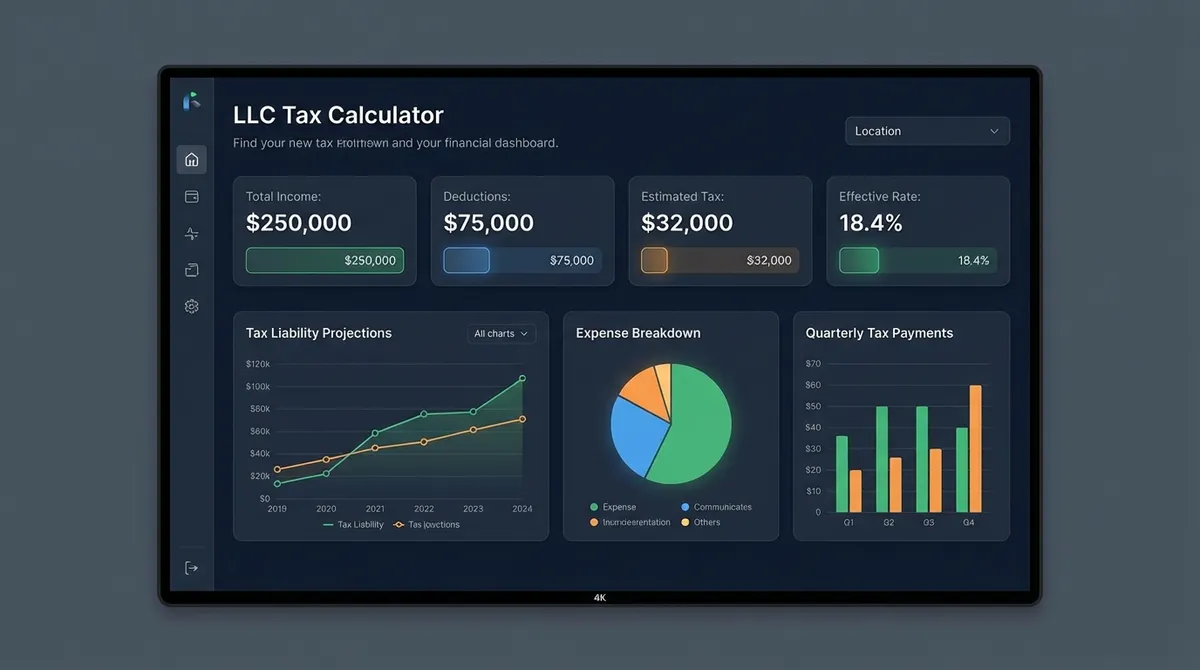
Understanding your tax obligations as a Limited Liability Company (LLC) owner is critical for maximizing your take-home pay. Unlike employees who have taxes withheld automatically, LLC members are responsible for calculating and paying their own taxes. This guide explains how LLCs are taxed, what the "pass-through" entity status means, and how to use the 2025 Qualified Business Income (QBI) deduction to potential save 20% on your taxes.
How Are LLCs Taxed?
By default, the IRS treats a single-member LLC as a "disregarded entity," meaning it is taxed exactly like a Sole Proprietorship. The business itself does not pay income tax. Instead, all profits "pass through" to the owner's personal tax return (Form 1040).
As an LLC owner, you are responsible for two main types of federal taxes:
- Self-Employment Tax (15.3%): This covers Social Security and Medicare taxes that an employer would normally pay half of.
- Federal Income Tax (10% - 37%): This is based on your total household income and your tax bracket.
Understanding Self-Employment Tax
The Self-Employment (SE) tax is often the biggest shock for new business owners. It consists of:
- 12.4% for Social Security: Applied to the first $168,600 of net earnings (2024 limit, adjusted annually).
- 2.9% for Medicare: Applied to all net earnings, with no cap.
Tax Saving Tip
You can deduct 50% of your Self-Employment Tax from your gross income. This is an "above-the-line" deduction that lowers your taxable income for federal income tax purposes. Our calculator automatically applies this deduction. Learn more at the IRS Self-Employed Tax Center.
The Qualified Business Income (QBI) Deduction
Introduced by the Tax Cuts and Jobs Act, the QBI deduction (Section 199A) is a massive benefit for LLC owners. It allows eligible business owners to deduct up to 20% of their Qualified Business Income from their taxes.
For example, if you have $100,000 in eligible net business income, you might be able to deduct $20,000, bringing your taxable amount down to $80,000.
Qualifications & Limits
The full 20% deduction is available if your total taxable income is below $191,950 (Single) or $383,900 (Married Filing Jointly) for 2024/2025. Above these thresholds, the deduction may be limited based on your business type (SSTB vs non-SSTB) and W-2 wages paid.
LLC vs. S-Corp Election
As your business grows, paying 15.3% SE tax on 100% of your profit becomes expensive. An LLC can elect to be taxed as an S-Corporation to save money.
In an S-Corp, you pay yourself a "reasonable salary" (subject to SE tax) and take the remaining profit as a "distribution" (NOT subject to SE tax). This strategy can save thousands in taxes once your net income exceeds roughly $60,000 - $80,000 per year.
Maximize Your Write-Offs: Common LLC Deductions
One of the biggest perks of operating as an LLC is the ability to deduct "ordinary and necessary" business expenses. Every dollar you deduct is a dollar you don't pay tax on.
🏠 Home Office Deduction
If you have a dedicated space in your home used exclusively for business, you can deduct a portion of your rent/mortgage, utilities, and internet. The simplified method allows a deduction of $5 per square foot (up to 300 sq ft).
🚗 Vehicle Expenses
You can deduct car expenses if you use your vehicle for business (client meetings, supply runs). You can track actual expenses (gas, insurance, repairs) or use the much simpler Standard Mileage Rate (67 cents per mile for 2024/2025).
💻 Software & Supplies
Laptops, printers, Zoom subscriptions, website hosting, accounting software, and office supplies are all 100% deductible in the year you buy them.
🏥 Health Insurance
Self-employed individuals can deduct health, dental, and long-term care insurance premiums for themselves and their families. This is an "above-the-line" adjustment to income.
Quarterly Estimated Taxes: Don't Get Penalized
Since taxes aren't withheld from your client payments, the IRS expects you to pay taxes as you earn money. If you owe more than $1,000 in tax at the end of the year, you are required to pay Quarterly Estimated Taxes.
| Payment Period | Due Date |
|---|---|
| Jan 1 – Mar 31 | April 15 |
| Apr 1 – May 31 | June 15 |
| Jun 1 – Aug 31 | Sept 15 |
| Sept 1 – Dec 31 | Jan 15 (Next Year) |
Tip: Set aside 25-30% of every payment you receive into a separate "Tax Savings" bank account. This ensures you have the cash ready when quarterly deadlines hit.
5 Common LLC Tax Mistakes to Avoid
- Mixing Personal and Business Funds: This is called "piercing the corporate veil." If you run personal expenses through your business account, you could lose your liability protection AND face an IRS audit. Always keep finances separate. Use a business loan or separate account if needed.
- Forgetting State Franchise Taxes: Even if your business makes $0, some states charge a mandatory fee just to exist. For example, California charges a minimum $800 franchise tax every year.
- Missed Startup Costs: You can deduct up to $5,000 in startup costs (marketing, legal fees, state filing fees) in your first year of business.
- Ignoring Local Taxes: Many cities and counties have their own business license fees or gross receipts taxes. Don't overlook these small but mandatory payments.
- Filing Late: The penalty for filing a late LLC return (Form 1065 for partnerships) is steep—approx $220 per member, per month. Single-member LLC schedules are due April 15th with your personal return.
LLC vs. Sole Proprietorship vs. Corporation
Choosing the right business structure is the first step in tax planning. While an LLC offers a sweet spot between protection and simplicity, it's helpful to compare it against the alternatives.
SimplestSole Proprietorship
This is the default if you just start doing business without registering anything.
- ✅ Pros: No setup fees, no annual reports, absolute control.
- ❌ Cons: Unlimited personal liability. If the business is sued, your house and car are at risk.
- 💰 Taxes: Same as a Single-Member LLC (Schedule C).
Limited Liability Company (LLC)
A legal entity formed at the state level that separates your personal assets from business debts.
- ✅ Pros: Personal liability protection (Corporate Veil), flexible management, pass-through taxation.
- ❌ Cons: State filing fees (e.g., $800 in CA), annual reporting requirements.
- 💰 Taxes: Flexible. Can be taxed as a Sole Prop, Partnership, S-Corp, or C-Corp.
C-Corporation
An independent legal entity owned by shareholders. This is the standard for Venture Capital-backed startups.
- ✅ Pros: Unlimited shareholders, ability to go public, strongest liability shield.
- ❌ Cons: Double Taxation (taxed on profit + shareholders taxed on dividends). Complex formalities (board sections, bylaws).
- 💰 Taxes: Flat 21% corporate tax rate (plus dividend tax).
The Verdict: For 90% of freelancers and small business owners, the LLC is the gold standard because it offers the protection of a corporation with the tax simplicity of a sole proprietorship.
How to Use This Calculator
- Enter Business Net Income: This is your Revenue minus Operating Expenses. Do not subtract taxes here.
- Add Expenses: If you haven't deducted them yet, input your deductible business expenses (rent, software, equipment).
- Select Filing Status: This affects your standard deduction and tax brackets.
- Review State Tax: Input your state's income tax rate (e.g., 0% for FL/TX, ~9.3% for CA).
Key Takeaways
- LLC owners must pay both employer and employee portions of Social Security/Medicare (15.3% total).
- The QBI deduction can reduce your income tax bill by 20%.
- Don't forget to pay Quarterly Estimated Taxes (Form 1040-ES) to avoid underpayment penalties.
- Keep meticulous records of all business expenses to lower your taxable income legally.