Complete Guide to Calculating Loan Interest
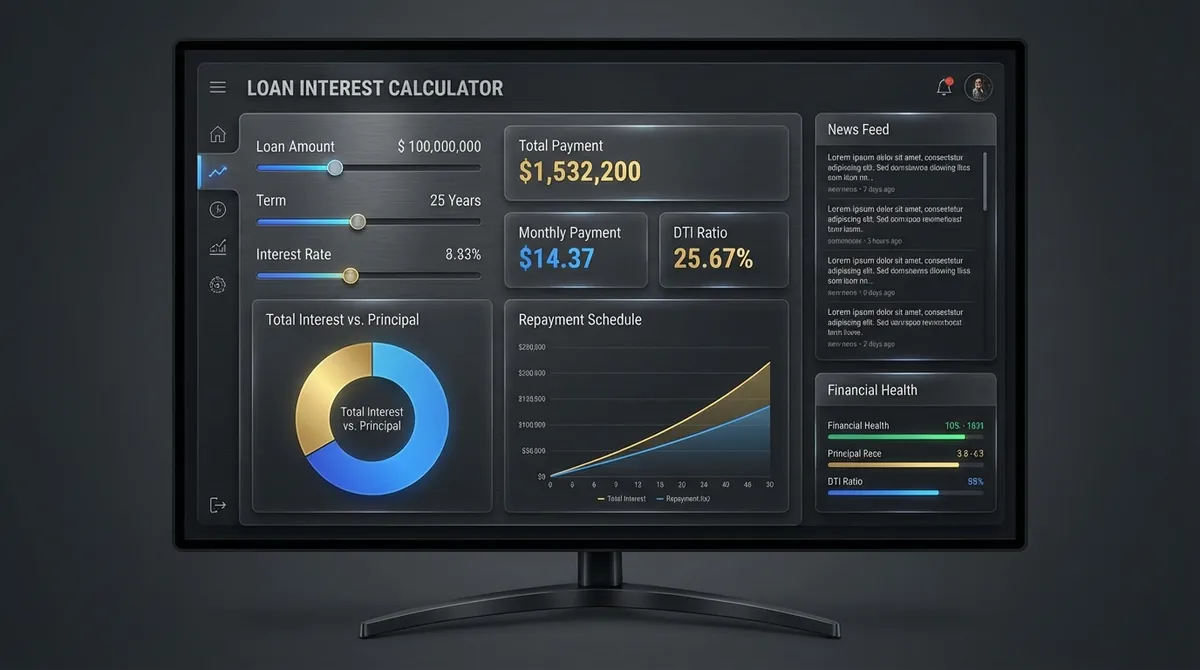
Understanding loan interest is the single most important factor in managing your debt effectively. Whether you are taking out a mortgage, buying a car, or consolidating credit cards, the interest rate determines the true cost of borrowing. A lower monthly payment might seem attractive, but it could mask thousands of dollars in hidden interest costs over the long run.
Why This Matters
A small difference in rates compounds massively over time. For example, on a $300,000 mortgage, the difference between a 6% and 7% interest rate is over $64,000 in extra interest payments over 30 years. Using a calculator empowers you to negotiate better terms.
How Loan Interest is Calculated
Not all loans are created equal. The way interest accrues depends on whether the loan uses Simple Interest or Amortized Interest. Knowing the difference is critical before you sign any paperwork.
Simple Interest
Interest is calculated only on the principal amount.
- Cost: Total interest is fixed upfront.
- Common In: Short-term personal loans, some auto loans.
Amortized Interest
Interest is calculated on the remaining balance each period.
- Cost: Front-loaded interest means you pay more early on.
- Common In: Mortgages, student loans, most car loans.
5 Factors That Control Your Interest Rate
Lenders don't just pick a number out of a hat. Your specific interest rate is determined by a risk assessment profile. Here are the five biggest levers you can pull:
- 1Credit Score (FICO)The most influential factor. A score of 760+ gets the "prime" rate. A score below 620 is considered "subprime" and can double your interest rate.
- 2Loan Term LengthShorter loans (e.g., 15-year mortgage vs. 30-year) inevitably have lower interest rates because the lender's money is at risk for less time.
- 3Down Payment / LTVPutting more money down lowers the Loan-to-Value (LTV) ratio. Lower LTV means less risk for the lender and often a lower rate for you.
- 4Debt-to-Income Ratio (DTI)Lenders look at how much of your monthly income is already committed to debt. Keep this below 36% for the best offers.
- 5Economic EnvironmentThe Federal Reserve's benchmark rate sets the floor for borrowing costs. When the Fed raises rates, your loan options get more expensive across the board.
A Brief History of Interest Rates
To understand if you are getting a good deal today, it helps to look at historical context. Interest rates are cyclical, driven by inflation data, economic growth, and Federal Reserve policy.
Decade-by-Decade Snapshot (30-Year Fixed Mortgage)
Takeaway: While rates today are higher than the historic lows of 2021, they are still well below the long-term historical average of ~7.75%.
Fixed vs. Variable Interest Rates: Which is Better?
When shopping for a loan, you will often face the choice between a fixed rate and a variable (adjustable) rate. Both have pros and cons depending on the economic environment.
Fixed Rate
Pros: Predictability. Your monthly payment never changes, making budgeting easy. You are protected if market rates rise.
Cons: Often starts slightly higher than variable rates. If market rates drop, you are stuck with the higher rate unless you refinance.
Variable Rate
Pros: Often starts with a lower introductory rate, saving you money initially. Good if you plan to pay off the loan quickly.
Cons: Unpredictable. If the Fed raises rates, your payment increases. Can lead to "payment shock."
The Invisible Cost: Inflation's Role
Inflation is the silent partner in every loan agreement. While interest is what you pay the bank, inflation is what happens to the value of the money you are paying back. Interestingly, inflation benefits borrowers with fixed-rate debt because you are paying back the loan with "cheaper" dollars in the future.
The Real Interest Rate Formula
To understand the true cost of your loan, you calculate the Real Interest Rate:
Real Rate ≈ Nominal Interest Rate - Inflation RateExample: If your mortgage rate is 4% and inflation is 3%, the real cost of borrowing is only about 1%. If inflation spikes to 5%, the real rate becomes negative—meaning the bank is effectively paying you to borrow money in real purchasing power terms!
Good Debt vs. Bad Debt
Not all interest payments are money down the drain. Financial experts often distinguish between "good debt" and "bad debt."
- Good Debt:
Debt used to acquire an asset that appreciates in value or generates income. Examples include a mortgage (builds equity), student loans (increases earning potential), or a business loan (generates profit). The interest is often tax-deductible.
- Bad Debt:
Debt used to buy depreciating assets or consumption goods. Examples include high-interest credit card debt for clothes or vacations, or payday loans. This debt drains your wealth and offers no return on investment.
The Psychology of Paying Interest
Behavioral economists have found that humans are naturally "present-biased." We prefer immediate gratification over future rewards. This is why high-interest debt is so dangerous—it allows us to buy something now while pushing the pain of paying for it into the future.
When you pay interest, you are essentially paying a premium for impatience. By shifting your mindset to delaying gratification and saving up for purchases, you flip the equation: instead of paying interest to a bank, you earn interest from the bank. This single behavioral shift is often the difference between those who build wealth and those who remain in debt cycles.
The "APR" Trap: Don't Be Fooled
One of the most common mistakes borrowers make is confusing the Interest Rate with the Annual Percentage Rate (APR). They are NOT the same thing, and knowing the difference can save you thousands.
Interest Rate
This is simply the cost of borrowing the principal amount. It determines your monthly principal and interest payment.
- • Used to calculate monthly payment
- • Doesn't include fees
- • Always lower than APR
APR (Annual Percentage Rate)
This is the TOTAL cost of the loan, expressed as a rate. It includes the interest rate PLUS origination fees, closing costs, points, and insurance.
- • True cost of borrowing
- • Includes all lender fees
- • Best for comparing lenders
Pro Tip: When shopping for a loan, always compare APRs, not just interest rates. Lender A might offer a 6.5% rate with high fees (6.9% APR), while Lender B offers a 6.6% rate with zero fees (6.6% APR). Lender B is actually cheaper!
Real-Life Example: The Cost of a Car Loan
Let's look at a realistic scenario for 2025. You want to buy a car for $25,000. You have two options for financing: a 3-year term or a 6-year term. Both have an interest rate of 8%.
| Scenario | Monthly Payment | Total Interest Paid | Total Cost |
|---|---|---|---|
| 3-Year Term (36 mo) | $783 | $3,200 | $28,200 |
| 6-Year Term (72 mo) | $438 | $6,550 | $31,550 |
The Verdict: By choosing the longer term to get a lower monthly payment ($438 vs $783), you end up paying double the interest ($6,550 vs $3,200). Always look at the "Total Interest" line, not just the monthly payment.
Expert Tips to Lower Your Interest
Shop Around
Never accept the dealer's or bank's first offer. Get quotes from at least 3 lenders (banks, credit unions, online lenders). Rate shopping within a 14-day window counts as a single hard inquiry on your credit.
Pay Bi-Weekly
Instead of one monthly payment, pay half that amount every two weeks. This results in 26 half-payments (13 full payments) per year, shaving months off your loan term effortlessly.
Round Up Payments
Round your payment up to the nearest $50 or $100. If your payment is $438, pay $450 or $500. This extra principal reduction destroys interest costs over time.
Refinance if Rates Drop
If your credit score improves or market rates drop by more than 1%, calculate if refinancing makes sense. The savings can be substantial.