Complete Guide: Markup Calculator
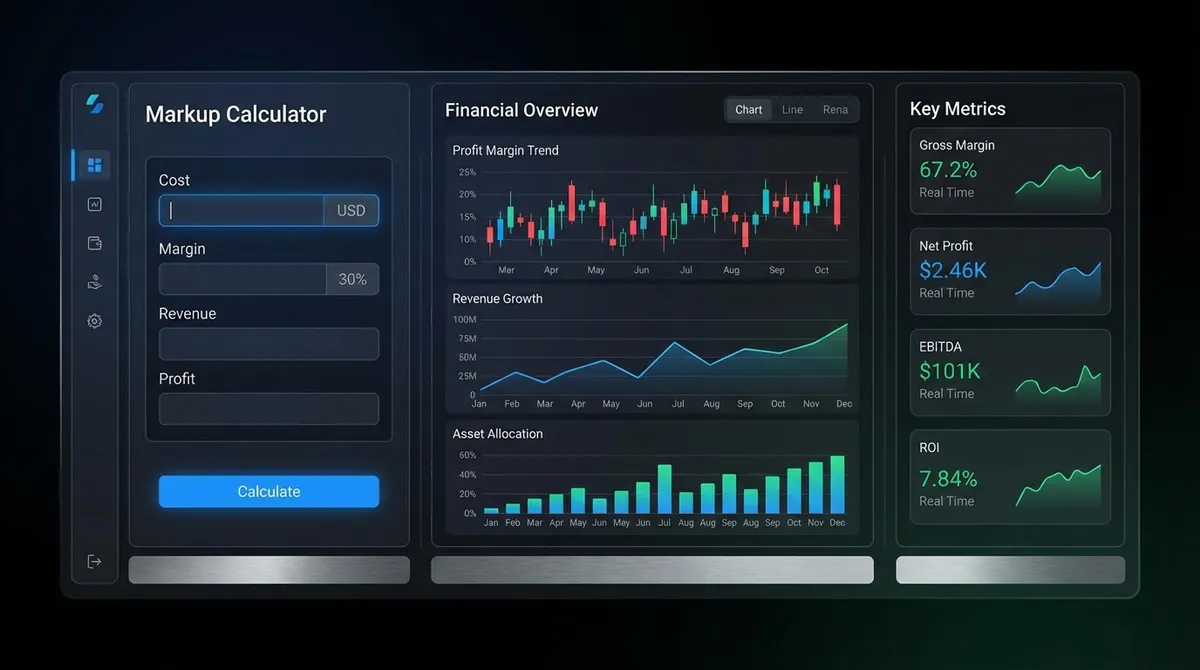
A markup calculator is an essential tool for business owners, entrepreneurs, and pricing managers who need to determine the optimal selling price for their products or services. Understanding markup calculation is fundamental to business success—it directly impacts your profitability, competitive positioning, and long-term sustainability.
What is Markup and Why Does it Matter?
Markup is the difference between the cost of a product and its selling price, expressed as a percentage of the cost. It represents the amount you add to your cost to cover overhead expenses and generate profit. For example, if a product costs $50 and you sell it for $75, your markup is $25, or 50% of the cost.
Proper markup calculation is critical because it ensures you not only cover all your costs—including direct costs (materials, labor) and indirect costs (rent, utilities, marketing)—but also generate sufficient profit to grow your business. Many small businesses fail not because they do not have good products, but because they underprice them, leading to insufficient margins to sustain operations.
Key Concepts: Markup vs. Margin
Many business owners confuse markup with profit margin, but these are distinct concepts that serve different purposes in financial analysis.
Markup: Calculated as a percentage of the cost price. It answers: "How much do I need to add to my cost to achieve my desired price?"
Gross Profit Margin: Calculated as a percentage of the selling price. It answers: "What percentage of my selling price is actual profit?"
This distinction is crucial because a 50% markup does not equal a 50% profit margin. In fact, a 50% markup results in only a 33.33% profit margin. Understanding this difference helps you set prices that actually achieve your profitability goals.
How to Use This Markup Calculator
Our markup calculator offers three different calculation modes to accommodate various pricing scenarios you might encounter in your business.
1. Cost & Markup % Mode (Most Common)
Use this when you know your product cost and want to apply a specific markup percentage. Simply enter your cost price and desired markup percentage, and the calculator will determine your selling price.
Example: Cost = $50, Markup = 50% → Selling Price = $75
2. Selling Price Mode
Use this when you want to achieve a specific selling price and need to determine what markup percentage to apply or what cost price to negotiate with suppliers.
Example: Desired Price = $100, Cost = $60 → Markup = 66.67%
3. Cost Price Mode
Use this reverse calculation when you know your selling price and markup percentage, and need to determine your maximum allowable cost to maintain profitability.
Example: Selling Price = $80, Markup = 100% → Max Cost = $40
The Formulas Behind Markup Calculation
Understanding the mathematical formulas helps you perform quick mental calculations and verify your pricing strategy even without a calculator.
Core Markup Formulas:
Selling Price = Cost Price × (1 + Markup % ÷ 100)
This is the fundamental formula used when calculating selling price from cost and markup percentage.
Markup Amount = Selling Price − Cost Price
Shows the actual dollar amount of profit per unit before overhead expenses.
Markup % = (Markup Amount ÷ Cost Price) × 100
Calculates the markup percentage when you know both cost and selling price.
Gross Margin % = (Gross Profit ÷ Selling Price) × 100
Shows what percentage of your selling price is actual profit (different from markup).
Industry-Specific Markup Guidelines
Different industries have vastly different standard markup percentages based on factors like competition, overhead costs, and typical sales volume. Here are the most common ranges:
Retail Products
Typical Markup: 50% to 100%
Why: Must cover store overhead, inventory carrying costs, and seasonal markdowns
Example: $50 cost → $75-$100 selling price
Restaurant Food & Beverages
Typical Markup: 200% to 400%
Why: High labor costs, waste, kitchen equipment, and perishable inventory
Example: $5 cost → $20 selling price
Clothing & Fashion
Typical Markup: 100% to 300%
Why: Seasonal trends, high return rates, and fashion obsolescence
Example: $25 cost → $50-$100 selling price
Electronics
Typical Markup: 10% to 50%
Why: High competition, rapid price erosion, and thin margins
Example: $200 cost → $220-$300 selling price
Jewelry & Luxury Goods
Typical Markup: 100% to 1000%
Why: Brand premium, craftsmanship, and exclusivity positioning
Example: $500 cost → $1,000-$5,000 selling price
Consulting Services
Typical Markup: 100% to 300%
Why: Expertise premium, limited billable hours, and business development costs
Example: $50/hour cost → $150-$200/hour rate
The Hidden Costs of Doing Business
One of the biggest mistakes business owners make is setting markup based solely on competitor prices without accounting for their own true costs. Your markup must cover both direct and indirect expenses:
Direct Costs (Cost of Goods Sold)
- • Product manufacturing or wholesale cost
- • Shipping and freight charges
- • Direct labor for production
- • Packaging materials
Indirect Costs (Operating Expenses)
- • Rent, utilities, and facility costs
- • Employee salaries and benefits
- • Marketing and advertising
- • Insurance and professional services
- • Equipment and technology
- • Administrative and office expenses
A general rule: If your total indirect costs are 30% of revenue, you need at least a 30% gross margin just to break even. This means your markup must be at least 43% (since 30% margin = 43% markup). Most successful businesses target a markup that yields 40-60% gross margin to ensure healthy net profits after all expenses.
Common Markup Mistakes to Avoid
Mistake 1: Underpricing to Compete
Competing solely on price is often a race to the bottom. Instead of lowering your markup, focus on differentiating your value proposition. Customers will pay premium prices for better quality, superior service, or unique features. A 10% price increase often has more impact on profit than a 10% sales volume increase.
Mistake 2: Not Accounting for All Costs
Many businesses calculate markup based only on product cost, forgetting about shipping, handling, storage, and overhead. Your markup must cover the total cost of getting the product to the customer, not just the wholesale price.
Mistake 3: Ignoring Psychological Pricing
A price of $99.99 feels significantly different from $100, even though the difference is just one cent. Similarly, luxury products often benefit from round numbers ($500) while value products work better with odd pricing ($47.50). Your markup calculation should consider these psychological factors in the final price.
Mistake 4: Failing to Adjust for Market Changes
Supplier costs, shipping rates, and market demand change constantly. Your markup should be reviewed quarterly and adjusted as needed. A price that was profitable six months ago might be losing you money today if costs have increased.
Advanced Markup Strategies
Tiered Markup Structure
Different products in your catalog should have different markups based on their role:
- • Loss Leaders: 10-20% markup (attract customers, drive traffic)
- • Core Products: 50-100% markup (steady sellers, reliable profits)
- • Premium Products: 150-300% markup (exclusive items, brand builders)
- • Complementary Items: 100-200% markup (impulse buys, accessories)
Dynamic Pricing
Consider implementing dynamic pricing where markup adjusts based on factors like seasonality, inventory levels, competitor pricing, and customer segments. Airlines and hotels have used dynamic pricing for decades, and e-commerce businesses are increasingly adopting similar strategies.
Value-Based Pricing
The most sophisticated pricing strategy focuses on customer-perceived value rather than cost-plus markup. If customers believe your product is worth $200, that's what you should charge—even if it only costs you $30 to produce. The key is understanding and communicating your unique value proposition effectively.
Using Your Markup Calculator for Strategic Planning
Beyond simple price calculations, use this tool for strategic business planning:
- Scenario Analysis: Test different markup percentages to see how they affect your selling price and profit margins. Use the preset scenarios to quickly evaluate pricing strategies.
- Break-Even Analysis: Determine the minimum markup needed to cover all your costs and achieve profitability goals.
- Competitive Positioning: Calculate your markup based on what the market will bear, then work backward to determine your maximum allowable product costs when negotiating with suppliers.
- Product Line Optimization: Identify which products in your catalog have healthy margins and which might need repricing or cost reduction efforts.
Key Takeaways
Mastering markup calculation is fundamental to business success. Remember these key points:
- • Markup and margin are different—markup is percentage of cost, margin is percentage of selling price
- • Your markup must cover both direct costs and indirect business expenses
- • Industry standards vary dramatically—know your industry's typical ranges
- • Regular price reviews are essential as costs and market conditions change
- • Value-based pricing often outperforms cost-plus pricing in mature markets
- • Use tiered pricing strategies for different product categories in your catalog
Use our markup calculator above to experiment with different scenarios, understand your true costs, and develop pricing strategies that ensure sustainable profitability. The right markup does not just cover your costs—it funds your growth, rewards your innovation, and positions you competitively in your market.