Complete Guide: Massachusetts Paycheck Calculator 2025
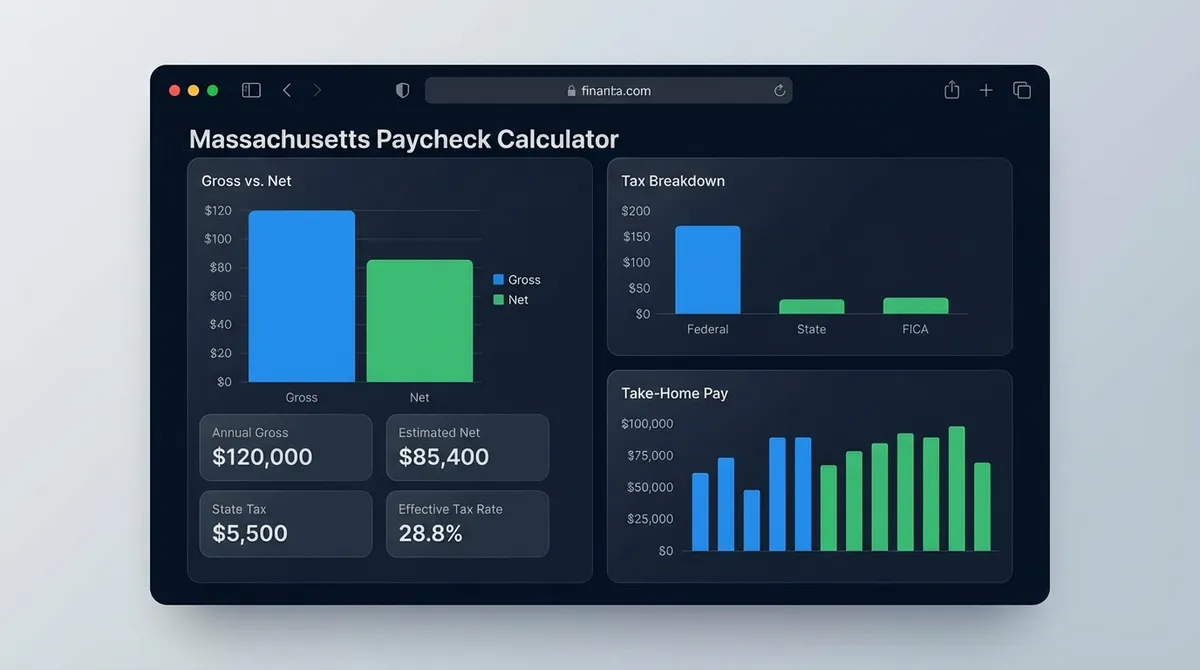
If you live or work in the Bay State, understanding your paycheck is surprisingly straightforward compared to other states, yet it comes with unique line items that can be confusing. Massachusetts predominantly uses a flat 5% income tax rate, making the core math simple, but mandatory contributions for programs like Paid Family and Medical Leave (PFML) add layers of complexity. Our 2025 Massachusetts Paycheck Calculator is designed to cut through this noise, helping you verify your take-home pay and ensure your employer is withholding the correct amounts.
1Understanding the "Flat Tax" System
Why It Matters
Most states use progressive tax brackets where your rate increases as you earn more (e.g., California tops out at 14.4%). Massachusetts is different. It applies a single rate of 5.00% to nearly all earned income.
- Consistency: Your raise is taxed at the same rate as your base salary.
- Bonus Pay: Supplemental wages are also withheld at a flat 5%, preventing "tax shock" at year-end.
This 5% rate applies to wages, salaries, tipping income, pensions, and business income. Note that short-term capital gains (assets held for less than a year) are taxed at a much higher rate of 8.5% (formerly 12%), but this rarely affects your standard paycheck.
2Decoding Your Pay Stub: The Deductions
Your "net pay" is the result of a specific subtraction sequence. Here is exactly what comes out of your check in Massachusetts:
A. Federal Taxes
- Federal Income Tax: Based on your W-4 form. Progressive rates from 10% to 37%.
- Social Security: 6.2% of your first $176,100 in earnings (2025 limit).
- Medicare: 1.45% of all earnings. High earners ($200k+) pay an extra 0.9%.
B. Massachusetts Taxes
- State Income Tax: A flat 5% on taxable income.
- PFML (Family/Medical Leave): A mandatory state insurance program. For 2025, the maximum contribution rate is roughly 0.88% of eligible wages, split between employer and employee. Learn more at Mass.gov.
🎁 Special Massachusetts Deductions
The Commonwealth offers unique deductions that can put money back in your pocket. These don't lower your weekly withholding directly, but they lead to larger refunds.
Rent Deduction
Renters in MA catch a break! You can deduct 50% of your rent paid from your taxable income, up to a maximum deduction of $4,000 (for 2024/2025).
Example: If you pay $2,000/mo ($24k/year), 50% is $12k. But you hit the cap of $4,000. At a 5% tax rate, that saves you $200 cash.
Commuter Deduction
Do you take the T, the Commuter Rail, or pay tolls on the Pike? You can deduct commuting costs (MBTA passes, E-ZPass) that exceed $150. The deduction is capped at $750 per person.
Student Loan Interest
Unlike the federal deduction which has income limits, Massachusetts allows you to deduct undergraduate student loan interest with NO cap and NO income limit.
Premium Pay & "Blue Laws"
Massachusetts has some of the strongest worker protection laws in the country, dating back to colonial "Blue Laws." While many restrictions on Sunday retail hours have been relaxed, pay requirements remain.
Retail Sundays
Historically, retail employees were entitled to 1.5x pay on Sundays. However, this has been phased out. As of 2023, the premium pay requirement was eliminated, but voluntary work protections remain—employers cannot force you to work Sundays in retail.
Holidays
For certain holidays (like Columbus Day, Veterans Day), retail workers may still be entitled to premium pay or voluntary refusal rights depending on the business size. Always check the latest Attorney General guidance. If you are unsure about your rights, consult your employee handbook or speak directly with your HR representative. This is especially true for small businesses that may not be covered by the same mandates as large retailers.
🎁 Special Massachusetts Deductions
The Commonwealth offers unique deductions that can put money back in your pocket. These don't lower your weekly withholding directly, but they lead to larger refunds.
Rent Deduction
Renters in MA catch a break! You can deduct 50% of your rent paid from your taxable income, up to a maximum deduction of $4,000 (for 2024/2025).
Example: If you pay $2,000/mo ($24k/year), 50% is $12k. But you hit the cap of $4,000. At a 5% tax rate, that saves you $200 cash.
Commuter Deduction
Do you take the T, the Commuter Rail, or pay tolls on the Pike? You can deduct commuting costs (MBTA passes, E-ZPass) that exceed $150. The deduction is capped at $750 per person.
Student Loan Interest
Unlike the federal deduction which has income limits, Massachusetts allows you to deduct undergraduate student loan interest with NO cap and NO income limit.
The Fair Share Amendment (Millionaire Tax)
Passed by voters in 2022 and effective since 2023, Massachusetts now has a "surtax" on high earners. If your annual taxable income exceeds $1,000,000 (adjusted annually for inflation), you pay an extra 4% on every dollar above that threshold.
Example: Income of $1,100,000.
First $1M is taxed at 5%.
The legally distinct $100k "excess" is taxed at 9% (5% flat + 4% surtax).
What is "MAPFML" on my pay stub?
You will often see a line item for MAPFML or PFML. This stands for Massachusetts Paid Family and Medical Leave. It is not exactly a tax, but a state-run insurance premium.
Most workers in Massachusetts are eligible to take up to 26 weeks of paid leave for medical or family reasons. To fund this, the state collects a small percentage of wages.
Note: Employers with fewer than 25 employees are exempt from paying the employer portion, but they must still remit the employee portion withheld from your check. This is why the specific amount deducted can vary slightly depending on your company's size.
Real-World Paycheck Scenarios (2025 Estimate)
| Annual Salary | Filing Status | Pay Period | Gross Pay | Est. Net Pay |
|---|---|---|---|---|
| $60,000 | Single | Bi-Weekly | $2,307 | ~$1,780 |
| $95,000 | Single | Semi-Monthly | $3,958 | ~$2,940 |
| $150,000 | Married | Monthly | $12,500 | ~$9,450 |
Frequently Asked Questions
Is there a standard deduction in Massachusetts?
Yes. For the flat tax calculation, Massachusetts allows a personal exemption. For 2024/2025, this is typically around $4,400 for singles and $8,800 for married joint filers, plus an additional amount for each dependent ($1,000 per dependent). This reduces your taxable income before the 5% rate is applied.
Does Massachusetts tax 401(k) contributions?
Generally, no. Traditional 401(k) contributions are deducted pre-tax for both federal and Massachusetts state tax purposes. This means investing in your retirement directly lowers your state tax bill today.
Do I pay tax if I work in MA but live in NH?
Yes. Massachusetts taxes income "sourced" within the state. Even though New Hampshire has no income tax on wages, if you commute to Boston for work, you owe Massachusetts 5% on the money earned there. However, you do not pay MA tax on income earned while physically working in NH (e.g., remote work days), subject to specific telecommuting rules.
About the Author
Marko Hrvojević is a Finance Expert and CPA with over a decade of experience in tax planning and payroll analysis. He specializes in simplifying complex tax codes for everyday earners.
Read full bio→