Massachusetts State Tax: The Complete 2025 Guide
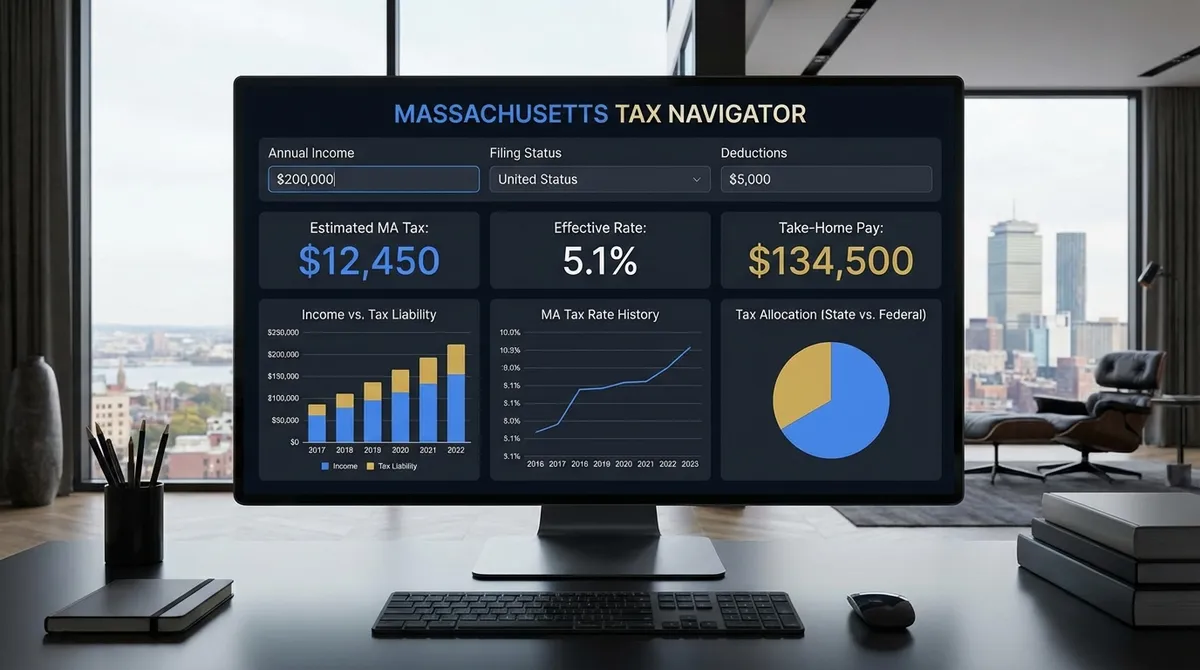
Massachusetts—often nicknamed "Taxachusetts"—actually has a simpler tax system than many realize. While states like New York and California use complex progressive brackets, Massachusetts relies primarily on a flat 5% income tax rate. However, recent changes like the "Millionaire's Tax" and Paid Family and Medical Leave (PFML) contributions have added new layers to the math.
Whether you earn $50,000 or $5,000,000, understanding these rules is key to avoiding surprises. This guide breaks down exactly how your 2025 taxes are calculated, where your money goes, and how you can legally lower your bill. By mastering the nuances of deductions, exemptions, and credits, you can ensure you're not paying a penny more than necessary.
At a Glance: MA Tax Rules (2025)
- • Flat Rate: 5.0% on most income.
- • Surtax: +4% on income over $1,083,150.
- • PFML: ~0.46% (Employee Share).
- • Standard Deduction: None (Use Exemptions).
How the Massachusetts "Flat Tax" Works
Unlike the federal government, which chops your income into brackets with rising rates (10%, 12%, 22%...), Massachusetts takes a different approach. For the vast majority of residents, every dollar of taxable income is taxed at the same 5% rate.
This means if you earn $60,000 in taxable income, your state tax is $3,000. If you earn $100,000, it's $5,000. Simple, right? But "taxable income" is the key phrase here. You don't pay tax on every dollar you earn thanks to exemptions. The beauty of a flat tax system is its predictability; you can easily estimate your liability without consulting complex tables. However, this simplicity also means fewer opportunities for rate arbitrage compared to progressive systems.
Understanding Exemptions (The MA "Standard Deduction")
Massachusetts doesn't use a "Standard Deduction" like the IRS. Instead, it uses Personal Exemptions. These reduce your income before the 5% rate is applied.
- Single / Married Separate$4,400
- Head of Household$6,800
- Married Filing Jointly$8,800
- Per Dependent+$1,000
The "Millionaire's Tax" (Fair Share Amendment)
In 2022, voters approved a constitutional amendment that changed the landscape for high earners. Starting in 2023, income over $1 million became subject to an additional 4% surtax.
For 2025, this threshold has been inflation-adjusted to roughly $1,083,150. This was a landmark shift in Massachusetts tax policy, moving the state from a purely flat tax system to a modified progressive one at the very top end.
How it works in practice:
If you earn $2,000,000, you pay the standard 5% flat tax on everything. Then, you pay an extra 4% only on the dollars above $1,083,150. You do not pay 9% on your entire income. This marginal structure ensures that earning one dollar over the threshold doesn't disproportionately penalize you.
What is the PFML Tax?
If you look at your pay stub, you might see a deduction for "MA PFML." This stands for Paid Family and Medical Leave. It's a state insurance program that allows workers to take paid time off for serious health conditions or to care for family members.
For 2025, the total contribution rate is 0.88% of eligible wages. However, employers often split this cost. The maximum amount allowed to be deducted from your paycheck is typically around 0.46% (for medical and family leave combined), while the employer covers the rest. Self-employed individuals may also opt-in to this program, though they would be responsible for the full contribution rate.
*Note: Our calculator estimates your share at 0.46%, but your actual deduction may vary depending on your employer's specific plan and size. Some employers with fewer than 25 employees are exempt from the employer portion, though they must still remit the employee portion.
3 Smart Ways to Lower Your MA Tax Bill
Even with a flat tax, you have control over how much you pay. Here are the most effective strategies for Massachusetts residents:
- Max Out Retirement Accounts (401k / 403b):
Massachusetts generally follows federal rules for pre-tax deductions. Every dollar you contribute to a traditional 401(k) reduces your MA taxable income. For 2025, that's up to $23,000 (or $30,500 if you're 50+) off the top. This is the single most powerful tool for most taxpayers to lower their AGI.
- Senior Circuit Breaker Credit:
If you're 65 or older and own or rent a home in Massachusetts, you might qualify for this refundable credit. It's designed to prevent property taxes from overwhelming your income. For 2024 tax returns (filed in 2025), the maximum credit is over $2,500. This credit is refundable, meaning if it reduces your tax liability below zero, the state sends you a check for the difference.
- Rental Deduction:
Renters in Massachusetts can deduct 50% of the rent they paid during the year, up to a maximum deduction of $4,000 (Verified 2024 limit). This is a unique "perk" of the MA tax code that often goes unclaimed. Make sure to keep your lease or rent receipts as proof in case of an audit.
Massachusetts vs. New Hampshire: The Border Effect
Living near the border presents unique choices. New Hampshire has no tax on earned income (wages/salaries), while Massachusetts has its 5% flat tax. This leads many to ask: "Should I live in NH and work in MA?"
The answer isn't always straightforward. If you live in NH and commute to MA, you are a non-resident of MA but must pay MA income tax on the wages earned there. You don't escape the 5% tax just by sleeping in New Hampshire. However, your investment income (interest, dividends, capital gains) would generally be shielded from MA tax if you are an NH resident, as NH is phasing out its interest and dividends tax.
Conversely, living in MA and working in NH means you pay MA tax on your worldwide income, including your NH wages. Massachusetts does give a credit for taxes paid to other states, but since NH has no income tax, there is no credit to claim. You pay the full 5% to Massachusetts. This "commuter tax" trap catches many new residents off guard.
Lesser-Known Massachusetts Tax Credits
Beyond the standard deductions, Massachusetts offers specific credits that target environmental improvements and dependent care.
Solar and Wind Energy Credit
If you install a renewable energy system in your primary residence, you can claim a credit of 15% of the net expenditure, up to a maximum of $1,000. This credit can be carried forward for three years if it exceeds your tax liability.
Septic System Credit (Title 5)
Homeowners who repair or replace a failed septic system can claim a credit of up to $1,500 per year for a total of $6,000 (40% of costs up to $15,000). This is a crucial credit for many residents in non-sewer areas.
Lead Paint Removal Credit
To encourage safety in older housing stock, Massachusetts offers a credit of up to $1,500 per residential unit for full lead compliance, or $500 for interim control measures.
Capital Gains Tax Details: Short vs. Long Term
Massachusetts distinguishes sharply between short-term and long-term investment gains, more so than the federal system.
- Short-Term Gains (Held < 1 Year): Taxed at a punitive 12% rate. This is significantly higher than the standard 5% income tax rate and is intended to discourage speculation and day trading. Use our capital gains tax calculator to estimate your liability.
- Long-Term Gains (Held > 1 Year): Taxed at the standard 5% rate. This aligns with the tax on wages and interest.
- Collectibles: Gains from the sale of collectibles (art, antiques, coins) are also taxed at the higher 12% rate, regardless of holding period.
This 12% short-term rate is one of the highest in the country. If you are planning to sell an asset that has appreciated significantly, waiting until you have held it for "one year plus one day" can save you 7% of the profit in state taxes alone.
Filing Requirements for Non-Residents
If you live in New Hampshire, Rhode Island, Connecticut, or Vermont but work in Massachusetts, you generally must file a Massachusetts Non-Resident Return (Form 1-NR/PY) if your Massachusetts-sourced income exceeds $8,000 or the prorated personal exemption, whichever is less.
Telecommuting Rule: Massachusetts has strict rules for telecommuters. If you work for a Massachusetts employer but live out of state, your wages may still be considered Massachusetts-sourced income unless your employer specifically requires you to work out of state for business necessity.
Penalties for Underpayment
Since Massachusetts relies heavily on withholding and estimated tax payments, falling behind can trigger penalties.
- Late Filing Penalty: 1% of the unpaid tax for each month the return is late, up to 25%.
- Late Payment Penalty: 1% of the unpaid tax for each month it remains unpaid, up to 25%.
- Underpayment of Estimated Tax: If you don't withhold enough (generally 80% of current year tax or 100% of prior year tax), you'll be charged interest on the underpayment balance.
Common Questions (FAQ)
I live in MA but work in another state. Do I pay MA tax?▼
Yes. As a Massachusetts resident, you are taxed on your worldwide income, regardless of where it is earned. However, you can typically claim a credit for taxes paid to the other state to avoid double taxation.
What is the Senior Circuit Breaker Credit?▼
It is a refundable credit for seniors (65+) whose property taxes or rent exceed a certain percentage of their income. For typical eligible homeowners and renters, this credit can be worth over $2,500.
Why is my Massachusetts withholding higher than 5%?▼
It likely accounts for the PFML tax (approx 0.46% for employees) in addition to the 5% income tax. If you are a high earner, your employer may also be withholding for the 4% surtax.
Are Social Security benefits taxable in MA?▼
No. Massachusetts does not tax Social Security benefits, nor does it tax government pensions (federal, MA state, or MA local). Other private pensions are generally taxable.
Does Massachusetts tax capital gains?▼
Yes. Long-term capital gains (held > 1 year) are taxed at the standard 5%. However, short-term capital gains (held < 1 year) are taxed at a much higher 12% rate.