Complete Guide: Michigan Paycheck Calculator 2025
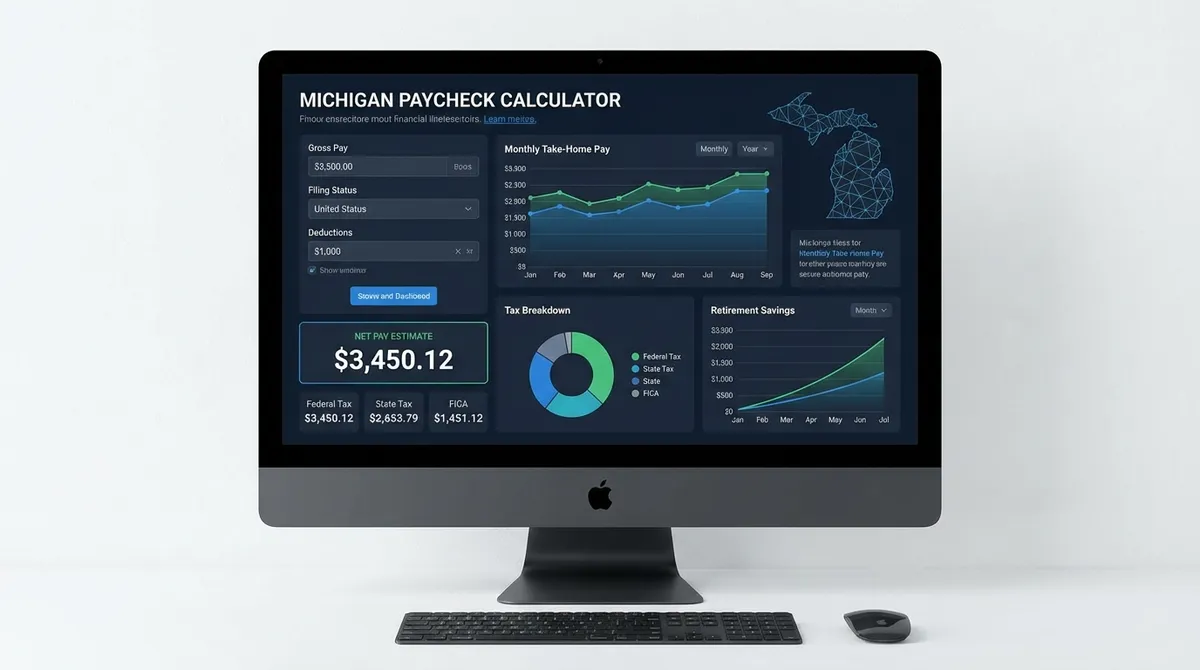
Understanding your take-home pay in Michigan means navigating a unique tax landscape. Unlike many states with complex progressive income tax systems, Michigan employs a straightforward flat tax rate, yet adds complexity with city-specific income taxes in over 20 municipalities. For a deeper dive into state taxes, check our Michigan Tax Calculator.
For 2025, Michigan residents continue to benefit from the flat 4.25% state income tax rate and an increasing personal exemption of $5,800. Whether you're a new employee in Detroit, a healthcare worker in Grand Rapids, or an engineer in Ann Arbor, accurately forecasting your net pay requires accounting for federal withholdings, FICA taxes, state levies, and potential local city taxes.
What's New for Michigan Taxes in 2025?
Several key updates affect your paycheck calculation for the 2025 tax year:
- Personal Exemption IncreaseThe state personal exemption has risen to $5,800, shielding more of your income from the 4.25% state tax.
- Standard Federal DeductionsFederal standard deductions have increased to $15,000 for singles and $30,000 for married joint filers, reducing your federal tax burden.
- Social Security Wage BaseThe maximum taxable earnings for Social Security (6.2%) has increased to $176,100.
- EITC ExpansionMichigan's specific Earned Income Tax Credit match remains at 30% of the federal credit, providing significant relief for eligible lower-income workers.
Deep Dive: How Michigan's Flat Tax Works
Michigan is one of the few states with a true flat income tax system. This means that regardless of whether you earn $30,000 or $3,000,000, your state tax rate is the same: 4.25%.
The Calculation Formula
Why It Matters
The flat tax simplifies planning. A bonus or raise is taxed at exactly the same 4.25% state rate as your regular salary, unlike federal taxes where extra income might jump into a higher bracket.
The Local City Tax Factor
While the state system is simple, Michigan's local city taxes add a layer of complexity. If you live OR work in one of the 24 taxing cities, you owe additional income tax.
| City | Resident Rate | Non-Resident Rate |
|---|---|---|
| Detroit | 2.40% | 1.20% |
| Grand Rapids | 1.50% | 0.75% |
| Saginaw | 1.50% | 0.75% |
| Lansing | 1.00% | 0.50% |
* Non-resident rates apply if you work in the city but live elsewhere.
The Hidden Paycheck Leaks: Voluntary Deductions
While taxes get all the attention, "Voluntary Deductions" often eat up 5-15% of a typical paycheck. These are the benefits you elect during open enrollment. It's crucial to understand which ones are "Pre-Tax" (good for your tax bill) and which are "Post-Tax" (no tax benefit).
✅ Pre-Tax (Reduces Taxes)
- Medical/Dental Premiums: Usually the largest deduction.
- HSA Contributions: Triple tax advantage.
- FSA (Flexible Spending): Use it or lose it funds for healthcare/caregiving.
- Traditional 401(k): Defers taxes until retirement.
- Commuter Benefits: Parking/Transit (up to federal limits).
🛑 Post-Tax (No Tax Help)
- Roth 401(k): Taxed now, tax-free later.
- Life Insurance (Supplemental): Often post-tax.
- Disability Insurance: Paying post-tax keeps benefits tax-free later.
- Union Dues: No longer federally deductible for most.
- Wage Garnishments: Child support, student loans, etc.
How Are Bonuses Taxed in Michigan?
If you receive a $5,000 annual bonus, you might be shocked to see a check for only ~$3,000. Is the government punishing you for working hard? Not exactly—it's just withholding rules (The "Supplemental Wage" rate).
| Tax Type | Regular Pay Method | Bonus Pay Method |
|---|---|---|
| Federal | Progressive Brackets (10-37%) | Flat 22% |
| Michigan State | Flat 4.25% | Flat 4.25% |
| FICA | 7.65% | 7.65% |
*Note: The 22% federal rate is just a withholding estimate. If your actual effective tax rate is only 12%, you will get the difference back as a refund when you file in April.
1099 Contractor vs. W-2 Employee in MI
The gig economy is growing in Michigan. If you drive for Uber, freelance design, or consult, you are a 1099 Independent Contractor. The math changes drastically because nothing is withheld for you.
- Self-Employment Tax: You must pay BOTH the employer and employee share of FICA. That is 15.3% total, not 7.65%.
- Estimated Taxes: You must make quarterly payments to the IRS and Michigan Treasury (Form MI-1040ES) to avoid penalties.
- Deductions: The upside? You can deduct business expenses (mileage, home office, equipment) to lower your taxable income.
How to Maximize Your MI Take-Home Pay
1. Leverage Pre-Tax Deductions
Contributions to a 401(k), 403(b), or HSA are exempt from Federal AND Michigan state income tax. Contributing $100 pre-tax only reduces your paycheck by roughly $70-75, effectively giving you an immediate 25-30% return on investment via tax savings.
2. Check Non-Resident Status
If you work in a taxing city like Detroit but live in a non-taxing suburb, ensure your employer is withholding the lower non-resident rate (usually half the resident rate). Over-withholding here is a common error.
3. Review W-4 Withholdings
While Michigan's tax is flat, your Federal withholding depends on your W-4. Use this calculator to see if you are withholding too much (giving the government an interest-free loan) or too little (risking a penalty).
Real-World Paycheck Scenarios
Scenario A: The Detroit Resident
- Description: Single filer living and working in Detroit.
- Annual Salary: $60,000
- State Tax (4.25%): ~$2,300/yr
- City Tax (2.4%): $1,440/yr
- Est. Take-Home: ~$45,800 (76%)
- Impact: City tax consumes roughly $120/mo of disposable income.
Scenario B: The Remote Worker
- Description: Married couple in Traverse City (No city tax).
- Combined Salary: $110,000
- State Tax (4.25%): ~$4,200/yr
- City Tax: $0
- Est. Take-Home: ~$88,500 (80%)
- Impact: Avoiding city tax saves this couple ~$1,500+ annually compared to city dwellers.
Note on Accuracy
While this calculator uses 2025 tax rates, individual tax situations vary. Deductions for healthcare, retirement (try our Retirement Calculator), and specific local reciprocity agreements can affect your final net pay. Use these figures as estimates for budgeting.
Frequently Asked Questions (FAQ)
Is Michigan's income tax rate changing in 2025?
The state income tax rate remains a flat 4.25% for the 2025 tax year. While there was a temporary reduction to 4.05% triggered in previous years due to revenue surpluses, the rate has stabilized at 4.25%. The personal exemption, however, has increased to $5,800, which effectively lowers your tax bill.
How do I know if I owe city tax?
You owe city income tax if you live OR work in one of the 24 Michigan cities that levy it (including Detroit, Grand Rapids, Lansing, Flint, and Saginaw). If you live in a taxing city, you pay the "Resident" rate. If you live outside but work inside, you pay the "Non-Resident" rate (usually half). Check your pay stub for a line item like "Local Tax" or "City Withholding."
What if I work remotely for a Detroit company but live elsewhere?
If you work 100% remotely from a non-taxing city (like Troy or Livonia) for a company based in Detroit, you generally do not owe the Detroit non-resident tax, because the work is performed outside the city. However, you must ensure your employer codes your work location correctly. If they withhold city tax, you may need to file a city tax return to claim a refund.
Are retirement contributions tax-deductible in Michigan?
Yes. Michigan uses your Federal Adjusted Gross Income (AGI) as the starting point for state taxes. Since traditional 401(k) and 403(b) contributions are deducted before AGI is calculated, they are tax-free for Michigan purposes as well. Roth contributions, however, are made with after-tax dollars and do not lower your current taxable income.
Does Michigan tax unemployment benefits?
Yes, unemployment compensation is fully taxable in Michigan and is subject to the 4.25% flat tax rate. It is also taxable at the federal level. You can choose to have taxes withheld from your unemployment checks to avoid a surprise bill at tax time.