Minnesota Paycheck Calculator 2025: Calculate Your MN Take-Home Pay
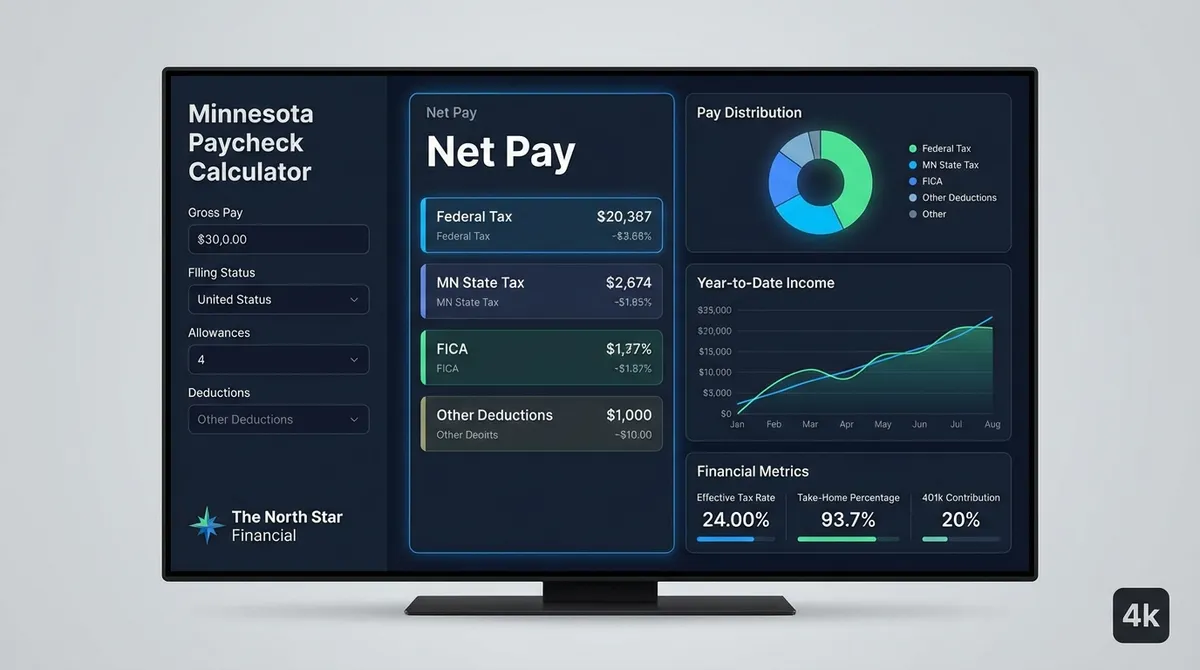
Understanding your Minnesota take-home pay requires navigating federal, FICA, and state income tax obligations. Our Minnesota Paycheck Calculator provides accurate, up-to-date calculations for 2025 tax rates, including Minnesota's progressive state income tax system with four tax brackets ranging from 5.35% to 9.85%.
Whether you're a new resident, changing jobs, or adjusting your withholdings, this calculator helps you estimate your net pay with precision. We account for federal withholdings, FICA taxes (Social Security and Medicare), Minnesota state income tax, and common pre-tax deductions like 401(k) contributions, HSA, and FSA.
Understanding Minnesota's Tax Structure
Minnesota's tax system features a progressive state income tax with four distinct brackets. Unlike some states, Minnesota does not have local income taxes, which simplifies paycheck calculations. For 2025, Minnesota's state income tax rates range from 5.35% to 9.85% based on income level and filing status.
2025 Minnesota State Tax Rates
| Taxable Income Range | Rate | Filing Status |
|---|---|---|
| $0 - $30,070 | 5.35% | Single |
| $30,070 - $92,350 | 6.80% | |
| $92,350 - $171,220 | 7.85% | |
| Over $171,220 | 9.85% |
Key Minnesota Tax Features
- No local income taxes - simpler calculations
- Four progressive tax brackets based on income. Compare with our Income Tax Calculator.
- Standard deduction of $13,825 for single filers (2025)
- Personal exemption credit available
- Married and head of household filers have different bracket thresholds
What Your Paycheck Deductions Include
Understanding each deduction on your Minnesota paycheck helps you plan your finances more effectively. Here's a detailed breakdown of what's taken out and why:
Federal Income Tax
Based on your W-4 form and IRS tax brackets, this withholding funds federal programs. The amount varies by income level, filing status, and the number of allowances you claim. Minnesota residents pay federal taxes just like residents of any other state.
FICA Taxes (Social Security & Medicare)
Social Security: 6.20% of gross wages up to $168,600 (2025 wage base limit)
Medicare: 1.45% of all gross wages, plus 0.9% additional Medicare tax for high earners ($200,000+ for single filers)
Minnesota State Income Tax
Minnesota's progressive tax system means you pay higher rates as your income increases. Tax rates range from 5.35% to 9.85% depending on your taxable income and filing status. This calculator applies the correct rate based on your annualized income.
Pre-tax Deductions (Optional)
- 401(k): Retirement savings that reduce taxable income at all levels
- HSA: Health Savings Account for medical expenses with triple tax advantages
- FSA: Flexible Spending Account for healthcare or dependent care expenses
Who Must File Minnesota State Taxes?
Not everyone living or working in Minnesota is required to file a state income tax return. However, understanding the filing requirements is crucial to avoid penalties and ensure you receive any refunds you're entitled to.
Residents: You must file a Minnesota return if you were a resident for any part of the year and your total income exceeds the minimum filing requirement, which generally matches the federal standard deduction. For 2025, single filers under 65 need to file if their income exceeds $13,825.
Part-Year Residents: If you moved into or out of Minnesota during the tax year, you must file if your Minnesota-sourced income surpasses the filing threshold. You'll calculate tax based on the income earned while living in the state.
Non-Residents: If you live in another state but earn income from Minnesota sources (like wages from a job in Minnesota, rental income, or business income), you are generally required to file a Minnesota non-resident return. For official details, visit the Minnesota Department of Revenue.
Minnesota Reciprocity Agreements
Reciprocity agreements can significantly simplify tax filing for people who live in one state and work in another. Minnesota has reciprocity agreements with two neighboring states: Michigan and North Dakota.
How Reciprocity Works
If you are a resident of Michigan or North Dakota and work in Minnesota, you are exempt from Minnesota state income tax withholding on your wages. Instead, you pay taxes only to your home state. To claim this exemption, you must file Form MWR (Reciprocity Exemption/Affidavit of Residency) with your Minnesota employer.
Without this form, your employer will withhold Minnesota taxes, and you'll have to file a Minnesota non-resident return to get a refund, which is an administrative hassle you can easily avoid.
Note for Wisconsin Residents
Minnesota and Wisconsin currently do not have a tax reciprocity agreement. This means if you live in Wisconsin and work in Minnesota, you must file returns in both states. However, you can typically claim a credit on your resident return for taxes paid to the non-resident state to avoid double taxation.
Bonus and Supplemental Wage Taxation
When you receive a bonus, commission, or overtime pay, you might notice a higher chunk taken out for taxes. This is because these earnings are classified as "supplemental wages" and are often taxed differently than regular pay.
Federal Supplemental Rates
The IRS allows employers to withhold federal tax on bonuses at a flat rate of 22% for amounts under $1 million. If the bonus exceeds $1 million, the excess is taxed at a mandatory 37% rate.
Minnesota Treatment
Minnesota also has specific rules for supplemental wages. Employers typically withhold state tax at a flat rate of 6.25% on supplemental wages. However, if your regular wages plus the bonus push you into a higher tax bracket (like the 9.85% bracket), you might owe more tax when you file your annual return.
Conversely, if your effective tax rate is lower than 6.25%, you might get a refund. It's important to anticipate these withholdings so a big bonus check doesn't result in a smaller-than-expected deposit.
Key Tax Credits for Minnesota Families
Minnesota offers several generous tax credits that can lower your effective tax rate or result in a larger refund. When using our calculator, keep in mind that these credits are reconciled on your annual return, not typically on each paycheck (unless you adjust your W-4MN allowances).
- Working Family Credit: Similar to the federal EITC, this credit supports low-to-moderate income working individuals and families.
- Child and Dependent Care Credit: Helps offset expenses for childcare, often matching or exceeding the federal credit amount for eligible families.
- K-12 Education Credit: A unique Minnesota benefit that reduces taxes for parents paying for educational expenses like tutoring, music lessons, and computer hardware for school.
- Student Loan Tax Credit: Provides relief for residents making payments on eligible student loans, capped at a certain amount per year.
How to Use This Calculator Effectively
Our Minnesota Paycheck Calculator is designed for accuracy and ease of use. Follow these steps to get the most accurate estimate of your take-home pay:
1Enter Your Gross Pay
Input your gross salary or hourly wage before any deductions. This is your total earnings for the pay period.
2Select Pay Frequency and Filing Status
Choose how often you're paid and your tax filing status. This affects how taxes are calculated.
3Add Pre-tax Deductions
Include any 401(k), HSA, or FSA contributions. These reduce your taxable income and can significantly increase take-home pay.
4Review Your Results
See your net pay breakdown with all deductions itemized. Toggle between per-paycheck and annual view for better planning.
Real-World Examples and Scenarios
Understanding how Minnesota taxes work in practice can help you make informed financial decisions. Here are realistic scenarios showing different situations:
Example 1: Single Professional in Minneapolis
Scenario: Sarah earns $75,000 annually, paid biweekly, filing as single
- Gross per paycheck: $2,884.62
- Federal tax: ~$396.15
- State tax (7.85% effective rate): ~$175.00
- FICA: ~$179.85
- Medicare: ~$41.83
- Net pay: ~$2,091.79
Example 2: Married Couple in St. Paul with 401(k)
Scenario: Mike and Lisa earn $120,000 combined, file jointly, contribute 6% to 401(k)
- Gross per paycheck: $4,615.38
- 401(k) contribution: $276.92
- Federal tax: ~$461.54
- State tax (7.85% bracket): ~$340.00
- FICA: ~$276.15
- Medicare: ~$64.31
- Net pay: ~$3,196.46
Example 3: Recent Graduate in Rochester
Scenario: Alex starts at $45,000 annually, single, in lower tax bracket
- Gross per paycheck: $1,730.77
- Federal tax: ~$173.08
- State tax (5.35%): ~$92.12
- FICA: ~$107.31
- Medicare: ~$25.10
- Net pay: ~$1,333.16
Common Mistakes to Avoid
Even small errors in calculating your Minnesota paycheck can lead to significant discrepancies. Avoid these common mistakes:
Mistake #1: Using Federal Tax Rates for State
Minnesota state tax brackets are different from federal brackets. Using 22% federal thinking it applies to state can significantly overestimate your Minnesota tax.
Mistake #2: Ignoring Pre-tax Deductions Impact
401(k), HSA, and FSA contributions reduce taxable income. Failing to include them means you're calculating taxes on income that isn't actually taxed.
Mistake #3: Not Accounting for Minnesota's High Top Rate
Minnesota's 9.85% top tax rate is one of the highest in the nation. High earners ($171,220+ single) need to plan for significant state tax withholding.