Complete Guide: Mortgage Interest & Amortization (2025 Edition)
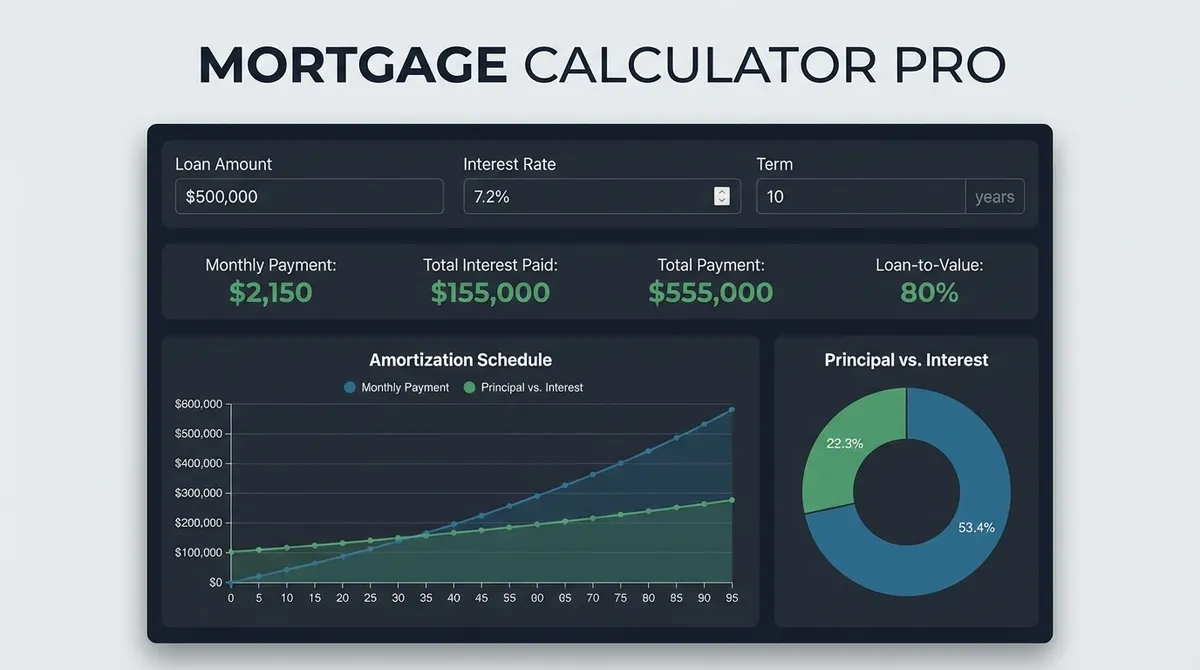
Mortgage interest is likely the single largest expense you will encounter in your lifetime. On a typical 30-year loan, you might pay more in interest than the actual price of the home itself. Understanding exactly how this interest accumulates—and how to minimize it—is the "secret weapon" of savvy real estate investors.
This guide strips away the banking jargon to explain exactly how mortgage amortization works in 2025, how your monthly payments are calculated, and the specific strategies you can use to save tens of thousands of dollars.
The Mechanics: How Mortgage Interest is Actually Calculated
Unlike a simple car loan or credit card, mortgages use an amortization schedule. This means your payment amount stays the same every month (for fixed-rate loans), but the composition of that payment changes drastically over time.
- Day 1: Your payment is mostly interest. You chip away very little principal.
- Year 15: You reach the "tipping point" where principal payments start to accelerate.
- Year 30: Your final payments are almost entirely principal.
The "Banks' Formula" Revealed
Lenders use the standard amortization formula to determine your fixed monthly payment:
M = P [ i(1 + i)^n ] / [ (1 + i)^n – 1 ]
Real-World Example: Where Does Your Money Go?
Let's look at a realistic 2025 scenario. You borrow $400,000 at a 6.5% interest rate for 30 years.
| Snapshot | Monthly Payment | Interest Portion | Principal Portion |
|---|---|---|---|
| Month 1 | $2,528 | $2,166 (86%) | $362 (14%) |
| Year 5 | $2,528 | $2,028 | $500 |
| Year 20 | $2,528 | $1,235 | $1,293 |
| Totals Paid | $910,178 | $510,178 | $400,000 |
Shocking Stat: In this scenario, you pay $1.27 in interest for every $1.00 you borrowed. This is why aggressive repayment strategies are so powerful.
3 Proven Strategies to slash Your Interest Costs
1. The "Round Up" Method (Painless)
Round your payment up to the nearest $100. If your payment is $1,840, pay $1,900. That extra $60 goes 100% to principal. Over 30 years, this small habit can effortlessly save you $25,000+ in interest and shave 2-3 years off your loan. This is one of the easiest ways to build equity without drastically changing your lifestyle.
2. The Bi-Weekly Payment Hack
Instead of paying monthly, pay half your mortgage payment every two weeks. Since there are 52 weeks in a year, you end up making 26 half-payments (13 full payments) instead of 12. This subtle "extra" annual payment typically cuts a 30-year mortgage down to 24-25 years. Most servicers allow you to set this up automatically.
3. Refinance Into a 15-Year Term
If rates drop or your income increases, refinancing to a 15-year loan is the nuclear option for interest destruction. You secure a lower rate and halve the amortization time. The catch? Your monthly payment will jump by about 40-50%. Only do this if your budget is rock solid.
Tax Implications: The Mortgage Interest Deduction
One "silver lining" to paying mortgage interest is the Federal Mortgage Interest Deduction. For 2025, if you itemize your deductions (Series A on your 1040), you can deduct the interest paid on the first $750,000 of your mortgage debt ($375,000 if married filing separately). Use our tax deduction calculator to see if itemizing makes sense for you.
However, with the Standard Deduction being so high ($29,200 for couples in 2024, likely higher in 2025), fewer people are itemizing. You should calculate whether your itemized deductions (interest + state taxes + charity) exceed the standard deduction. If they don't, the interest deduction provides no tax benefit.
Current Interest Rate Landscape (Late 2025 Analysis)
As of late 2025, we are seeing a "new normal" in mortgage rates. The ultra-low rates of 2020 are behind us.
- 30-Year Fixed: Hovering between 6.25% - 7.25%. Best for long-term stability.
- 15-Year Fixed: Typically 0.50% lower than 30-year rates. Best for minimizing total cost.
- ARM (Adjustable Rate): roughly 0.50% - 0.75% lower initially, but carries risk if rates rise.
Pro Tip: When should you lock your rate?
Mortgage rates fluctuate daily based on the 10-year Treasury yield. If you see a dip in the 10-year yield, it's often a good signal to lock your mortgage rate. Don't try to time the absolute bottom; if the numbers work for your budget today, lock it.
Advanced Strategy: Mortgage vs. Market Investing
One of the most debated questions in personal finance is: "Should I pay off my mortgage early or invest that extra money?" The answer depends entirely on the spread between your mortgage interest rate and your expected investment returns.
The Mathematical Approach
If your mortgage rate is 6.5% and the stock market returns 8%-10%, math suggests you should invest. You earn a "spread" of roughly 2-3%. However, this ignores risk. Mortgage payoff offers a guaranteed 6.5% return on your money (tax-free saving), whereas the stock market is volatile.
The Risk Adjustment
In a high-interest rate environment (rates above 5-6%), the "guaranteed return" of paying down debt becomes extremely attractive. A 6.5% risk-free return is hard to beat. Conversely, if you have an older loan at 3%, hoarding cash in high-yield savings (earning 4-5%) actually makes you money compared to paying down the loan.
The Psychology of Debt Freedom
Spreadsheets don't account for how you feel. For many homeowners, the peace of mind of owning a home "free and clear" outweighs mathematically optimal investment strategies.
Eliminating a mortgage lowers your monthly fixed expenses dramatically. This reduces financial fragility—if you lose your job, you don't lose your house. It also frees up massive cash flow for other goals, like retirement catch-up contributions, college funding, or lifestyle upgrades.
The "Sleep Well at Night" Factor
If debt causes you stress, pay it off aggressively. If you are comfortable with leverage and have a long time horizon, investing might be better. There is no single "right" answer—only the trade-off between maximizing wealth and minimizing risk.
Comprehensive Mortgage FAQ
Does paying twice a month save interest?
Yes, but only if it results in an extra payment per year. Simply splitting your monthly payment in half (e.g., sending $1,000 on the 1st and $1,000 on the 15th) doesn't save much interest unless your lender calculates interest daily (which is rare for mortgages). The "bi-weekly" strategy works because 26 half-payments equals 13 full payments, effectively making one extra payment per year directly to principal.
What is the difference between APR and Interest Rate?
The Interest Rate is the cost of borrowing the principal amount. The APR (Annual Percentage Rate) is a broader measure that includes the interest rate plus other costs like broker fees, discount points, and some closing costs. APR is the "true" legal cost of the loan. If a lender offers a low rate but a high APR, it means they are charging high upfront fees to get you that rate.
Can I pay my mortgage with a credit card to get points?
Generally, no. Most servicers do not accept credit cards directly because of the processing fees (1.5% - 3%). Third-party services exist (like Plastiq) that allow this, but they charge a fee that usually outweighs the value of the rewards points, making it a losing proposition mathematically.
What happens if I pay extra for a few months and then stop?
Nothing bad happens. You are not obligated to continue making extra payments. The extra money you paid previously has permanently lowered your principal balance, so every subsequent regular monthly payment will have a slightly higher portion going toward principal than it would have otherwise. You have permanently accelerated the amortization curve.
Is it better to invest or pay off a 3% mortgage?
Mathematically, investing is usually better. High-yield savings accounts and Treasury bonds in 2025 are paying over 4-5%, which is a risk-free arbitrage over a 3% debt. The S&P 500 historically returns 10%. However, many people prefer the psychological freedom of being debt-free, which cannot be quantified on a spreadsheet.
Mortgage Glossary
- Amortization
- The process of spreading out a loan into a series of fixed payments. The loan is paid off at the end of the payment schedule.
- Escrow
- An account held by the lender to pay property taxes and homeowners insurance on your behalf. Part of your monthly payment goes into this "piggy bank."
- LTV (Loan-to-Value)
- A ratio comparing the amount of the loan to the appraised value of the property. LTV affects interest rates and PMI requirements.
- PMI (Private Mortgage Insurance)
- Insurance that protects the lender (not you) if you default. Required if your down payment is less than 20%.
- Points (Discount Points)
- Upfront fees paid to the lender at closing to "buy down" the interest rate. One point equals 1% of the loan amount.