Understanding Your Mortgage Payment: The Complete PITI Guide (2025)
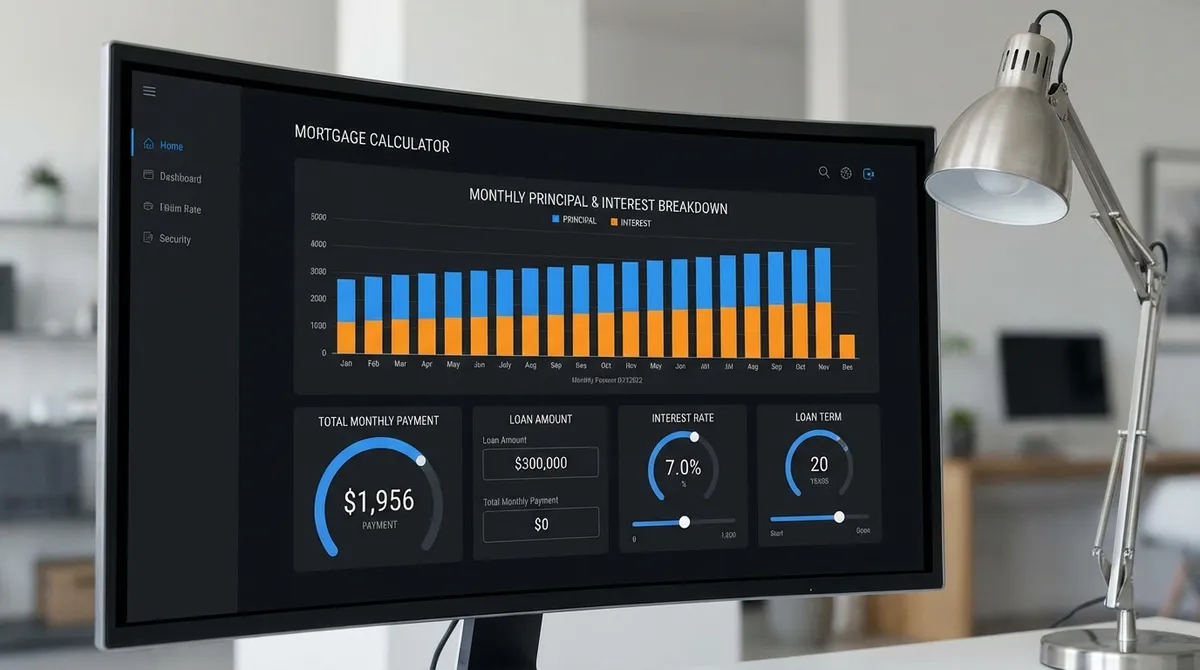
Investing in a home is one of the most significant financial milestones in life, but the complexities of mortgage financing can often feel overwhelming. The headline price of a home is merely the starting point; the number that truly dictates affordability is your monthly payment. This payment is rarely just a simple repayment of your loan—it is a bundle of costs collectively known as PITI (Principal, Interest, Taxes, and Insurance).
In 2025, with housing markets shifting and interest rates stabilizing, understanding the components of PITI is more critical than ever. We recommend reviewing the HUD Home Buying Guide for federal standards. A slight change in property tax rates or a difference in insurance premiums can swing your monthly obligation by hundreds of dollars. Our Mortgage Payment Calculator is designed to transparently break down these costs, ensuring you have a complete, accurate picture of what homeownership will really cost you each month.
Key Insight: Did you know that for the first several years of a 30-year mortgage, nearly 70-80% of your monthly payment goes purely toward interest? This "front-loaded" interest structure means you build equity slowly at first. Using our calculator's amortization schedule reveals exactly when the scales tip in your favor.
Deconstructing PITI: The 4 Pillars of Your Payment
To master your mortgage, you must understand each of the four pillars that comprise your monthly bill. Let's break them down:
1Principal
This is the portion of your payment that actually reduces your debt. It goes directly to paying down the loan balance. On a 30-year loan, the principal portion starts very small and grows larger with every payment you make.
2Interest
This is the cost of borrowing money—profit for the lender. Interest is calculated monthly based on your remaining loan balance. Since your balance is highest at the start, your interest payments are highest at the start too.
3Taxes (Property)
Local governments assess property taxes to fund schools, roads, and services. Lenders collect this monthly and hold it in an escrow account to pay the bill annually. Rates vary wildly—from ~0.3% in Hawaii to ~2.2% in New Jersey.
4Insurance
Homeowners insurance protects against fire, theft, and damage. Like taxes, this is usually escrowed. If you live in a flood-prone area, you may also need separate flood insurance, which can be a significant additional cost.
Case Study: The $400,000 Home
Let's look at a realistic scenario for a homebuyer in 2025 purchasing a median-priced home. Seeing the numbers in action helps clarify why the "monthly payment" is so much higher than just the loan repayment.
Scenario: Purchasing a $400,000 Home
20% Down Payment ($80,000) • 30-Year Fixed • 6.5% Interest Rate
Notice that taxes and insurance add $500/month—a 25% increase over the base loan payment. If this buyer had put down only 5%, they would also owe roughly $150/month in PMI, pushing the total over $2,670.
How to Use Mortgage Payment Calculator
Getting an accurate estimate is fast and simple. Follow these five steps to see your true monthly cost.
Determine the Home Price
Adjust the Down Payment
Input Current Interest Rates
Refine Tax and Insurance Estimates
Analyze the PITI Breakdown
Complete!
Once you have your baseline, try adjusting the loan term to 15 years to see how much interest you could save!
This guide provides general instructions for using Mortgage Payment Calculator. Results should be interpreted in consultation with healthcare professionals.
Expert Strategies to Lower Your Payment
1. Boost Your Credit Score: The difference between a 700 and 760 credit score in 2025 can be 0.5% in interest usage. On a $320k loan, that 0.5% saves you nearly $100/month and $36,000 over the life of the loan.
2. Eliminate PMI: If you can stretch your down payment to 20%, do it. Avoiding $100-$200/month in wasted PMI premiums is one of the best "returns on investment" you can find.
3. Shop Your Insurance: Don't just auto-renew homeowners insurance. Shopping around annually or bundling with auto insurance can often save $300-$500 per year, which directly lowers your monthly PITI.
4. Recast Instead of Refinance: If you come into a lump sum of cash later, ask your lender about "recasting." For a small fee (usually $250), they re-calculate your monthly payment based on the new lower balance without changing your interest rate or loan term.
Advanced Strategy: The Hack to Pay Off 5 Years Early
Want to save $30,000+ without spending an extra dime? Switch to Bi-Weekly Payments.
Most people pay their mortgage once a month (12 payments a year). However, there are 52 weeks in a year. If you pay half your monthly payment every two weeks, you end up making 26 half-payments.
By inadvertently making one extra full payment every year, you attack the principal balance much faster. On a $300,000 loan at 6%, this simple switch knocks roughly 5 years off your 30-year term and saves over $45,000 in interest.
Caution: Check with your lender first. Some servicers charge a fee for bi-weekly setups or hold the partial payment until the full amount is received. Ensure they apply the extra amount directly to the principal immediately.
Common Mortgage Pitfalls to Avoid
Ignoring Maintenance Costs
Your mortgage is the *minimum* you'll pay each month. Repairs are extra. Budget 1% of the home's value annually for maintenance (e.g., $4,000/year for a $400k home) so a broken furnace doesn't break your budget.
The "Escrow Shortage" Surprise
Property taxes and insurance premiums usually go up. If they rise, your escrow account will be short. Your lender will then increase your monthly payment next year to cover the difference *and* replenish the account.
Buying the "Maximum Approved" Amount
Just because a bank approves you for $500,000 doesn't mean you should spend it. Banks don't account for your daycare costs, retirement savings, or lifestyle. Stick to your own budget, not the bank's max limit.
Frequently Asked Questions about Mortgage Payment Calculator
Have more questions? Feel free to contact us for personalized assistance with Mortgage Payment Calculator.
Explore Related Financial Tools
Home Affordability Calculator
Determine exactly how much house you can afford based on your income and debts.
Amortization Calculator
See your full payment schedule and how extra payments accelerate your payoff date.
Refinance Calculator
Calculate if refinancing makes sense and how much you can save monthly.
Rent vs. Buy Calculator
Compare the long-term mechanics of renting versus buying a home.