Complete Guide: Mortgage Payoff Calculator
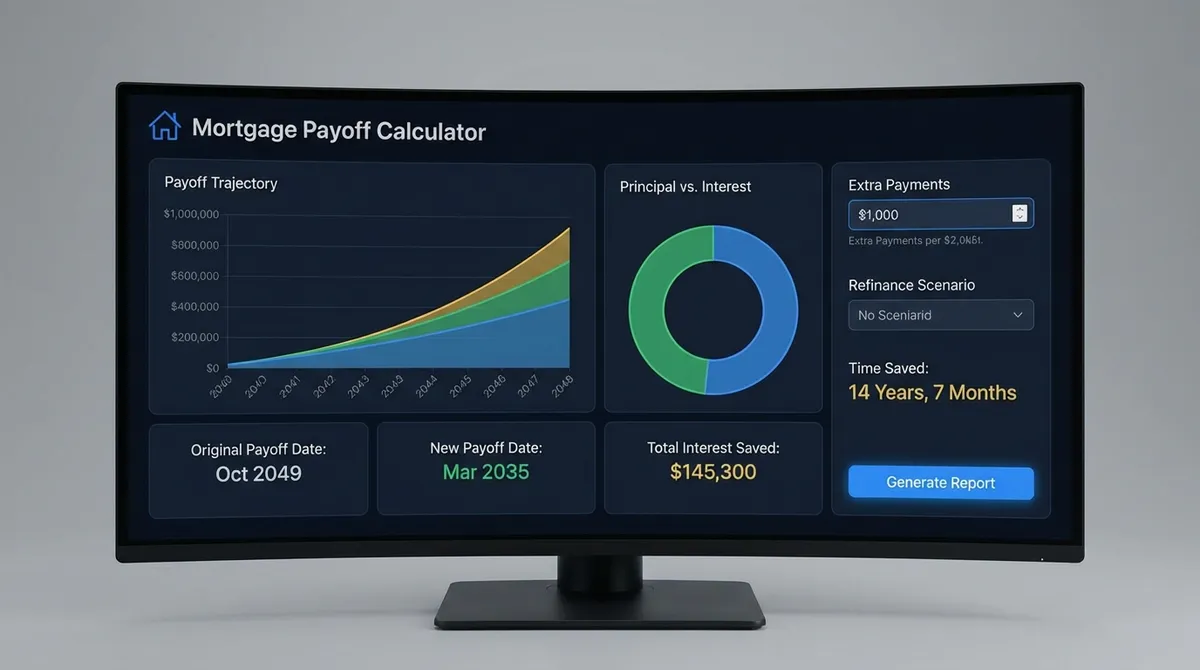
Paying off your mortgage early is one of the most powerful financial moves you can make. Our mortgage payoff calculator shows you exactly how much time and money you can save with extra payments, helping you achieve debt freedom years ahead of schedule.
Key Insight
Adding just $200 extra to your monthly mortgage payment can save you over $50,000 in interest and cut 6+ years off a typical 30-year mortgage. The power of accelerated payments compounds just like investment growth—time and consistency are your greatest assets.
1What Is a Mortgage Payoff Calculator and Why It Matters
A mortgage payoff calculator is a specialized financial tool that models how extra payments affect your mortgage timeline and total interest costs. Unlike basic mortgage calculators that only compute monthly payments, this tool shows you the real impact of acceleration strategies like:
- Monthly extra payments - Consistent additional principal reduction
- Biweekly payment schedules - Making half-payments every two weeks creates one extra monthly payment annually
- Annual lump sum contributions - Applying bonuses, tax refunds, or windfalls to principal
- One-time extra payments - Strategic principal reductions at optimal times
The mathematics behind mortgage acceleration is compelling. When you make extra principal payments, you reduce the outstanding balance faster, which means less interest accrues in subsequent months. This creates a compounding effect where each extra payment saves progressively more interest over time.
Real Example:
For a $300,000 mortgage at 6.5% interest over 30 years, the standard monthly payment is $1,896.20. Adding $200 extra per month:
- • Payoff time: 24.5 years instead of 30 years (5.5 years early)
- • Total interest saved: $82,859
- • Total payments: Reduced by $142,859
- • Return on extra payments: Every $1 of extra payment saves $4.14 in interest
2The Mathematics Behind Mortgage Acceleration
Mortgage payoff calculations use the same amortization formula as standard mortgage calculators, but with modified payment amounts and timing. The key difference is in how extra payments are applied to principal and how that affects subsequent interest calculations.
Standard Mortgage Payment Formula:
- M = Monthly payment
- P = Principal loan amount
- r = Monthly interest rate (annual rate ÷ 12)
- n = Total number of payments (loan term in years × 12)
When you add extra payments, each additional dollar goes directly to reducing principal. This creates two powerful effects:
1. Immediate Interest Reduction
Extra payments reduce your balance immediately, which means the next month's interest is calculated on a smaller principal amount. This saves you money right away.
2. Compounding Savings
The interest savings from each extra payment compound over time. Early extra payments save more interest than later ones because they affect more future payment periods.
How Different Strategies Work:
Monthly Extra Payments
The simplest and most effective strategy. Each extra payment reduces principal immediately, and the effect compounds every month thereafter. Even small amounts like $50-100 monthly create significant long-term savings.
Biweekly Payments
Switching from monthly to biweekly payments (half the monthly amount every two weeks) results in 26 half-payments or 13 full monthly payments per year instead of 12. This effectively adds one extra monthly payment annually without feeling like a big burden. Our calculator models this as adding an extra 1/12th of a payment each month.
Annual Lump Sum
Applying work bonuses, tax refunds, or other windfalls to your mortgage principal once per year. This strategy works well for people with variable income or those who prefer less frequent but larger payments.
One-Time Payment
Strategic large payments at optimal times (early in the loan term) maximize interest savings. The earlier you make the payment, the more interest you save over the loan's life.
3Understanding Your Mortgage Payoff Results
Our mortgage payoff calculator provides comprehensive results to help you understand the true impact of your extra payment strategy. Here's what each result means:
Payoff Time
The number of months until your mortgage is completely paid off with your extra payment strategy. Compare this to your original loan term to see acceleration.
Interpretation: If your payoff time is 282 months (23.5 years) on a 30-year loan, you're saving 6.5 years and making 78 fewer monthly payments.
Interest Savings
The total amount of interest you'll save compared to the standard payment schedule. This represents your return on the extra payments you've made.
Interpretation: $83,000 in interest savings means every dollar of extra payments earned a 413% return over the life of the loan.
Payoff Date
The specific calendar date when your mortgage will be paid off. This helps you plan other financial goals around debt freedom.
Interpretation: A payoff date of March 2048 (instead of November 2054) means you achieve debt freedom nearly 7 years earlier.
Time Saved
The number of months you've eliminated from your mortgage term. Each month saved represents one less payment and more financial freedom.
Interpretation: Saving 78 months means you've eliminated 6.5 years of payments—potentially freeing up $150,000+ in future cash flow.
Reading the Charts and Tables
Loan Balance Over Time Chart
The blue line shows how your mortgage balance decreases month by month. Notice how the curve steepens with extra payments—this visually represents the accelerating principal reduction. Compare this to the shallow curve of a standard payment schedule.
Interest vs. Principal Payments Chart
The stacked bars show how each payment is split between principal (green) and interest (red). With extra payments, you'll see the green portion grow faster, indicating more of each payment goes toward building equity rather than paying interest.
Payment Schedule Table
The detailed breakdown shows every payment's impact on your balance. Use this to understand exactly when your one-time or annual payments are applied and how they accelerate your progress toward debt freedom.
⚠️ Important Limitations
- • This calculator assumes your interest rate remains constant over the loan term
- • Variable-rate mortgages may see different results if rates change
- • Some mortgages have prepayment penalties—check your loan terms
- • Property taxes and insurance are not included in these calculations
- • The emotional and psychological benefits of being debt-free are not quantified but are valuable
4Mortgage Payoff Strategies for Every Situation
The beauty of mortgage acceleration is its flexibility. You can tailor your strategy to your financial situation, income stability, and personal preferences. Here are proven strategies for different scenarios:
Strategy 1: The Steady Accelerator
Best for: Salaried employees with stable income who want consistent, predictable progress.
- • Add $100-300 to your monthly payment
- • Keep the same amount every month
- • Automate the payment for consistency
- • Typical result: Pay off 4-7 years early
Example: $200 extra monthly on a $300,000 loan at 6.5% saves $82,859 in interest and pays off 5.5 years early.
Strategy 2: The Biweekly Booster
Best for: People paid biweekly who want to align mortgage payments with their paycheck.
- • Switch from monthly to biweekly payments
- • Pay half your monthly payment every two weeks
- • Creates 13 monthly payments per year
- • Typical result: Pay off 4-5 years early
Example: $1,948 biweekly (half of $3,896 monthly) pays off 4.5 years early and saves $58,123 in interest on a $300,000 loan at 6.5%.
Strategy 3: The Annual Accelerator
Best for: People with variable income, annual bonuses, or commission-based earnings.
- • Make standard monthly payments
- • Apply 50-100% of annual bonus to principal
- • Apply tax refunds when received
- • Typical result: Pay off 3-6 years early
Example: $3,000 annual extra payment saves $65,000+ in interest and cuts 6+ years off the loan term.
Strategy 4: The One-Time Windfall
Best for: Those receiving inheritance, selling assets, or experiencing liquidity events.
- • Apply large lump sum to principal early in loan term
- • Maximize time for compound savings to accrue
- • Consider refinancing with lower balance
- • Typical result: Pay off 10-15+ years early
Example: $50,000 lump sum in year 2 saves $180,000+ in interest and cuts 13 years off a 30-year mortgage.
💡 Hybrid Strategy: The Power Combo
Combine multiple strategies for maximum impact. The most powerful approach is:
- 1. Switch to biweekly payments (creates one extra payment annually)
- 2. Add $100-200 extra to each biweekly payment (small, consistent amounts)
- 3. Apply 50% of annual bonus or tax refund as lump sum
- 4. Expect result: Pay off 8-12 years early and save $100,000+ in interest
5Mortgage Payoff Mistakes That Cost You Money
Even well-intentioned mortgage acceleration efforts can backfire if you fall into common traps. Avoid these costly mistakes to maximize your savings and financial security.
Mistake #1: Ignoring Higher-Interest Debt
The Problem: Paying extra on a 6% mortgage while carrying 18% credit card debt is mathematically backward. You're effectively borrowing at 18% to pay down 6% debt.
The Solution: Always prioritize high-interest debt first. Pay minimums on your mortgage until credit cards, personal loans, and other high-rate debt are eliminated.
Mistake #2: Not Building Emergency Savings First
The Problem: Pouring all extra cash into mortgage payoff without an emergency fund leaves you vulnerable to job loss, medical expenses, or unexpected repairs. You can't easily access money sent to the mortgage.
The Solution: Build 3-6 months of expenses in liquid savings before aggressively paying down your mortgage. Keep some money accessible.
Mistake #3: Missing Out on Employer 401(k) Match
The Problem: Skipping employer 401(k) contributions to pay extra on your mortgage leaves free money on the table. A 50% employer match is an immediate 50% return.
The Solution: Always contribute enough to get the full employer match before making extra mortgage payments. The match typically outweighs mortgage interest savings.
Mistake #4: Having Prepayment Penalties
The Problem: Some mortgages charge fees for paying off the loan early, potentially costing thousands of dollars and negating your interest savings.
The Solution: Check your mortgage terms for prepayment penalties. If they exist, calculate whether the penalties outweigh the interest savings, or wait until the penalty period expires.
Mistake #5: Not Considering Investment Returns
The Problem: Paying down a low-interest mortgage (3-4%) when you could earn higher returns (7-10%) in the stock market may not be optimal for long-term wealth building.
The Solution: Compare your mortgage rate to expected investment returns. For low-rate mortgages, investing may create more wealth over time, especially in tax-advantaged accounts.
Mistake #6: Timing Payments Poorly
The Problem: Making extra payments late in the loan term when principal is already low minimizes interest savings. Early payments have much greater impact.
The Solution: If you're going to make extra payments, start early. Month 1 extra payments save 5x more interest than month 240 extra payments. Time is your ally in compound savings.
6Tax Implications and Mortgage Interest Deductions
Understanding how mortgage interest deductions work helps you make informed decisions about extra payments. The mortgage interest tax deduction can reduce the effective interest rate on your loan, but this benefit changes as you pay down principal and pay less interest.
How the Mortgage Interest Deduction Works
- • Current Limit: You can deduct interest on up to $750,000 of mortgage debt ($375,000 if married filing separately) for loans taken after December 15, 2017
- • Itemizing Required: You must itemize deductions on Schedule A to claim this benefit
- • Standard Deduction Impact: For many taxpayers, the standard deduction ($13,850 single, $27,700 married filing jointly in 2025) may be higher than itemized deductions
As you make extra payments and reduce principal faster, you pay less interest each year. This means your mortgage interest deduction decreases over time, potentially reducing its tax benefit. However, the overall financial benefit of paying less interest typically outweighs the lost deduction.
Example: Tax Impact of Extra Payments
Consider a $300,000 mortgage at 6.5% with a 22% marginal tax bracket:
- • Total interest: $382,633
- • Tax deduction value: $84,179 (22% of interest)
- • Net cost of interest: $298,454
- • Total interest: $299,774
- • Tax deduction value: $65,950 (22% of interest)
- • Net cost of interest: $233,824
Net savings after tax impact: $64,630 (even after accounting for reduced deductions)
Alternative Tax-Advantaged Strategies
Sometimes it makes sense to prioritize other financial goals over mortgage payoff based on tax considerations:
Max Out Tax-Advantaged Accounts First
401(k), IRA, and HSA contributions often provide better tax benefits than mortgage interest deductions, especially with employer matching.
Priority: 401(k) to employer match → HSA → Roth IRA → extra mortgage payments
Consider Your Tax Bracket
Higher tax brackets benefit more from mortgage interest deductions. Calculate your effective mortgage rate after tax benefits before deciding on extra payments.
Effective rate formula: Mortgage rate × (1 - tax bracket)
7Real-World Mortgage Payoff Success Stories
Learning from real examples helps you understand what's possible and choose a strategy that fits your situation. Here are three detailed case studies showing different paths to mortgage freedom.
Case Study 1: Sarah's Steady Acceleration Strategy
- • $280,000 balance
- • 6.25% interest rate
- • 28 years remaining
- • $1,725 monthly payment
- • $200 extra monthly payment
- • $2,000 annual tax refund
- • 22-year timeline
- • Paid off in 22.3 years
- • Saved $91,400 in interest
- • Debt-free at age 52
Sarah, a registered nurse earning $75,000 annually, started with a $200 monthly extra payment and committed her entire tax refund each year. The consistent approach was manageable on her budget and became automatic after six months. She celebrated every 6 months by calculating her progress, which motivated her to maintain the strategy. At age 52, she hosted a mortgage-burning party and redirected her former payment to retirement savings, building an additional $450,000 in retirement funds before age 65.
Case Study 2: Mike and Lisa's Biweekly Boost
- • $350,000 balance
- • 6.75% interest rate
- • 27 years remaining
- • $2,270 monthly payment
- • Switched to biweekly payments
- • $1,135 every two weeks
- • No additional extra payments
- • 23-year timeline
- • Paid off in 23.8 years
- • Saved $62,300 in interest
- • Extra effort: $0 per month
Mike and Lisa, both teachers earning $60,000 each, switched to biweekly payments to align with their paycheck schedule. The strategy was effortless—they simply split their monthly payment in half and paid every other week. This created one extra monthly payment per year without feeling like extra money. Their mortgage payoff calculator showed they saved over $62,000 in interest and cut 4 years off their loan. The secret was consistency and timing—by matching payments to income, they never felt the financial strain while achieving significant acceleration.
Case Study 3: David's Aggressive Approach
- • $425,000 balance
- • 7.0% interest rate
- • 29 years remaining
- • $2,827 monthly payment
- • Tech salary: $180,000
- • $500 extra monthly payment
- • $10,000 annual bonus to principal
- • $25,000 inheritance in year 3
- • 15-year timeline
- • Paid off in 15.2 years
- • Saved $247,000 in interest
- • Debt-free at age 41
- • Retired mortgage by 50
David, a software engineer with a high income but high expenses, decided to tackle his mortgage aggressively before his kids started college. He set up an automatic $500 extra monthly payment and committed a portion of his annual stock grants to principal. When he received a small inheritance, he applied it entirely to the mortgage rather than upgrading his car. The result? He paid off his 30-year mortgage in just over 15 years, freeing up $3,300+ per month to cash-flow his children's college education without taking out parent loans.