Understanding Mortgage Recasting
Mortgage recasting is a powerful but often overlooked financial strategy that allows homeowners to lower their monthly mortgage payments without refinancing. Unlike refinancing, which replaces your existing loan with a new one at current market rates, recasting keeps your original loan terms—including your interest rate and maturity date—intact.
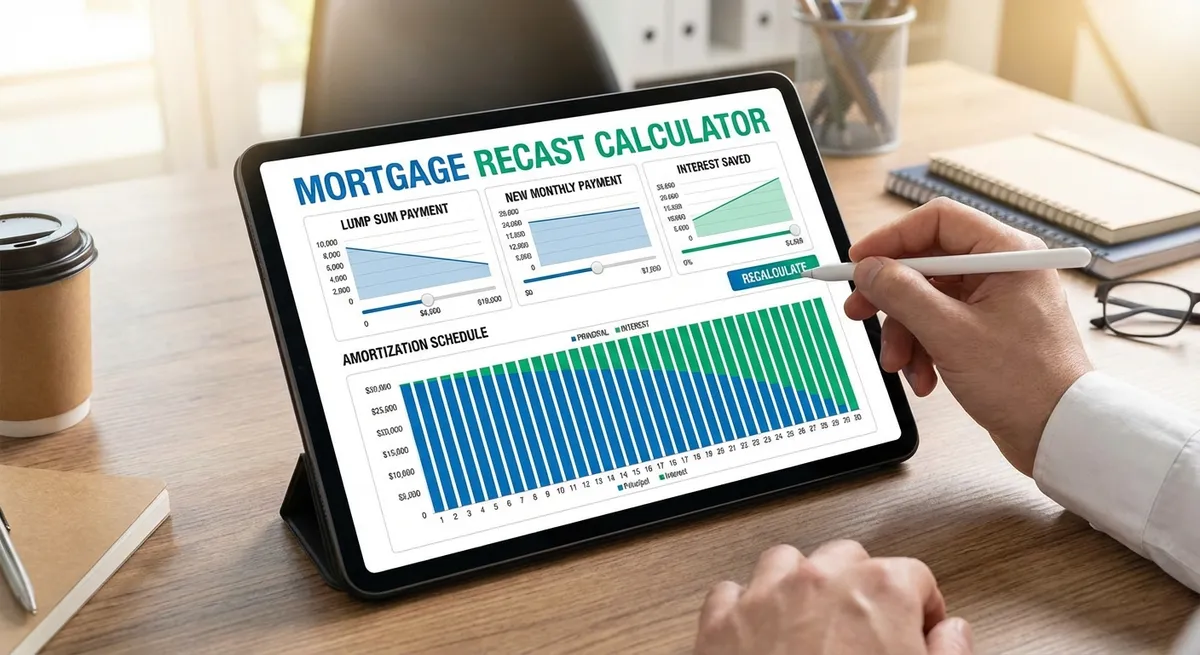
By making a substantial lump-sum payment toward your principal, your lender re-amortizes the remaining balance over the remainder of your loan term. This results in immediately lower monthly payments and significant interest savings over the life of the loan.
When to Recast
- • You have a large lump sum of cash available
- • Your current interest rate is lower than market rates
- • You want to lower monthly payments immediately
- • You plan to stay in your home long-term
When Not to Recast
- • You have high-interest debt (credit cards, etc.)
- • You need to access cash (equity) from your home
- • You plan to sell or refinance soon
- • You have an FHA, VA, or USDA loan (typically ineligible)
How Mortgage Recasting Works
The math behind mortgage recasting is straightforward. When you make a regular extra principal payment, your loan term shortens, but your monthly payment stays the same. With recasting, the lender adjusts the amortization schedule so your term stays the same, but the required payment drops.
The Calculation Process
- Lump Sum Application: You pay a large amount (e.g., $50,000) toward your principal. You might use funds from a savings account.
- Fee Payment: You pay a small administrative fee to the lender (typically $150–$500).
- Re-amortization: The lender calculates a new monthly payment based on:
- The new reduced principal balance.
- The original interest rate.
- The remaining months on the loan.
Example Calculation
Consider a $300,000 mortgage at 6% with 25 years remaining. The monthly principal and interest payment is roughly $1,933.
Loan paid off years early.
Saves $322/month immediately.
Recast vs. Refinance vs. Principal Payment
| Feature | Mortgage Recast | Refinance | Extra Principal |
|---|---|---|---|
| Interest Rate | Stays the same | Changes to market rate | Stays the same |
| Monthly Payment | Decreases | Usually Decreases | Stays the same |
| Loan Term | Stays the same | Resets (e.g. to 30 years) | Shortens |
| Cost | $150 - $500 | 2% - 5% of Ioan | $0 |
| Qualification | Simpler (Payment history) | Full Application (Credit/Income) | None needed |
How to Request a Mortgage Recast
Contact Your Lender
Call your loan servicer and ask if your loan is eligible for recasting. Ask about the minimum lump-sum requirement (often $5,000 or $10,000) and the fee.
Submit the Request
You will likely need to sign a simple modification agreement. This is not a full closing, so it's much faster than refinancing.
Make the Lump Sum Payment
Pay the lump sum amount as instructed. ensure it is applied to the principal balance.
Pay the Fee
Pay the administrative fee to process the re-amortization.
Receive New Schedule
Your lender will send you a new amortization schedule with your lower monthly payment amount.
The Amortization Effect: Why Recasting Saves Interest
Many borrowers mistakenly believe that interest savings only come from a lower interest rate. However, interest is calculated on your outstanding principal balance. By drastically reducing that balance through a lump-sum payment (recasting), you are effectively "de-risking" the loan for the bank and yourself.
How Amortization Adjusts
In a standard mortgage, your early payments are mostly interest. As you approach the end of the loan, payments become mostly principal.
When you recast, you don't reset the clock. You stay at your current point in the amortization timeline (e.g., Year 7 of 30). The lender simply takes your new, lower balance and spreads it evenly over the remaining months (e.g., 276 months). This results in a smaller required monthly payment that still pays off the loan on the exact same date.
Did You Know?
If you make a large principal payment without recasting, your monthly payment stays the same, but the loan is paid off years earlier. Compare with our mortgage payoff calculator. Recasting is the opposite: the payoff date stays the same, but the monthly payment drops.
You can get the best of both worlds: Recast to lower your required payment (for safety), but keep paying your original amount (for speed). This accelerates payoff even faster while giving you a safety net if your income drops.
Strategic Scenarios: Recasting in Action
Let's look at how recasting performs in different 2025 market environments compared to other strategies using a standard $400,000 mortgage at 6.5% interest.
Scenario 1: The "Cash Flow Protector"
Goal: Maximize monthly safety net.
Action: User invests a $100,000 inheritance into a recast.
Result: Monthly payment drops from ~$2,528 to ~$1,896 (saving $632/month).
Scenario 2: The "Hybrid Accelerator"
Goal: Pay off loan ASAP but stay safe.
Action: User recasts with $50,000 but continues making the original higher payment.
Result: The loan is paid off 7 years early, saving over $140,000 in interest.
The Psychology of Recasting: Why Lower Payments Matter
Financial decisions aren't always purely mathematical; they are often emotional. While a spreadsheeet might say "invest the extra cash," the peace of mind from a lower monthly obligation is valuable.
The "Sleep Well at Night" Factor
Knowing your required mortgage payment is $1,500 instead of $2,500 reduces financial anxiety. If you lose your job or face a medical emergency, the lower payment is easier to cover with savings or unemployment benefits. Recasting buys you resilience.
Cash Flow Flexibility
Lower fixed expenses mean more disposable income each month. This extra cash flow can be redirected to:
- Maxing out retirement accounts (401k/IRA)
- Saving for a child's college fund (529 Plan)
- Building a robust emergency fund
- Funding lifestyle goals like travel or renovations
Major Lender Recasting Policies (2025 Guide)
Policies vary by servicer. Here is a general guide to what major banks typically require. Always verify with your specific loan officer. For more general info, see Investopedia's guide.
| Lender | Typical Fee | Min. Payment | Processing Time |
|---|---|---|---|
| Chase | $150 - $250 | $5,000 | 30-45 Days |
| Wells Fargo | $250 | $20,000* | 45-60 Days |
| Bank of America | $250 | $5,000 | 30 Days |
| Rocket Mortgage | $250 - $300 | $10,000 | 60+ Days |
*Minimums can vary based on loan type and current investor guidelines.
Advanced Recast Strategies
1. The "Inheritance" Strategy
If you receive a large windfall (inheritance, bonus, stock sale), you might be tempted to just pay off a chunk of your mortgage. If you just pay the principal, your term shortens but your monthly obligation remains high. Recasting allows you to use that windfall to permanently lower your monthly overhead, giving you more financial freedom every single month.
2. The "Buy First, Sell Later" Strategy
This is the most common use case. You buy a new home before selling your old one, so you can't put all your equity into the down payment. You take a larger mortgage on the new home with a small down payment. Once your old home sells, you take the proceeds, apply them to the new mortgage, and recast. This lowers your payments to where they would have been if you had made a large down payment initially.
3. The "Rate Lock" Strategy
If you have a historic low interest rate (e.g., 3% or 4%), you never want to refinance in a high-rate environment (e.g., 7%). But if you want lower payments, what can you do? Recasting is the only way to lower monthly payments while keeping your ultra-low interest rate locked in.
Final Verdict
Mortgage recasting is a hidden gem in the mortgage world. It offers the payment relief of a refinance without the high costs or the risk of losing a great interest rate. If you have the cash, it is almost always mathematically superior to refinancing in a rising-rate environment.