Understanding Motorcycle Financing
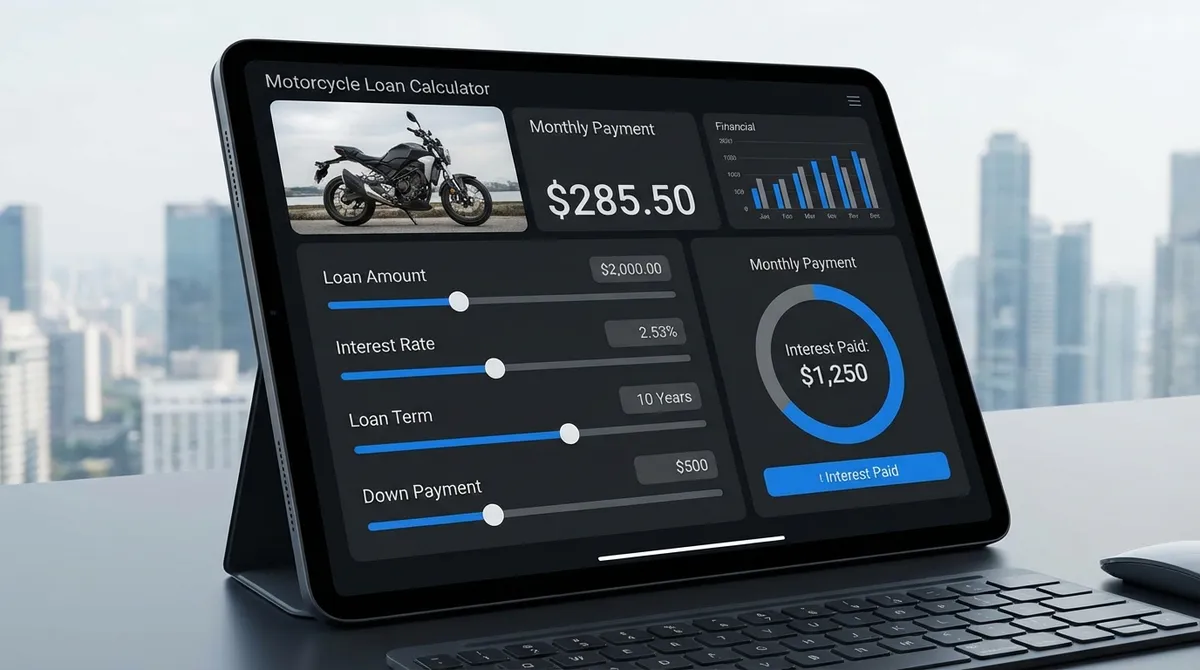
Financing a motorcycle is fundamentally different from financing a car. While the excitement of a new bike is undeniable, the financial reality involves specialized "powersports" lending standards, higher risk assessments, and unique depreciation curves.
Our Motorcycle Loan Calculator is designed to cut through the complexity. Beyond just a simple monthly payment, it reveals the true cost of ownership—including the impact of taxes, fees, and interest over time. Whether you're eyeing a $8,000 cruiser or a $25,000 touring machine, seeing the numbers in black and white is the first step to smart ownership.
2025 Market Update: Interest rates for motorcycle loans currently average between 6.5% and 12% for borrowers with good credit. Because loans are smaller and terms are shorter (typically 36-60 months) than auto loans, even a small difference in rate or term can significantly change your monthly obligation.
How to Use This Calculator
To get the most accurate result, you'll need a few specific numbers. Here's what each input means and how to find it:
Bike Price & Trade-In
Enter the negotiated price of the motorcycle, not just the sticker price (MSRP). If you're trading in an old bike, enter its value to reduce the taxable amount (in most states) and loan principal.
Loan Term
Standard terms are 36, 48, or 60 months. While 72-month loans exist, they often come with higher rates and leave you "upside down" (owing more than the bike is worth) for longer.
Interest Rate (APR)
This is the annual cost of borrowing. Rates for motorcycles are typically 1-3% higher than new car loans. Your rate depends heavily on your credit score and the bike's age.
Taxes & Fees
Don't forget sales tax (often 5-10%) and dealer fees (doc fees, prep fees, etc.). These can easily add $1,000-$2,000 to your total loan amount if financed.
Strategy: Accelerate Your Payoff
One of the hidden features of our calculator is the "Extra Monthly Payment" field. Because motorcycle loans use simple interest, every extra dollar you pay goes directly to principal, reducing the interest charged in future months.
Example: The $50 Difference
Imagine a $15,000 loan at 8.5% over 60 months.
- StandardPayment: $307/mo. Total Interest: $3,400. Term: 5 Years.
- With +$50/moPayment: $357/mo. Total Interest: $2,800. Term: 4 Years, 2 Months.
Result: You save $600 in interest and own the bike 10 months earlier just by adding $50—the price of a tank of gas—to your payment.
Financing Options Compared
Dealer Financing
Convenient but often marked up.
- Specific OEM promos (0-3.9%)
- Rate markups common
Credit Unions
Often the lowest rates for members.
- Lower rates (6-8%)
- Flexible terms
Personal Loans
Unsecured cash for purchase.
- No lien on title
- Higher rates (10%+)
3 Traps to Avoid
Financing Gear & Accessories
Dealers love to roll helmets, jackets, and exhaust systems into the loan. Don't do it. You'll pay interest on a $600 helmet for 5 years.
Reviewing Only Monthly Payments
A "low" monthly payment often hides a long term (72+ months) or high rate. Always look at the "Total Interest" line in our calculator.
Skipping Gap Insurance
Motorcycles depreciate fast. If you put less than 20% down, a crash in year 1 could leave you owing thousands more than the insurance payout.
Credit Score & Interest Rates: What to Expect
Motorcycle loans are considered "recreational vehicle" loans, meaning they are riskier for lenders than car loans. Consequently, rates vary wildly based on your FICO score.
Strategizing Your Exit: Selling a Financed Bike
Most riders keep a bike for only 2-3 years before upgrading or selling. If you financed your motorcycle, selling it isn't as simple as handing over the title—because the bank holds the title. Here is the step-by-step process to sell a bike with a lien:
- Determine the Payoff Amount: Call your lender and ask for the "10-day payoff amount." This is the exact dollar figure needed to clear the loan, including daily accruing interest.
- Find a Buyer willing to work with you: Private buyers are often hesitant to hand over cash without getting a title immediately. You will likely need to meet the buyer at your bank or credit union.
- The Transaction: The buyer pays the lender directly. If the sale price ($8,000) is higher than the loan balance ($6,000), the bank pays off the loan and cuts you a check for the difference ($2,000). If you owe more than it's worth (negative equity), you must pay the bank the difference out of pocket to release the title.
Warning: Selling a bike with negative equity is difficult. This is why a substantial down payment (20%+) is critical when you first buy—it gives you the freedom to sell without writing a check to get out of the loan.
| Credit Tier | Score Range | Est. APR (New Bike) |
|---|---|---|
| Super Prime | 780+ | 5.99% - 7.49% |
| Prime | 660 - 779 | 7.50% - 12.99% |
| Non-Prime | 600 - 659 | 13.00% - 22.99% |
| Sub-Prime | < 600 | 23.00% + |
The Insurance Factor
Before you sign the loan papers, call your insurance agent. If you finance a bike, the lender will require you to carry:
- Comprehensive & Collision: Covers theft and damage to your bike. This is the expensive part of the policy, especially for sportbikes under 25-year-old riders.
- Deductibles: Lenders usually cap your deductible at $500 or $1,000 to ensure you can afford to fix the bike if crashed.
Pro Tip: For high-performance motorcycles, insurance can cost as much as the monthly loan payment. Always get a quote for the specific VIN before buying.
Beyond the Loan: The "True" Monthly Cost
Novice riders often budget for the loan payment but forget the ecosystem of costs that comes with motorcycle ownership. A $200/month loan can easily turn into a $600/month liability.
1. Insurance Premiums
Motorcycle insurance is unlike auto insurance. For a 21-year-old on a 600cc sportbike, premiums can exceed $2,000/year—sometimes more than the bike loan itself.
2. Depreciation Cliff
New motorcycles depreciate faster than cars. Expect a 20% drop the moment you leave the dealership, and 50% within 3-4 years.
3. Gear & Maintenance
Helmet, jacket, gloves, and boots cost $800 minimum for safety. Plus, motorcycle tires last only 3,000-8,000 miles.
4. Winter Storage
If you don't have a garage, winter storage costs $100-$300/month in cold climates.
The Golden Rule: Buy Used?
Financial experts almost universally recommend buying used motorcycles, especially for a first bike. The math is undeniable.
Buying New ($12k Bike)
- + Dealer Fees: $1,200
- + Instant Depreciation: -$2,400
- + Premium Insurance
- Result: -$3,600 equity day one.
Buying Used ($7k Bike)
- + Zero Dealer Fees (Private Party)
- + Stable Value (Depreciation already hit)
- + Lower Insurance
- Result: Break-even resale possible in 1 year.
Frequently Asked Questions
Can I refinance a motorcycle loan later?▼
Yes, and it's a smart move if your credit score improves. However, not all lenders refinance motorcycles, and many have rigid restrictions: the loan usually uses be for at least $5,000, and the bike cannot be older than 7-10 years. Start with credit unions, as they are most friendly to powersports refinancing.
Should I use a Personal Loan or Motorcycle Loan?▼
Motorcycle Loans are "secured" by the bike description. They generally offer lower interest rates (e.g., 7-10%) but require full-coverage insurance and allow the lender to repossess the bike if you miss payments. Personal Loans are "unsecured" (cash). They have higher rates (10-15%+) but you hold the title immediately and can carry liability-only insurance. Personal loans are better for cheap, older bikes or "project" bikes.
What is a "good" motorcycle loan rate in 2025?▼
For borrowers with Excellent credit (720+), rates around 6-8% are competitive from credit unions. Dealer financing tied to manufacturer promotions can sometimes hit 0-3.9%. Average credit (660-719) will see rates of 9-14%, while anything over 15% should be considered subprime and potentially dangerous to your financial health.
Why is my down payment so important?▼
Motorcycles are "rapid depreciation assets." If you put $0 down, you are instantly "upside down" (owe more than it's worth) due to taxes and depreciation. If you crash or sell, you have to pay cash to close the loan. A 20% down payment protects you from this equity gap.