Complete Guide: North Carolina Paycheck Calculator: Calculate Your NC Take-Home Pay (2025)
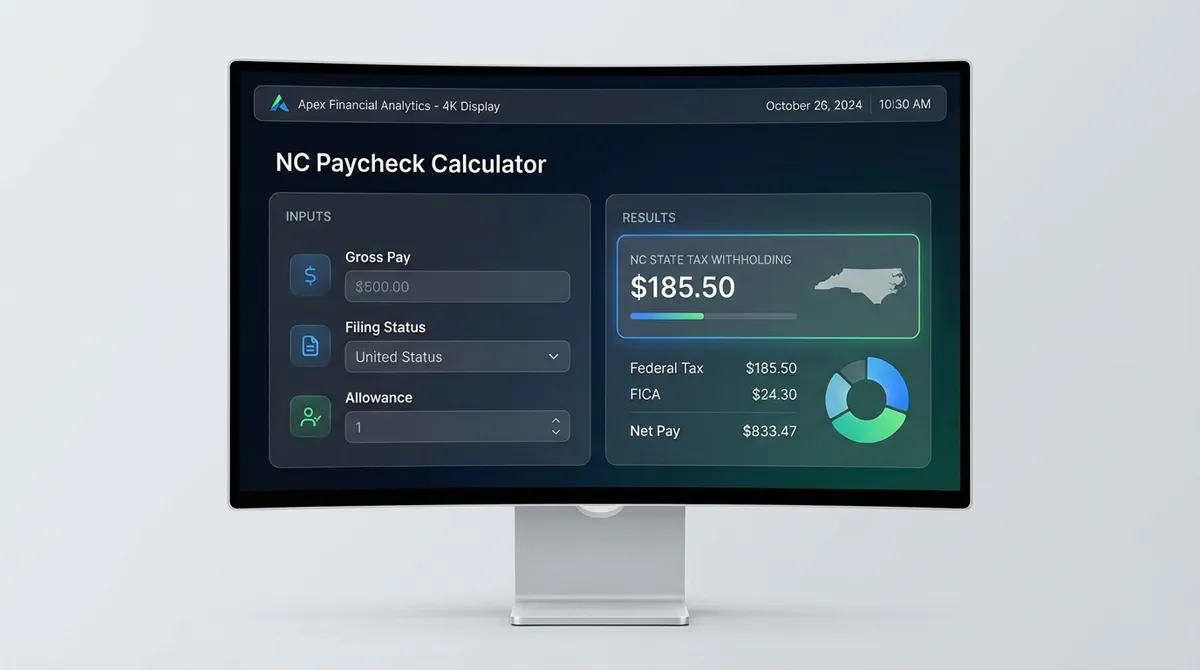
For North Carolina residents, understanding your paycheck means keeping up with a tax system that has been steadily evolving. For the 2025 tax year, the state continues its trend of reducing individual income tax rates, moving from 4.50% down to 4.25%. This reduction puts more money back into the pockets of workers across the Tar Heel State.
Whether you are starting a new job in Charlotte, planning a move to Raleigh, or simply double-checking your pay stub, our 2025 North Carolina Paycheck Calculator provides precise estimates of your take-home pay. It accounts for the latest federal tax brackets, FICA wage base increases, and specifically, North Carolina tax's updated flat tax rate.
NC Minimum Wage & Overtime
North Carolina adheres to the federal minimum wage of $7.25 per hour. While there has been debate about raising it, as of 2025, it remains at this level.
However, if you earn tips (like waitstaff), your cash wage can be as low as $2.13, provided your tips bring you up to the $7.25 threshold. Overtime is mandated at 1.5x your regular rate for any hours worked over 40 in a single week.
How North Carolina Taxes Your Pay in 2025
North Carolina is one of the few states with a "flat tax" system. Unlike the federal system (or states like California) where higher earners pay higher percentages, North Carolina taxes every dollar of taxable income at the same rate. This simple structure is similar to what you might find on a generalized flat tax calculator (if available) or simpler state models.
1. The State Income Tax Rate (4.25%)
For 2025, the flat income tax rate is 4.25%. This applies to your "North Carolina Taxable Income," which is roughly your gross pay minus standard deductions and pre-tax contributions (like a 401k).
Example: If you have $50,000 in taxable income after deductions, your state tax is simply $50,000 × 0.0425 = $2,125.
2. No Local Income Taxes
One major financial benefit of living in North Carolina is the absence of local income taxes. Residents of cities like Asheville, Durham, or Greensboro do not pay any additional city or county income tax on top of the state levy.
3. Standard Deductions
You don't pay state tax on your entire paycheck. North Carolina Department of Revenue offers a standard deduction that reduces your taxable income. While these amounts are subject to inflation adjustments, for 2025 they are estimated to be:
- Single: $12,750
- Married Filing Jointly: $25,500
- Head of Household: $19,125
Federal and FICA Tax Updates for 2025
Beyond state taxes, your paycheck is significantly impacted by federal withholdings. Our calculator uses the official 2025 numbers:
- Federal Brackets: Adjusted for inflation. The top rate remains 37%, but the income thresholds for each bracket have increased, meaning you might stay in a lower bracket longer. You can verify your bracket with our tax bracket calculator.
- Social Security: The tax rate remains 6.2%, but the taxable wage base has increased to $176,100. Income above this amount is not subject to Social Security tax.
- Medicare: Calculations remain at 1.45% on all earnings, with an additional 0.9% surtax for high earners (over $200k for singles, $250k for couples).
Real-World Examples
Example A: The Single Professional
Annual Salary: $65,000 | Single Filer
- Gross Pay (Biweekly): $2,500.00
- Federal Tax (~9.4%): -$235.00
- FICA Taxes (7.65%): -$191.25
- NC State Tax (4.25%): -$85.40
- Net Pay: $1,988.35
Example B: Married Couple
Annual Household Income: $120,000 | MFJ | 2 Kids
- Gross Pay (Monthly): $10,000.00
- Federal Tax (~7.5%): -$750.00
- FICA Taxes (7.65%): -$765.00
- NC State Tax (4.25%): -$334.70
- Net Pay: $8,150.30
Understanding Your Pay Stub: Key Terms
When you look at your pay stub, it can be a soup of acronyms and numbers. Understanding these is the first step to financial control.
Gross Pay vs. Net Pay
Gross Pay is the big number at the top—your agreed-upon salary or hourly wages before anyone touches it. Net Pay is what actually hits your bank account after Uncle Sam and the State of North Carolina take their share.
YTD (Year-to-Date)
This column tracks your total earnings and tax payments from January 1st to the current pay period. It's crucial for verifying your W-2 at the end of the year.
FICA
Stands for the Federal Insurance Contributions Act. It combines Social Security and Medicare taxes. You generally cannot opt out of these.
Withholding Allowances
Based on your NC-4 (state) and W-4 (federal) forms. These tell your employer how much tax to hold back. Too many allowances mean you owe money in April; too few mean you gave the government an interest-free loan.
Strategies to Optimize Your NC Paycheck
Since you cannot change the flat 4.25% tax rate, the only way to pay less tax is to reduce the income that interacts with that rate.
The HSA Advantage
If you have a High Deductible Health Plan, contributing to a Health Savings Account (HSA) is a triple-tax win. It avoids Federal income tax, FICA tax (if done via payroll), AND North Carolina state tax.
Pre-Tax Commuter Benefits
Some NC employers offer pre-tax deduction programs for parking or transit. These lower your taxable gross income before any taxes are calculated.
NC 529 Plan
While contributions to a North Carolina 529 plan are not deductible on your state tax return (a common misconception), the earnings grow tax-free, which is a long-term benefit for education planning.
Check Your Withholding
If you regularly get a large refund, adjust your NC-4. A large refund means you gave the state an interest-free loan. adjusting allowances puts that money in your monthly paycheck instead.
Frequently Asked Questions (FAQ)
Did the NC state tax rate change for 2025?
Yes. The individual income tax rate decreased from 4.50% in 2024 to 4.25% for the 2025 tax year. Further reductions are planned for future years, aiming for 3.99% by 2026.
Are 401(k) contributions taxed in North Carolina?
No. Traditional 401(k) contributions are consistent with federal law—they are deducted from your gross pay before income taxes are calculated. This lowers both your federal and NC state taxable income appropriately.
Does North Carolina tax bonuses differently?
Bonuses are considered "supplemental wages." While they are often withheld at a flat 22% rate for federal taxes, for North Carolina state tax purposes, they are simply taxed at the standard flat rate of 4.25%, just like your regular salary.
Do I pay Social Security on my entire income?
Not for 2025. You only pay the 6.2% Social Security tax on the first $176,100 of earnings. Any income earned above this cap is exempt from Social Security tax (though Medicare tax still applies to every dollar).
What form do I use to adjust my NC withholding?
To change your state tax withholding, you need to file Form NC-4 (Employee's Withholding Allowance Certificate) with your employer. This is separate from the federal W-4 form.
How does filing status affect my NC taxes?
Since the tax rate is flat, filing status primarily affects your Standard Deduction amount. Married couples filing jointly receive a double deduction ($25,500) compared to single filers ($12,750), effectively allowing them to earn more tax-free income before the 4.25% rate kicks in.
Tax Planning Tip
Because North Carolina's rate is flat and relatively low, itemizing deductions on your state return is less common unless you have significant mortgage interest or charitable contributions that exceed the standard deduction. Always check if itemizing yields a better result than the standard deduction.