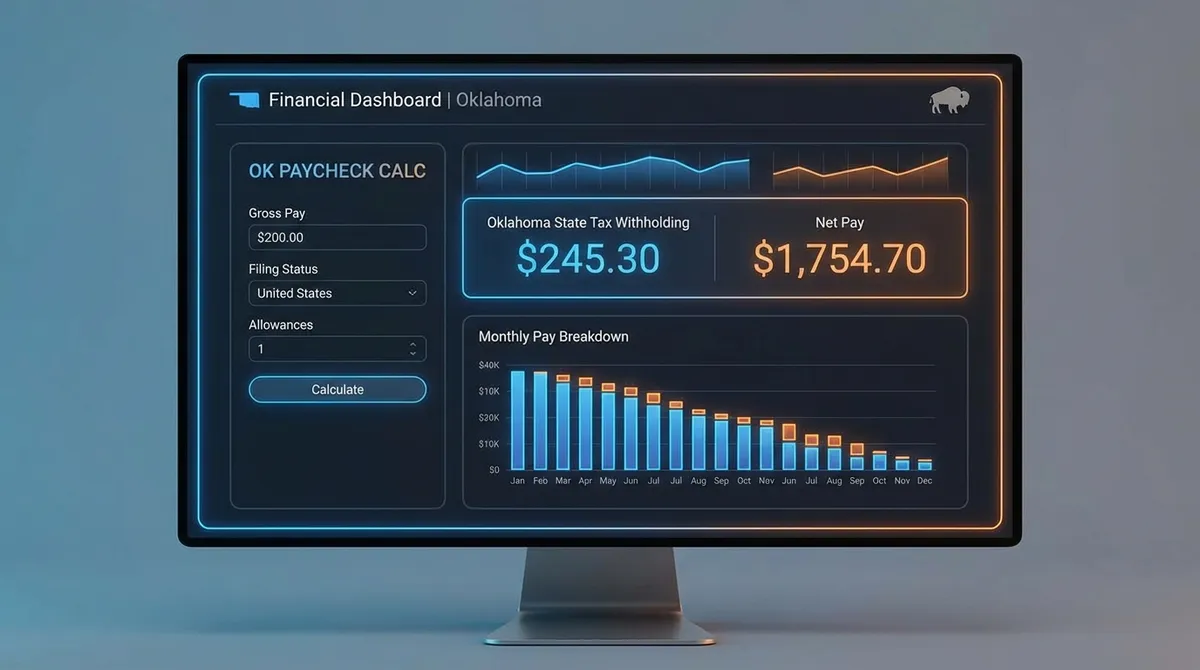
Complete Guide to Oklahoma Paycheck Calculations
Understanding your Oklahoma paycheck goes beyond just knowing your hourly rate or salary. With a progressive state income tax system and specific withholding rules outlined in the Oklahoma Tax Commission, predicting your exact take-home pay can be complex. This guide breaks down every component of your paycheck, from federal and FICA taxes to the specific nuances of Oklahoma's 2025 tax brackets.
How Oklahoma Paycheck Calculations Work in 2025
Your take-home pay is what remains after several layers of taxation. Oklahoma employers use the "Percentage Method" or "Wage Bracket Tables" from the official OW-2 guide to determine your state withholding. Here is the step-by-step process our calculator uses to give you precise results.
1. Gross Pay
This is your starting point—your total earnings before any taxes or deductions.
2. Pre-Tax Deductions
Contributions to retirement plans (traditional 401k) and health accounts (HSA, FSA) are deducted before taxes are calculated. This lowers your taxable income, which can be a powerful way to reduce your tax bill.
3. Federal & FICA Taxes
Federal Income Tax: Calculated based on IRS tax brackets (10% to 37%) and your W-4 information.
FICA Taxes: A flat 6.2% for Social Security (up to the $176,100 wage base in 2025) and 1.45% for Medicare (with no limit).
4. Oklahoma State Income Tax
For 2025, Oklahoma uses a progressive tax structure with a top rate of 4.75%. The process for withholding is specific:
- Allowances: Each claiming allowance reduces your annualized taxable income by $1,000.
- Tax Calculation: The remaining income is run through the tax brackets below.
Oklahoma Tax Brackets & Rates (2025)
Oklahoma taxes earnigs at increasing rates as your income rises. Note the specific jump at the $4,900 mark.
2025 Tax Rates (Single Filers)
| Taxable Income Range | Tax Rate |
|---|---|
| $0 - $1,000 | 0.25% |
| $1,000 - $2,500 | 0.75% |
| $2,500 - $3,750 | 1.75% |
| $3,750 - $4,900 | 2.75% |
| $4,900 - $7,200 | 3.75% |
| Over $7,200 | 4.75% |
*Married couples filing jointly have wider brackets, reaching the top 4.75% rate at $14,400 of taxable income.
How to Maximize Your Oklahoma Paycheck
Review Your OK-W-4
If you regularly get a large tax refund, you are essentially giving the state an interest-free loan. You can increase your withholding allowances on form OK-W-4 to get more money in each paycheck. Conversely, if you owe taxes at the end of the year, reduce your allowances.
Leverage Pre-Tax Savings
Every dollar you contribute to a traditional 401(k) or HSA avoids both Federal and Oklahoma state income tax. For a single filer in the top bracket, a $100 contribution only reduces your take-home pay by roughly $70—the rest is funded by tax savings.
Oklahoma Paycheck FAQs
Does Oklahoma tax bonuses differently?
Oklahoma treats supplemental wages (like bonuses) as regular income, but employers often resolve to a flat withholding rate or add it to your regular pay period, which can artificially inflating your estimated tax bracket for that check.
Are there local income taxes in Oklahoma?
Generally, no. Oklahoma relies on state income tax and sales tax. You won't typically see city or county income taxes deducted from your wages, unlike in some neighboring states.
Why doesn't my withholding match the tax table exactly?
Employers often use the "Wage Bracket Method" which groups income into $10-$20 ranges, causing slight rounding differences compared to the exact "Percentage Method" our calculator uses.
Disclaimer
This calculator estimates your paycheck based on 2025 tax law (Packet OW-2). It is for financial planning purposes only and is not a substitute for professional tax advice or official payroll services.
Deep Dive: Oklahoma Standard Deduction & Exemptions
One of the reasons your taxable income is lower than your gross income is the standard deduction. For the 2025 tax year, Oklahoma aligns closely with federal definitions but maintains its own adjustments.
- Standard Deduction (Single): Typically matches the federal filing status method, meaning substantial income is tax-free.
- Personal Exemption: Oklahoma allows a $1,000 personal exemption for each filer and dependent. This is directly subtracted from your taxable income before the tax brackets are applied.
- Senior Citizens: Additional exemptions apply if you are over 65 or blind, further reducing your state tax liability.
Filing Status: Single vs. Married
Your filing status significantly impacts your Oklahoma paycheck.
Single Filers
Tax brackets are narrower. You hit the top 4.75% rate at just $7,200 of taxable income. Heavily reliant on the standard deduction to lower effective rate.
Married Filing Jointly
Brackets are doubled. The top 4.75% rate kicks in at $12,200+. This "marriage bonus" helps couples where one spouse earns significantly more than the other.
Pre-Tax vs. Post-Tax Deductions explained
Not all deductions are created equal. Understanding the difference can help you save hundreds in taxes.
Pre-Tax (The Good Ones)
These are subtracted from your gross pay before taxes are calculated.
- 401(k) / 403(b): Lowers Federal and State taxable income. Does NOT lower FICA taxes.
- Health Insurance Premiums: Usually exempt from all taxes (Federal, State, FICA).
- HSA / FSA: 100% tax-deductible. The most efficient way to pay for medical expenses.
Post-Tax (The Mandatory Ones)
These come out after taxes have been assessed.
- Roth 401(k) / Roth IRA: You pay taxes now to enjoy tax-free withdrawals in retirement.
- Wage Garnishments: Child support, student loan defaults, or unpaid taxes.
- Union Dues: Typically post-tax, though specific rules vary by industry.
Oklahoma Labor Laws & Pay Regulations (2025)
Beyond taxes, understanding your rights as an employee in Oklahoma is critical for ensuring your paycheck is accurate. The Oklahoma Department of Labor enforces specific statutes that dictate when and how you must be paid.
Minimum Wage & Overtime
Oklahoma adopts the federal minimum wage of $7.25 per hour. While there has been legislative debate about raising this, it remains the baseline for 2025.
- Overtime Rule: Non-exempt employees must be paid 1.5x their regular hourly rate for all hours worked over 40 in a single workweek.
- Tipped Employees: The minimum cash wage for tipped employees is $2.13/hour. However, if tips plus this wage do not equal $7.25/hour, the employer must make up the difference (Tip Credit).
Pay Frequency & Pay Stubs
Oklahoma law requires employers to pay employees at least twice a month on regular paydays. If you need to plan your monthly expenses, consider using a budget calculator to manage your irregular income.
Pay Stub Requirements: While federal law doesn't strictly mandate a pay stub, Oklahoma requires employers to provide a statement of deductions for each pay period. This transparency ensures you can verify that your FICA, State, and Federal withholdings match your own calculations. If you notice a discrepancy between your check and our calculator, request this itemized statement immediately.
Oklahoma Payroll Frequently Asked Questions
Does Oklahoma tax out-of-state income?
Yes, if you are a resident of Oklahoma, you are taxed on your worldwide income. However, you can typically claim a credit for taxes paid to another state to avoid double taxation. If you are a non-resident working in Oklahoma, you are taxed only on the income earned physically within the state.
What is the "Packet OW-2"?
The OW-2 is the official instruction booklet from the Oklahoma Tax Commission (OTC) for employers. It contains the withholding tables and percentage formulas used to calculate how much state tax to deduct from your paycheck.
How does pay frequency affect my taxes?
While your total annual tax liability remains the same, your withholding per check varies. A weekly paycheck splits the tax tables into 52 small chunks, while a monthly check calculates it in 12 larger chunks. Occasionally, a quirk in the math might cause slightly different total withholding depending on frequency, but this is reconciled when you file your annual return.
Why is my bonus taxed at a higher rate?
Bonuses are considered "supplemental wages." Federal law allows employers to apply a flat 22% withholding rate on bonuses. Oklahoma follows a similar logic, often withholding at the top marginal rate (4.75%) to ensure you don't underpay. You'll get any excess back as a refund when you file.