Complete Guide: Oregon Paycheck Calculations (2025)
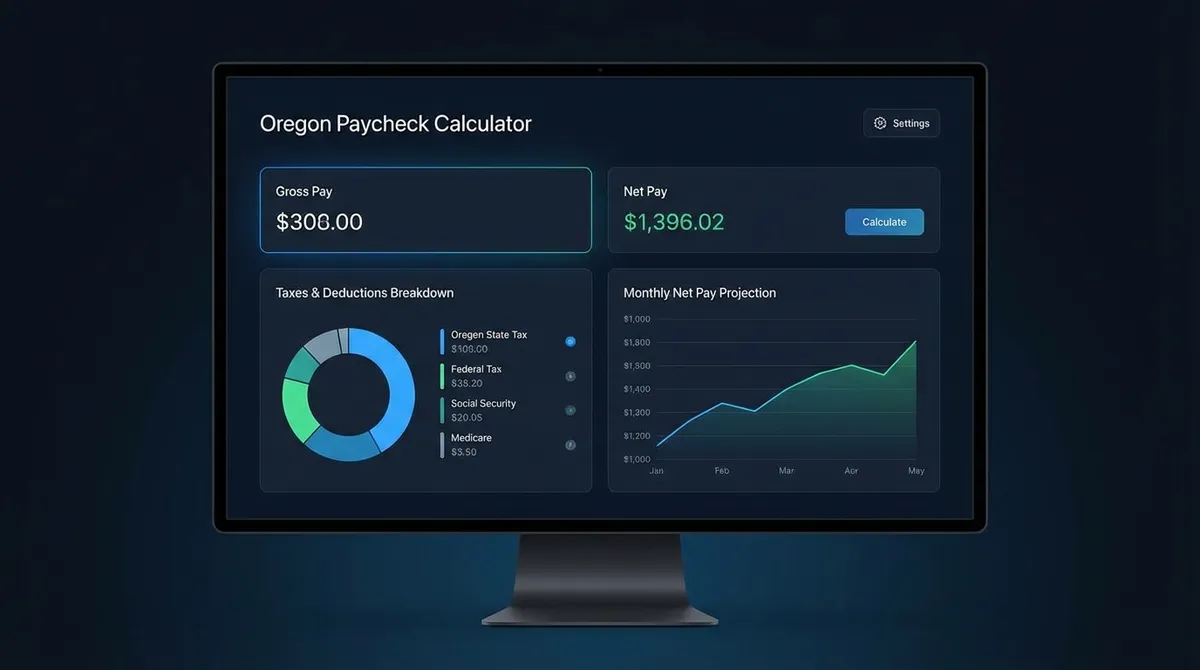
If you live or work in Oregon, you already know the trade-off: no sales tax in exchange for a higher-than-average state income tax. This unique structure makes understanding your paycheck calculation vital for accurate budgeting. For 2025, inflation adjustments to tax brackets and standard deductions mean your take-home pay might look different than last year.
Our 2025 Oregon Paycheck Calculator breaks down every component of your salary—from Federal withholding and FICA taxes to Oregon Department of Revenue. Whether you're accepting a new job in Portland, moving to Bend, or just double-checking your pay stub, this guide gives you the clarity you need.
What's New for 2025?
- Indexed Brackets: Oregon state tax brackets have been adjusted for inflation, potentially lowering your effective rate.
- Standard Deduction Increase: The standard deduction has risen to approx. $2,835 for singles and $5,675 for joint filers.
- Federal Tax Subtraction: You can subtract up to ~$7,800 of your federal tax liability from your Oregon taxable income (income limits apply).
- FICA Limit: The Social Security wage base has increased to $176,100.
How Oregon Taxes Your Paycheck
Oregon's tax system is progressive, meaning high earners pay a higher percentage. However, unlike the federal system which has seven brackets, Oregon has four. The top rate kicks in relatively early compared to other states.
Oregon Tax Brackets (2025)
For Single Filers:
Unique Oregon Deductions
- Federal Tax Subtraction: Oregon allows you to subtract a portion of your federal taxes paid from your state taxable income, up to ~$7,800.
- Standard Deduction: Automatically applied if you don't itemize (~$2,835 for singles).
Federal & FICA Taxes: The National Bite
Before Oregon touches your paycheck, the federal government takes its share. Here is what comes out of every US paycheck:
Federal Income Tax
Progressive rates from 10% to 37%. Depends on your taxable income (Gross Pay minus pre-tax deductions like 401k).
Social Security
Flat 6.2% rate on earnings up to $176,100 (2025 limit). Once you earn more than this, you stop paying for the year.
Medicare
Flat 1.45% rate on all earnings. High earners ($200k+) pay an additional 0.9% surtax.
How to Keep More of Your Money
Proactive planning is the best way to increase your net worth. Using pre-tax deductions lowers your taxable income for both federal and Oregon purposes.
💡 The 401(k) Advantage
Every dollar you contribute to a traditional 401(k) is exempt from federal and Oregon income tax (though normally still subject to FICA).
Example: Earning $75,000 in Oregon
If you contribute 5% ($3,750), you don't just save for retirement. You also save approx. $825 in taxes immediately because that money isn't taxed today.
Regional Payroll Taxes (Portland & Lane County)
Depending on where you work, you might see additional items on your pay stub. These are transit district taxes:
TriMet Tax (Portland Metro)
Primarily an employer tax (0.8037% in 2025), but effective self-employed individuals must pay it too. It funds the bus and light rail system used by millions.
Lane Transit District (LTD)
If you work in the Eugene/Springfield area, employers pay a transit tax (0.78% in 2025). Like TriMet, this doesn't usually come out of your check, but it impacts the cost of hiring.
Oregon Workers' Benefit Fund (WBF)
A tiny assessment (cents per hour worked) split 50/50 between employer and employee. It funds return-to-work programs for injured workers.
The Famous Oregon "Kicker"
No guide to Oregon taxes is complete without mentioning the "Kicker." It is unique to Oregon.
How it works: If state revenues exceed economists' projections by 2% or more, the SURPLUS is returned to taxpayers.
This appears as a refundable credit on your tax return every two years (odd-numbered years). It can be significant—often hundreds or thousands of dollars depending on how much tax you paid in the previous biennium.
Note: Self-employed individuals also pay these taxes based on net earnings if they work within the district.
Portland Metro: The High Earner Surtaxes
If you live or work in the Portland Metro area, you likely face two additional taxes that make the region one of the highest-taxed jurisdictions in the nation for high income earners. It is critical to check if your address falls within the "Metro" boundary.
1. Metro Supportive Housing Services (SHS) Tax
Rate: 1%
This tax funds homeless services. It applies to individual income over $125,000 (or $200,000 for couples filing jointly). Note that the 1% is only charged on the income above that threshold.
2. Multnomah County Preschool to All (PFA) Tax
Rate: 1.5% to 3%
This is often the surprise "gotcha" for high earners in Multnomah County.
- 1.5% on taxable income over $125,000 (single) / $200,000 (joint).
- 3.0% on taxable income over $250,000 (single) / $400,000 (joint).
Combined Impact: A high earner in Portland can face a marginal tax rate approaching 14.9% (9.9% State + 1% SHS + 3% PFA + TriMet) before even touching Federal taxes.
How to Read Your Oregon Pay Stub
Oregon pay stubs can be cluttered with acronyms. Here is a decoder for the most common line items you will see:
| Code | Meaning | Notes |
|---|---|---|
| FED MED / EE | Federal Medicare | 1.45% flat rate. "EE" stands for Employee. |
| FED OASDI / SS | Social Security | 6.2% up to the wage base limit. |
| OR SIT / WTH | Oregon State Income Tax | Your progressive state tax withholding. |
| OR TRANS / WBF | Workers Benefit Fund | A tiny charge (pennies) split between you and employer. |
| OR STT | State Transit Tax | 0.1% flat tax for public transit. No cap. |
| OR PFMLI | Paid Leave Oregon | New in 2023. 0.6% employee contribution rate for paid leave. |
Relocation Guide: Is Moving to Vancouver, WA Worth It?
A common strategy for Portland workers is to move across the Columbia River to Vancouver, Washington, to avoid Oregon's high income tax. But does the math work?
🏠 Scenario A: Live in WA, Work in OR
Verdict: You still pay Oregon Tax.
Oregon taxes non-residents on "Oregon-sourced income." If you physically commute to an office in Portland, you pay Oregon income tax on those wages, even if you sleep in tax-free Washington.
💻 Scenario B: Live in WA, Remote Work
Verdict: HUGE Savings.
If you work 100% remotely from your Washington home for an Oregon company, you generally do not pay Oregon income tax. Washington has 0% state income tax. This saves a $100k earner roughly $8,500/year.
The Washington / Oregon Border Dilemma
Living in Vancouver, WA (no income tax) and working in Portland, OR (high income tax) is a common scenario. Here is the hard truth:
Working Physically in Oregon
If you commute to Oregon, you pay Oregon income tax on the wages earned there. Only days physically worked in Washington (like teleworking from home) are exempt.
Working Remotely from Washington
If you are a WA resident working 100% remotely for an OR company, you generally do not pay Oregon income tax. Oregon does not use the "Convenience of the Employer" rule that New York uses.
Frequently Asked Questions
Does Oregon tax my 401(k) contributions?▼
No. Traditional 401(k) contributions are deducted from your state taxable income, just like federal. However, Roth 401(k) contributions are taxed upfront by both.
Why is my paycheck smaller than in other states?▼
Oregon has one of the highest income tax rates in the country, topping out at 9.9%. In exchange, you pay 0% sales tax on purchases. It forces a trade-off: your recurring paycheck is lighter, but your purchasing power at the register is stronger.
What is the "Transit Tax" on my pay stub?▼
This is the Statewide Transit Tax (0.1%). It comes out of the wages of everyone who works in Oregon, regardless of whether you live there or ever ride a bus. It funds public transportation across the state.