Complete Guide: Pennsylvania Income Tax Calculator (2025)
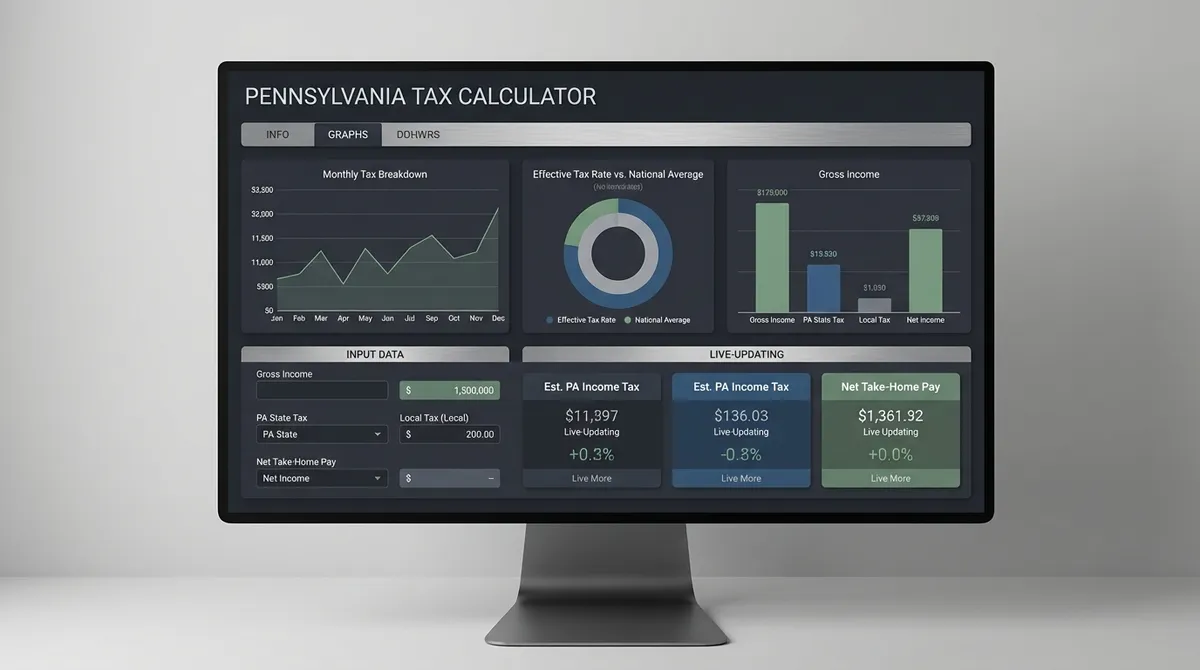
Pennsylvania’s tax system is unique in the United States. Unlike the federal government and most other states that use a "progressive" bracket system (where higher earners pay a higher percentage), **Pennsylvania uses a flat tax rate**. This means everyone pays the same percentage, regardless of how much money they make.
However, the state tax is only one piece of the puzzle. Local Earned Income Tax (EIT) and the Local Services Tax (LST) can significantly impact your take-home pay depending on exactly where you live and work. This 2025 guide breaks down everything you need to know to estimate your liability accurately.
2025 Tax Snapshot
- • **PA State Rate:** 3.07% (Flat rate, unchanged for 2025)
- • **Local EIT:** Varies by municipality (typically 1.0% - 3.87%)
- • **Standard Deduction:** $0 (PA does not have a standard deduction)
- • **Retirement Income:** Generally **tax-free** (401k, pensions, Social Security)
The "Flat Tax" Explained
The cornerstone of Pennsylvania tax law is uniformity. The state income tax rate is **3.07%**. Whether you earn $20,000 or $2,000,000, the state takes 3.07% of your taxable income.
While this simplicity is attractive to high earners, it comes with a trade-off: **few deductions**. You cannot deduct mortgage interest, student loan interest, or charitable contributions on your PA return like you can on your federal return. This makes your "PA Taxable Income" often higher than your "Federal Taxable Income."
Local Earned Income Tax (EIT): The Hidden Cost
Many residents forget about the Local Earned Income Tax (EIT) until they see their first paycheck. Almost all municipalities in PA charge an additional tax on earned income (wages, salaries, commissions).
How EIT Rates Are Determined:
- Your Residence Rules: You primarily owe tax to the municipality where you live. The most common rate is 1.0%, split between your town (0.5%) and school district (0.5%).
- Non-Resident Rate: If you work in a municipality with a higher non-resident tax than your home rate, you may owe the difference.
- The Philadelphia Exception: If you work in Philadelphia, you pay the Philadelphia Wage Tax regardless of where you live. If you live in Philadelphia, you pay it regardless of where you work.
How to Calculate Your PA Tax Bill
Calculating your Pennsylvania paycheck is a three-step process:
Calculate State Tax
Multiply your gross income by 0.0307.
$50,000 × 3.07% = $1,535Calculate Local EIT
Multiply your gross income by your local rate (typically 1%).
$50,000 × 1.00% = $500Add Local Services Tax (LST)
Add the flat LST fee, usually $52 per year for most workers.
$1,535 + $500 + $52 = $2,087 TotalThe PA Tax Forgiveness Credit
One of Pennsylvania's most generous but underutilized programs is Tax Forgiveness. It essentially refunds some or all of your state income tax if you are a low-income earner or retiree.
Who Qualifies? (2025 Estimates)
Eligibility is based on your total household income and the number of dependents you claim.
*Income limits increase by $9,500 for each dependent. Partial forgiveness is available for incomes slightly above these limits.
Cross-Border Workers: Reciprocal Agreements
If you live in a neighboring state but work in Pennsylvania (or vice versa), you might be worried about double taxation. Thankfully, Pennsylvania has reciprocal agreements with six states:
How it works: You only pay income tax to the state where you live, not where you work.
- Scenario A:You live in NJ but work in Philadelphia. Your employer should withhold NJ tax. You file an NJ return.
- Scenario B:You live in PA but work in Ohio. Your employer should withhold PA tax. You file a PA return.
Frequently Asked Questions (2025 Update)
What income is NOT taxed in Pennsylvania?▼
This is one of PA's biggest benefits. **Retirement income is generally tax-free.** This includes payments from 401(k) plans, IRAs, pensions, and Social Security benefits. Pennsylvania is one of the most tax-friendly states for retirees for this reason.
Does PA tax conform to federal bonus depreciation?▼
No. Pennsylvania does not conform to federal bonus depreciation rules. Business owners must often make adjustments (add-backs) on their PA returns because the state has its own rules for depreciation calculations.
What is Tax Forgiveness?▼
Pennsylvania offers a Tax Forgiveness credit for low-income families. Eligible claimants may receive a refund of some or all of the state tax paid. Eligibility depends on your income and number of dependents. For example, a family of four can earn significantly more than a single filer and still qualify.
I work remotely for a PA company but live in NJ. Do I pay PA tax?▼
No, thanks to the **Reciprocal Agreement**. Pennsylvania and New Jersey have a tax agreement. If you verify your NJ residency (Form REV-419), your PA employer should withhold NJ tax, not PA tax. You would only file a return in your home state of New Jersey.
Why is my local tax rate higher than 1%?▼
While 1% is standard, "Distressed Municipalities" (Act 47) allow for higher rates to fund recovery. Cities like Scranton, Pittsburgh, and Reading have rates significantly higher than 1% for this reason. Philadelphia is a separate class entirely with its own wage tax system.
Tax Planning Strategies for PA Residents
While Pennsylvania's flat tax system limits deductions, there are still strategic ways to lower your overall tax burden and optimize your budget. Smart planning can keep more money in your pocket.
1. Maximize PA 529 Contributions
Pennsylvania offers one of the best tax perks for education savings. You can deduct up to $18,000 per beneficiary, per year (or $36,000 for married couples filing jointly) from your PA taxable income for contributions to a PA 529 plan. This deduction applies to 529 plans from any state, not just Pennsylvania's!
2. Health Savings Accounts (HSAs)
For a long time, PA did not conform to federal HSA rules. However, recent changes and clarifications mean that contributions made by your employer (or through a Section 125 cafeteria plan) are generally excluded from PA taxable income. Always verify your W-2 to ensure these pre-tax deductions are handled correctly.
3. Strategic Business Expenses (UEZ)
Unreimbursed Business Expenses are a rare deduction in PA that doesn't exist on the federal level (for W-2 employees). If your employer requires you to buy tools, uniforms, or pay for travel that isn't reimbursed, you can deduct these directly from your PA compensation using Schedule UE. Keep meticulous receipts!
How to File Your PA Return (2025)
Filing in Pennsylvania is straightforward compared to other states. Here is your step-by-step checklist for the 2025 tax season (filing for the 2024 tax year).
- Gather Documents: You will need your W-2s from all employers, 1099s for interest/dividends (PA-40 Schedule A/B), and records of any 529 contributions.
- Choose Your Method: The easiest way is to use mypath.pa.gov, the state's free filing portal. It's fast, secure, and processes refunds quicker than paper filing. Alternatively, most commercial software (TurboTax, H&R Block) handles PA returns well.
- Check for Forgiveness: ALWAYS fill out Schedule SP (Special Tax Forgiveness) if your income is below the threshold ($6,500 single, $32,000 for family of 4). The system doesn't always do this automatically.
- File Local Taxes Separately: This is the biggest mistake newcomers make. Your PA-40 is for the state. You must arguably file a separate local return with your local collector (often Berkheimer or Keystone Collections Group).
Disclaimer
This calculator provides an estimate based on 2025 tax laws. Pennsylvania local tax laws (Act 32) can be complex due to the thousands of overlapping school district and municipal jurisdictions. Always consult a CPA or use the official PA Department of Revenue services for final filing.