Mastering Personal Loans: A Complete Guide for 2025
In today's financial landscape, personal loans have become a versatile tool for everything from debt consolidation to funding dream weddings. But with interest rates fluctuating and lenders offering a dizzying array of terms, understanding the *true cost* of borrowing is more critical than ever.
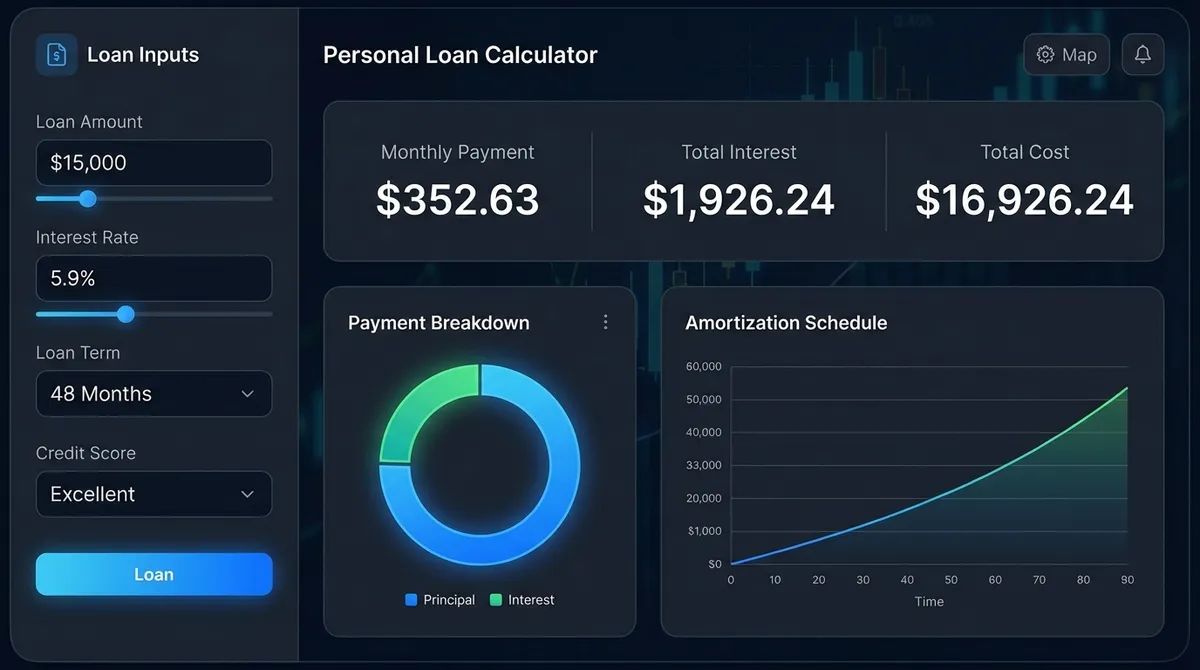
Our Personal Loan Calculator isn't just a math tool—it's your defense against hidden fees and bad deals. By revealing the total interest paid and the impact of origination fees, it empowers you to negotiate better terms and choose the loan that fits your financial goals, not just your monthly budget.
How Personal Loans Actually Work
Unlike a mortgage (secured by your house) or an auto loan (secured by your car), most personal loans are **unsecured**. This means the lender relies entirely on your creditworthiness—credit score, income, and debt-to-income ratio—to approve the loan. Because there's no collateral, interest rates are typically higher than secured loans but lower than credit cards.
Key Terms You Need to Know:
- PrincipalThe actual amount of money you borrow and receive.
- TermThe lifespan of the loan, usually 12 to 60 months. Longer terms lower your monthly bill but raise your total interest cost.
- APRAnnual Percentage Rate. This is the **most important number**. It combines the interest rate PLUS any fees (like origination fees) to show the true annual cost of the loan.
Don't Fall for the "Monthly Payment" Trap
Car dealers and loan officers love to ask, "How much can you afford per month?" This is a classic sales tactic. By stretching your loan over a longer term (e.g., 60 months instead of 36), they can make an expensive loan look "affordable."
Loan Amount: $15,000
Rate: 10%
$484/mo
Total Interest: $2,424
Loan Amount: $15,000
Rate: 10%
$319/mo
Total Interest: $4,122
In this example, choosing the "cheaper" monthly payment costs you nearly **$1,700 more** in interest. Always compare TOTAL COST, not just monthly payments.
Expert Tips for Getting the Best Rate
Check for Origination Fees
Many online lenders charge a 1-6% origination fee. If you borrow $10,000 with a 5% fee, you only receive $9,500 but pay interest on the full $10k. Always ask about this upfront.
Use "Pre-Qualification"
Most lenders allow you to check your rate without hurting your credit score (soft inquiry). Shop around with at least 3 lenders before formally applying.
Consider a Co-Signer
If your credit score is below 670, adding a co-signer with excellent credit can significantly lower your APR, potentially saving you thousands.
Smart Ways to Use a Personal Loan
Debt Consolidation
Using a 12% personal loan to pay off 24% credit card debt is a mathematical win. You save on interest and simplify to one payment.
Home Improvement
For mid-sized renovations ($10k-$30k) where you don't want to tap into home equity or pay closing costs on a HELOC.
Large Purchases
When the merchant doesn't offer 0% financing and you need to spread the cost of a wedding, moving, or medical bill over time.
Deep Dive: Secured vs. Unsecured Loans
Most personal loans are unsecured, meaning they require no collateral. However, if you have a lower credit score, you might qualify for a secured personal loan (using your car or savings as collateral).
| Feature | Unsecured Loan | Secured Loan |
|---|---|---|
| Collateral | None Required | Required (Car, Savings, etc.) |
| Interest Rate | Higher (6% - 36%) | Lower (4% - 15%) |
| Risk | Damage to Credit Score if default | Loss of Collateral + Credit Score |
| Approval Speed | Fast (1-2 Days) | Slower (Appraisal may be needed) |
How to Use This Personal Loan Calculator
Enter Your Loan Details
start by inputting the total amount you wish to borrow in the "Loan Amount" field. Next, enter your expected interest rate. If you don't know your exact rate, you can use the national average for your credit score range (typically 10-15% for good credit).
Select Your Loan Term
Choose how many years you'll take to pay back the loan. Common terms are 3 or 5 years (36 or 60 months). Remember: shorter terms mean higher monthly payments but less interest paid overall.
Add Fees (Optional but Recommended)
Many lenders charge an origination fee (1% to 8%) which is deducted from your loan proceeds. Toggle the "Include Fees" option if you want to see the true cost including these hidden charges.
Analyze the Results
The calculator will instantly show your estimated monthly payment, total interest cost, and total payoff amount. Use these numbers to compare offers from different lenders. Additionally, playing with these variables allows you to see how a slightly lower interest rate or a shorter term can save you significant money over the life of the loan.
Alternatives to Personal Loans
Before taking out a personal loan, consider these alternatives which might offer lower rates or better terms depending on your situation.
0% APR Credit Card
Best for smaller amounts ($1k-$10k) that you can pay off in 12-18 months. If you have good credit, you effectively pay zero interest.
HELOC or Home Equity Loan
Best for homeowners needing large amounts ($20k+). Rates are lower because the loan is secured by your home, but there is risk of foreclosure if you default.
Family Loan
Best for those with poor credit. A formal agreement with a family member can avoid interest, but requires strict repayment discipline to preserve relationships.
Frequently Asked Questions (FAQ)
What is a good interest rate for a personal loan?
Interest rates vary significantly by credit score. As of 2025, borrowers with excellent credit (720+) might see rates between 6% and 10%. Those with good credit (690-719) typically see 10% to 15%, while average credit (630-689) can expect 15% to 20%. If your credit score is below 630, rates can exceed 25%. Always shop around to find the most competitive offer for your specific profile.
Does checking my rate hurt my credit score?
Usually, no. Most modern lenders use a "soft credit check" to show you pre-qualified rates. This does NOT affect your credit score. However, once you officially apply for the loan and accept the offer, they will perform a "hard inquiry," which may temporarily drop your score by a few points.
Can I pay off my personal loan early?
Yes, in most cases you can pay off your loan early to save on interest. However, strictly check for "prepayment penalties." While most reputable online lenders have abolished these fees, some traditional banks and subprime lenders still charge them. Our calculator assumes no prepayment penalty when showing total interest savings.
What can I use a personal loan for?
Personal loans are incredibly flexible. The most common use is debt consolidation (paying off high-interest credit cards). Other popular uses include home improvements/renovations, medical bills, wedding expenses, moving costs, or even starting a small business. Most lenders place few restrictions on use, though you typically cannot use them for illegal activities, gambling, or college tuition (use student loans instead).
What is the difference between APR and Interest Rate?
The interest rate is the cost of borrowing money paid to the lender. The APR (Annual Percentage Rate) includes the interest rate PLUS other costs like origination fees. The APR provides a more accurate picture of the true cost of the loan. For example, a loan with a 10% interest rate and a 5% origination fee might have an APR of around 13-14%. Always compare loans using the APR, not just the interest rate.
How long does it take to get approved?
Online lenders are typically the fastest, often providing approval within minutes and funding within 24 to 48 hours. Credit unions and traditional banks may take longer—from a few days to a week—as their application processes can be more manual and document-heavy.