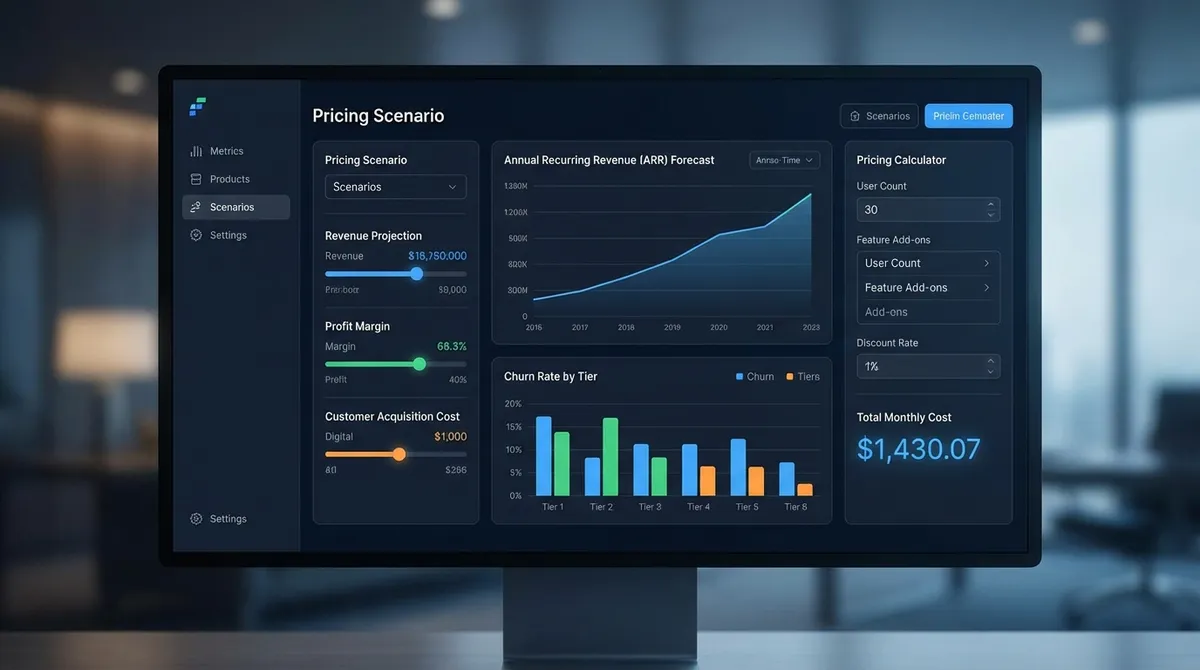
Complete Guide: Business Pricing Strategy and Profit Optimization
Setting the right price for your products or services is one of the most critical decisions any business owner makes. Price too high, and you risk losing customers to competitors. Price too low, and you leave money on the table or even lose money on each sale. Our pricing calculator helps you find that sweet spot where your prices are competitive, profitable, and sustainable for long-term growth.
Did you know? A 1% improvement in pricing can increase operating profits by 6-10% on average, according to market research. This makes pricing optimization one of the highest-impact levers for business profitability.
What Is a Pricing Calculator and Why Does It Matter?
A pricing calculator is a business tool that helps you determine the optimal selling price for your products or services by factoring in all your costs, desired profit margins, and market conditions. Unlike simple markup calculators, a comprehensive pricing calculator considers direct costs (materials, labor), indirect costs (overhead, marketing), and your target profit margins to ensure every sale contributes positively to your bottom line.
For small business owners, freelancers, and entrepreneurs, understanding pricing is crucial because:
- Cash flow depends on it: Underpricing can quickly lead to cash flow problems, even if sales volume is high
- Competitive positioning: Your price signals quality and value to potential customers
- Scalability: Sustainable pricing allows you to grow without constantly fighting financial fires
- Profitability: Proper pricing ensures you're actually making money, not just covering costs
Understanding the Key Pricing Concepts
Cost-Plus Pricing vs. Value-Based Pricing
Cost-plus pricing (the method our calculator uses) starts with your total costs and adds a markupto determine price. This ensures you never lose money on a sale and provides a consistent profit margin. It's straightforward and works well for: manufacturers, wholesalers, and businesses with standardized products.
Value-based pricing focuses on what customers are willing to pay based on perceived value. This approach often yields higher profits but requires market research and customer understanding. It works best for: unique services, luxury goods, and innovative products with little direct competition.
Pro Tip: The Hybrid Approach
Smart businesses use cost-plus pricing as a floor (to ensure profitability) and value-based pricing as a ceiling (to maximize revenue). Your optimal price usually lies somewhere between these two points.
Profit Margin vs. Markup: What's the Difference?
This is one of the most common sources of confusion in business pricing, and misunderstanding it can severely impact your profitability.
Markup is the percentage added to your cost price. If a product costs $50 and you sell it for $75, your markup is 50% ($25 ÷ $50 = 0.50 or 50%).
Profit margin is the percentage of the selling price that is profit. Using the same example, your profit margin is 33.3% ($25 ÷ $75 = 0.333 or 33.3%).
Markup Formula
Markup % = (Selling Price - Cost) ÷ Cost × 100
Use when setting prices based on costs
Margin Formula
Margin % = (Selling Price - Cost) ÷ Selling Price × 100
Use when analyzing profitability
Industry Benchmarks: What's a Good Profit Margin?
"Good" profit margins vary significantly by industry. Here are typical ranges to guide your pricing decisions:
| Industry | Typical Margin | Markup Equivalent | Characteristics |
|---|---|---|---|
| Retail | 30-50% | 43-100% | High volume, competitive |
| Manufacturing | 10-20% | 11-25% | High overhead, bulk sales |
| Professional Services | 50-70% | 100-233% | Low variable costs |
| Software/SaaS | 70-85% | 233-567% | Scalable, low marginal cost |
| Restaurants | 60-70% | 150-233% | High waste, labor intensive |
Common Pricing Mistakes That Kill Profits
1. Confusing Markup with Margin
A 50% markup does NOT mean 50% profit margin. Many small businesses set prices using markup but budget using margin, creating a dangerous profit shortfall. Always know both numbers.
Example: If you want a 40% profit margin, you need a 66.7% markup. Use our calculator to find the correct markup for your target margin.
2. Ignoring Hidden Costs
Your product cost isn't just what you pay suppliers. Include:
- Shipping and logistics
- Storage and warehousing
- Payment processing fees (2-4% of revenue)
- Marketing and customer acquisition
- Customer service and returns
- Your time and administrative overhead
Missing these can turn a seemingly profitable product into a money-loser.
3. Underpricing to 'Get Volume'
Competing on price alone is a race to the bottom. There's always someone willing to go lower. Instead, compete on value, quality, or service. Price wars destroy industries and leave everyone broke.
Remember: It's easier to lower prices than raise them. Start higher and offer discounts if needed, rather than starting low and trying to increase prices later.
4. Not Accounting for Different Sales Channels
Selling on Amazon? They take 15-45% in fees. Using Shopify? Payment processing is 2.9% + $0.30 per transaction. Wholesale to retailers? They expect 50% margins. Your price must vary by channel or you'll lose money.
Create separate pricing strategies for each channel, or set your base price high enough to accommodate your most expensive sales channel.
5. Set-and-Forget Pricing
Costs change. Suppliers raise prices. Shipping gets more expensive. Your rent increases. If you're not reviewing and adjusting prices quarterly, your margins are slowly eroding.
Schedule price reviews every 3 months and adjust based on current costs and market conditions.
Step-by-Step: How to Price Your Product or Service
Calculate Your True Cost Per Unit
Add up everything that goes into creating or acquiring your product:
- Direct materials or wholesale cost
- Direct labor (time × hourly rate)
- Overhead allocation (rent, utilities, insurance ÷ monthly units)
- Shipping and fulfillment
- Payment processing fees
- Packaging
Example: A handmade candle costs $3 in wax, $1 in packaging, $2 in labor (20 minutes at $6/hour), and $1 in overhead allocation = $7 total cost per unit
Research Your Market and Competition
Your price must fit within market expectations, but you don't have to match competitors exactly:
- Identify 3-5 direct competitors and note their prices
- Note any quality or feature differences that justify price variations
- Research your target customer's price sensitivity
- Consider your brand positioning (budget, premium, or luxury)
Key Question: Are you competing on price, quality, or uniqueness? Your answer determines your pricing flexibility.
Set Your Target Profit Margin
Choose a profit margin based on your industry, business model, and growth goals:
- 20-30% margin: High-volume retail, competitive markets
- 30-50% margin: Standard for most product-based businesses
- 50-70% margin: Professional services, unique products
- 70%+ margin: Software, digital products, luxury goods
Startup Tip: Aim for higher margins initially to account for unexpected costs and give yourself room to offer discounts as you scale.
Calculate Your Minimum Price
Use our calculator to determine the minimum price needed to achieve your target margin:
- Enter your total cost per unit
- Input your desired profit margin percentage
- The calculator shows the required selling price
- This becomes your price floor—never go below this
Caution: If this price is much higher than competitors, you need to either reduce costs, increase perceived value, or target a different market.
Test and Adjust Based on Market Response
Your first price is an educated guess. Use real market data to refine it:
- Start slightly higher than your calculated minimum
- Offer introductory discounts to early customers
- Track conversion rates at different price points
- A/B test prices if you have significant traffic
- Gather direct customer feedback on pricing
Golden Rule: Price is never permanent. Adjust based on costs, competition, and customer value perception—but always adjust upward strategically, not reactively.
Advanced Pricing Strategies for Growth
Psychological Pricing Techniques
How you present prices affects buying decisions. Proven techniques include:
- Charm pricing: $99 instead of $100 (the left-digit effect)
- Prestige pricing: Round numbers ($200) signal quality for luxury items
- Price anchoring: Show a higher "original" price next to the sale price
- Bundle pricing: "3 for $50" often outsells individual unit pricing
Tiered Pricing for Maximum Revenue
Offering multiple price points captures more customers and increases average order value:
- Good-Better-Best: Three options with the middle one often being most popular
- Freemium: Free basic tier, paid premium features (for software)
- Volume discounts: Lower per-unit price for larger quantities
Dynamic Pricing for Seasonal Businesses
Adjust prices based on demand, season, or customer segment:
- Raise prices during peak seasons (hotels in summer)
- Lower prices during off-peak to maintain cash flow
- Offer different prices to different customer segments (student discounts)
When to Raise Your Prices (Without Losing Customers)
Raising prices is necessary for business growth, but timing and communication matter:
✓ When Costs Increase
Pass on supplier price increases, rent hikes, or minimum wage changes. Customers understand cost-driven increases.
✓ When You've Added Value
New features, better quality, improved service, or additional benefits justify price increases.
✓ When Demand Exceeds Supply
If you're turning away business or have long waitlists, your price is too low.
✓ At Regular Intervals (Annual/Bi-annual)
Small, regular increases (3-5%) are better received than large, infrequent jumps.
How to Communicate Price Increases
- Give 30-day notice to regular customers
- Explain the reason (cost increases, improvements, inflation)
- Emphasize continued value and quality
- Offer to lock in old prices for prepayment or contracts
- grandfather existing customers when possible
Conclusion: Pricing Is a Continuous Process
Effective pricing isn't a one-time calculation—it's an ongoing process of monitoring costs, understanding customer value perception, and adjusting to market conditions. Our pricing calculator gives you the mathematical foundation, but your business judgment and market understanding turn that data into profitable pricing strategies.
Key Takeaways:
- Know your true costs, including hidden expenses
- Understand the difference between markup and margin
- Set prices based on profit goals, not just competition
- Review and adjust prices quarterly
- Test different price points and monitor customer response
- Communicate price increases clearly and provide advance notice
Use our pricing calculator above to experiment with different scenarios, understand your net profit, and find the optimal price that balances profitability with customer value. Remember: the best price is one that sustains your business while making customers feel they're getting excellent value.