Complete Guide: Rate of Return Calculator & Investment Performance Analysis (2025)
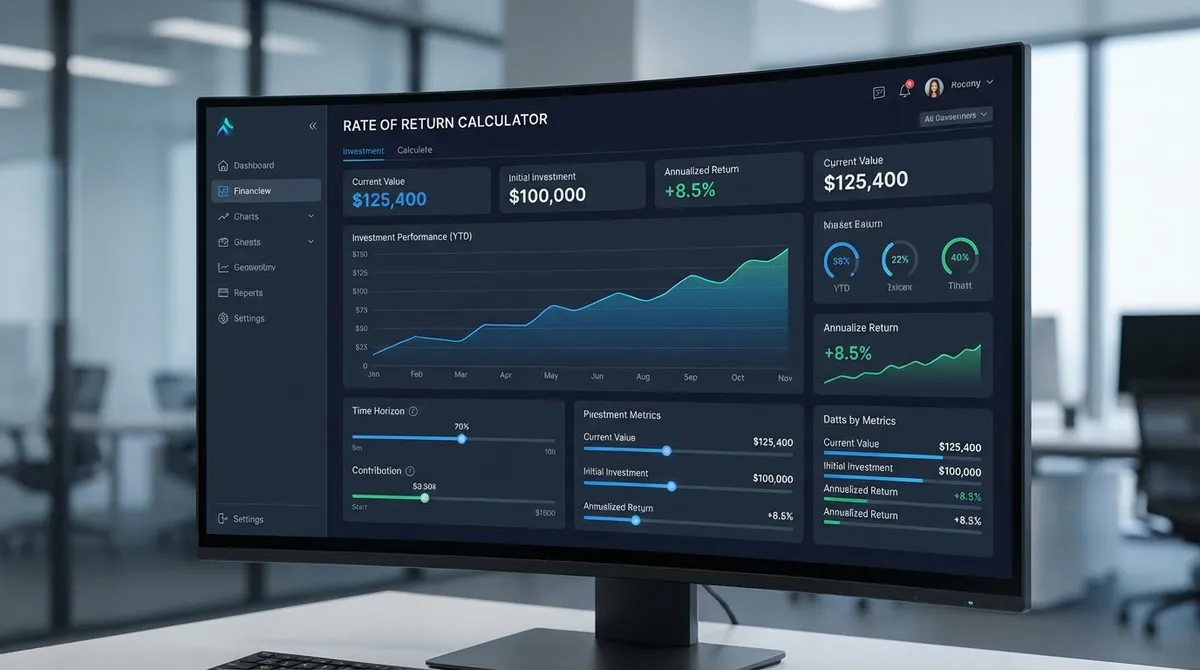
Understanding your true investment performance is crucial for making informed financial decisions. Our rate of return calculator helps you calculate theCompound Annual Growth Rate (CAGR)—the gold standard for measuring investment performance over time. Unlike simple average returns, CAGR accounts for the effects of compounding and provides a true annualized rate that you can compare across different investments and time periods.
What is Rate of Return?
Rate of return is the gain or loss on an investment over a specified time period, expressed as a percentage of the investment's cost. While there are several ways to calculate returns, the most meaningful measure for comparing investments is the Compound Annual Growth Rate (CAGR).
CAGR represents the constant annual rate at which your investment would need to grow to go from its initial value to its final value over a given period. This metric smooths out volatility and provides a clear picture of your investment's true performance, making it essential for evaluating stocks, mutual funds, real estate, and other investment vehicles.
How to Calculate Rate of Return: CAGR Formula
The CAGR formula is straightforward but powerful:
CAGR = (End Value ÷ Beginning Value)^(1 ÷ Number of Years) − 1This formula accounts for the compounding effect that simpler calculations miss. For example, if your investment grew from $10,000 to $15,000 over 5 years, the CAGR would be:
CAGR = ($15,000 ÷ $10,000)^(1 ÷ 5) − 1 = 8.45% per yearTotal Return vs. Annualized Return: What's the Difference?
Total Return
The overall percentage gain from your entire investment period, calculated as: (Final Value − Total Contributions) ÷ Total Contributions
Annualized Return (CAGR)
The consistent annual rate that would produce the same end result, accounting for compounding effects over time.
Understanding both metrics is crucial. Total return shows your overall success, while CAGR allows for fair comparison between investments of different time periods. For instance, a 50% total return over 5 years (8.45% CAGR) is much more impressive than a 50% return over 10 years (4.14% CAGR).
How to Use the Rate of Return Calculator
Our calculator simplifies complex financial mathematics into an intuitive interface. Here's how to get accurate results:
- Initial Investment: Enter the amount you originally invested. This is your starting principal.
- Final Value: Input the current or ending value of your investment. For ongoing investments, use the most recent statement balance.
- Investment Period: Specify how long your money was invested. You can use decimals for partial years (e.g., 2.5 years for 2 years and 6 months).
- Additional Contributions (Optional): If you made regular monthly additions, check this box and enter the monthly amount. The calculator will adjust the CAGR calculation accordingly.
Practical Investment Scenarios
Let's examine real-world scenarios to better understand how rate of return calculations work:
Scenario 1: Conservative Stock Investment
A diversified blue-chip stock portfolio growing at 8.45% annually
This investment generated $5,000.00in profit over 5 years, representing a 50.0% total return but only a 8.45% annualized return— illustrating how compounding affects long-term performance.
Scenario 2: Growth Stock Success
A technology stock that became a market leader
This investment generated $20,000.00in profit over 10 years, representing a 400.0% total return but only a 17.46% annualized return— illustrating how compounding affects long-term performance.
Scenario 3: Real Estate Investment
Property appreciation in a growing suburban market
This investment generated $80,000.00in profit over 7 years, representing a 40.0% total return but only a 4.92% annualized return— illustrating how compounding affects long-term performance.
Common Mistakes to Avoid When Calculating Returns
Ignoring Inflation
A 7% nominal return with 3% inflation means only 4% real purchasing power growth. Always consider real returns for long-term planning.
Using Simple Average Instead of CAGR
Adding annual returns and dividing by years ignores compounding. Use CAGR for accurate annualized performance.
Forgetting to Include All Costs
Trading fees, management fees, and taxes significantly impact returns. Net returns after costs matter more than gross returns.
Comparing Different Time Periods
A 50% return over 3 years is very different from 50% over 10 years. Always annualize returns for fair comparison.
Advanced Rate of Return Concepts
For more sophisticated investors, several advanced return metrics provide deeper insights:
- Risk-Adjusted Returns: Metrics like Sharpe ratio and Jensen's alpha account for investment risk alongside returns
- Internal Rate of Return (IRR): Useful for investments with multiple cash flows at irregular intervals
- Time-Weighted Return: Eliminates the impact of cash flow timing for performance measurement. Learn more about Time-Weighted Return on Investopedia.
- Money-Weighted Return: Reflects the timing and amount of all cash flows
What is a Good Rate of Return?
"Good" returns depend on your investment type, risk tolerance, and time horizon. Here are realistic benchmarks:
Conservative Portfolio
4-6% CAGR (Bonds, CDs, conservative stocks)
Balanced Portfolio
6-8% CAGR (50/50 stocks/bonds mix)
Growth Portfolio
8-12% CAGR (Stock-heavy portfolio)
Historical S&P 500 returns average 10-11% annually, but with significant volatility. Your personal rate of return depends on asset allocation, fees, timing, and market conditions.
Using Rate of Return for Financial Planning
Calculating your actual rate of return is the first step toward better investment decisions. Use this information to:
- Evaluate Investment Performance: Compare your actual returns against benchmarks and expectations
- Adjust Asset Allocation: Rebalance your portfolio based on performance analysis
- Plan for Goals: Project future values using realistic return assumptions
- Compare Alternatives: Make informed decisions between different investment options
- Track Progress: Monitor whether you're on track to meet financial goals
Frequently Asked Questions (FAQ)
Can CAGR be negative?
Yes. If your final investment value is lower than your initial value, your CAGR will be negative. For example, if you invested $10,000 and ended up with $8,000 after 2 years, your CAGR would be approximately -10.56%. This accurately reflects the annual rate at which you lost money.
Does this calculator include dividends?
For an accurate total return calculation, your "Final Value" essentially needs to include reinvested dividends. If you took dividends as cash and did not reinvest them, you should add the total cash dividends received to your final portfolio value to get your true rate of return.
Why is CAGR better than average annual return?
Average annual return is misleading because it ignores volatility and the sequence of returns. If you lose 50% one year and gain 50% the next, your "average" return is 0%, but your actual portfolio is down 25% (went from $100 to $50, then to $75). CAGR captures this reality, whereas simple averages mask it.
How do I verify the accuracy of my returns?
Most brokerage statements provide a "Personal Rate of Return" which is usually a money-weighted return (IRR) accounting for deposits and withdrawals. Our calculator provides a Time-Weighted-like return (CAGR) if you only input start/end values, which is better for judging the investment's performance itself rather than your timing.
What happens if I contributed monthly?
Regular contributions complicate the math. A simple CAGR formula assumes a lump sum at the start. If you added money monthly, use the "Additional Contributions" feature to calculate an Internal Rate of Return (IRR), which properly weights your cash flows based on when they hit the account.
Is a higher rate of return always better?
Not necessarily. A higher return almost always comes with higher risk. If one investment offers 15% but has a 50% chance of going to zero (like a speculative crypto coin), and another offers 7% with high stability (like an S&P 500 index fund), the "lower" return might be the superior risk-adjusted choice for long-term wealth preservation.
Final Thoughts
Understanding your rate of return is fundamental to successful investing. While past performance doesn't guarantee future results, knowing how your investments have performed helps you make informed decisions about your financial future. Regularly calculate and track your returns to stay on top of your investment strategy and ensure you're progressing toward your goals.
Remember that consistency matters more than occasional high returns. A steady 8% return over decades creates more wealth than volatile double-digit returns with significant drawdowns. Focus on sustainable, long-term growth rather than short-term gains.