Complete Guide: Rent vs Buy Analysis
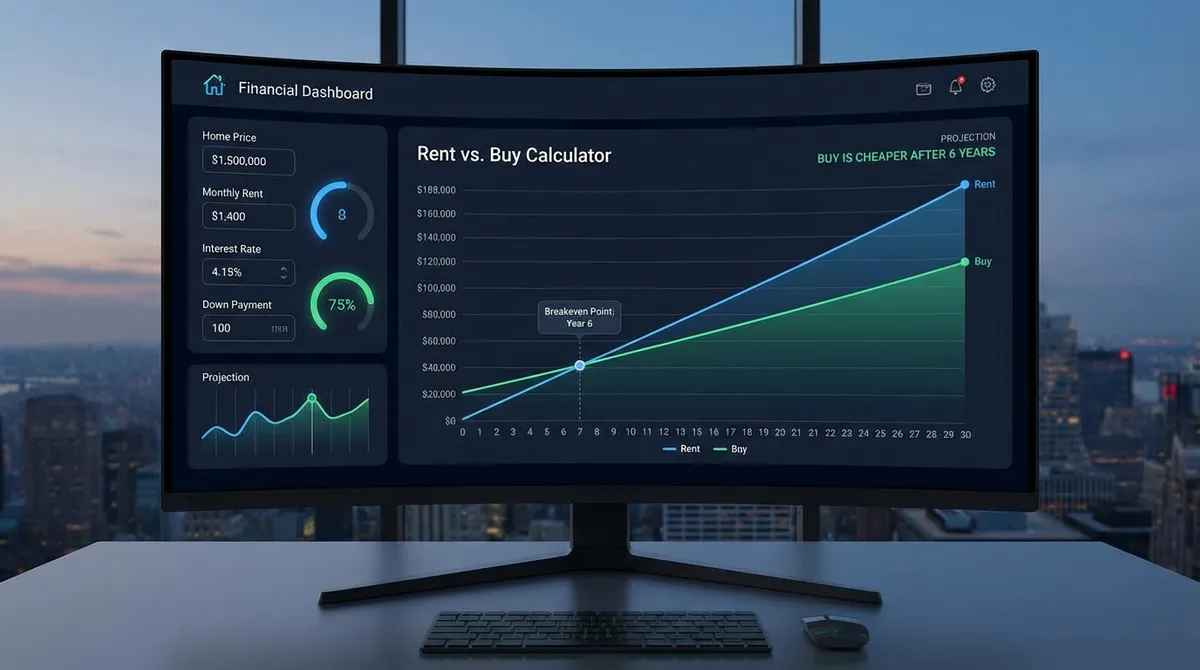
The decision to rent or buy is one of the biggest financial choices you'll make in your lifetime. It's not just about monthly payments; it's about opportunity cost, equity building, market risk, and lifestyle flexibility. This guide breaks down the math behind the decision so you can move forward with confidence.
Table of Contents
How the Rent vs Buy Math Works
Comparing renting and buying isn't as simple as comparing a monthly mortgage payment to rent. You have to look at the unrecoverable costs in both scenarios.
Unrecoverable Costs of Renting
- Rent Payment: Money paid to a landlord that you never see again.
- Renters Insurance: A small but necessary sunk cost.
Unrecoverable Costs of Buying
- Mortgage Interest: The cost of borrowing money.
- Property Taxes: Annual tax based on home value.
- Maintenance: Repairs (approx 1% of home value/year).
- HOA Fees: Association dues that build no equity.
- Buying/Selling Costs: Closing costs and realtor fees (6-10%).
When you buy, you are essentially "renting" money (interest), "renting" space from the government (taxes), and paying for upkeep (maintenance). If these unrecoverable costs are lower than your rent, buying is often the winner. If not, renting might be smarter, provided you invest the difference.
The 5% Rule Explained
A quick rule of thumb used by many financial experts (like Ben Felix) is the 5% Rule. It states that the annual unrecoverable cost of owning a home is roughly 5% of the home's value.
- Property Tax: ~1%
- Maintenance: ~1%
- Cost of Capital (Interest + Opportunity Cost): ~3% (This varies with rates, but 3% is a solid long-term proxy).
Example: For a $500,000 home, the annual unrecoverable cost is roughly $25,000 (or $2,083/month). If you can rent a similar home for less than $2,083/month, renting is likely the better financial decision.
The Hidden Factor: Opportunity Cost
This is the most overlooked variable. When you buy a home, you lock up a massive amount of cash in a down payment. That cash could have been invested in the stock market (S&P 500 historically returns ~10% nominal).
Our calculator explicitly models this. It assumes that if you rent, you take the money you would have spent on a down payment and invest it. In high-interest rate environments or strong bull markets, the opportunity cost of that "dead equity" in your house can be huge, often tipping the scale in favor of renting.
Pros & Cons: Beyond the Numbers
| Feature | Renting | Buying |
|---|---|---|
| Mobility | High. Move with 30 days' notice. | Low. Expensive to sell and move. |
| Monthly Cost | Unpredictable long-term (rent hikes). | Stable P&I, but taxes/insurance rise. |
| Maintenance | Landlord's problem. | Your problem (time & money). |
| Wealth Building | Requires discipline to invest savings. | Forced savings via mortgage principal. |
Frequently Asked Questions
How many years does it take to break even on a house?▼
Typically, it takes 5 to 7 years to break even. This is because the upfront transaction costs (closing costs, inspection, etc.) and the backend selling costs (realtor fees, transfer taxes) are significant—often 6-10% of the property value combined. You need enough time for home appreciation and principal paydown to offset these transaction fees.
Is rent money really "throwing money away"?▼
No. You are exchanging money for a place to live, just like you exchange money for food. Buying also has "thrown away" money in the form of mortgage interest, property taxes, HOA fees, and maintenance costs. Often, these unrecoverable costs of buying can exceed the cost of rent.
Should I buy a house if I plan to move in 3 years?▼
Almost certainly not. The closing costs to buy (~3%) and the commission to sell (~6%) mean you start roughly 9% in the hole. It is very rare for a home to appreciate enough in 3 years to cover these costs and turn a profit, especially after accounting for interest and taxes.
Does this calculator include tax benefits?▼
This calculator focuses on the direct cash flow and equity comparison. While mortgage interest and property taxes can be deductible in the US, the high Standard Deduction (nearly $30,000 for married couples in 2025) means most homeowners do not itemize and thus receive no specific tax benefit from owning. Consult a tax pro for your specific situation.
What is a "Price-to-Rent Ratio"?▼
It's a simple metric to gauge a market: Home Price divided by Annual Rent. A ratio below 15 suggests buying is favorable. A ratio above 20 suggests renting is favorable. For example, a $500k home that rents for $2,000/mo ($24k/year) has a ratio of 20.8, leaning towards renting.
How does inflation affect the rent vs buy decision?▼
Inflation generally favors homebuyers because their largest expense (the mortgage principal and interest payment) is fixed for 30 years. Meanwhile, renters face annual rent increases that typically track or exceed inflation. Over a long period (10+ years), this inflation hedging is a powerful benefit of ownership.
The Psychology of Renting vs. Buying
Spreadsheets don't account for feelings, but feelings drive decisions.
- Pride of Ownership: The feeling of "this is mine." You can paint walls, renovate kitchens, and plant gardens without asking permission.
- Stability: No landlord can sell the building out from under you or raise rent. You are the master of your timeline.
- Forced Savings: For those who struggle to save, a mortgage acts as a mandatory savings account.
- Freedom: You are not tied to a location. If you get a job offer in London or New York, you can break a lease and leave. Selling a house takes months.
- Simplicity: When the water heater breaks at 2 AM, you call someone else to fix it—for free. Your weekends are for leisure, not lawn care.
- Liquidity: Your net worth isn't trapped in drywall. You have cash in the bank that you can access instantly in emergencies.
Market Timing: Is 2025 the Right Time to Buy?
Trying to time the housing market is as difficult as timing the stock market. However, understanding current conditions is vital.
In 2025, we face a unique "lock-in" effect where many homeowners are holding onto low-rate mortgages from previous years, restricting inventory. This keeps prices high even if demand softens.
The "Marry the House, Date the Rate" Fallacy
Real estate agents often say, "Date the rate, marry the house" (implying you can refinance later). Be careful. Refinancing is never guaranteed. If property values drop, you may lose the equity required to refinance. Always ensure you can afford the monthly payment at the CURRENT rate.
The "Remote Work" Factor
The rise of remote work has fundamentally changed the Rent vs Buy verification.
- Geo-Arbitrage: Renting in a high-cost city (NYC, SF) while buying in a low-cost area to build equity is now a viable strategy. You essentially become a landlord while being a tenant.
- Flexibility Premium: If your job allows you to work from anywhere, buying a home anchors you to one spot. Renting allows you to test drive different cities—Miami for the winter, Denver for the summer—before committing.
Avoiding the "House Poor" Trap
One risk the calculator can't show is "Lifestyle Inflation." When you buy a house, you often impulsively buy furniture, renovations, and landscaping to match. These are "unrecoverable costs" that rarely increase the home's value dollar-for-dollar.
The Golden Rule: Keep your total housing payment (PITI + Utilities) under 28% of your gross monthly income. This buffer ensures you can still save for retirement and enjoy life, rather than existing just to pay your mortgage.
Conclusion
There is no universal "right" answer. Renting is not throwing money away; it's purchasing flexibility and freedom from maintenance. Buying is not a guaranteed investment; it's a leveraged bet on a single asset class with high transaction costs but immense utility value.
Use our Rent vs Buy Calculator to run your own scenarios. Be honest about how long you plan to stay and what your alternative investment returns might be. The numbers will tell you the financial truth—the rest is up to your lifestyle goals.